Charging as a service: the UK business guide

Updated: Aug 14

Charging as a Service (CaaS) is a managed model where a third party owns, installs, operates and maintains EV charging infrastructure on your site, so you get working chargers without the capital outlay or the operational burden of running them yourself. For most UK businesses, fleets and property managers weighing up their first or next charging installation, CaaS is the fastest low-risk route to live, managed charging.
TL;DR verdict:
CaaS wins when you want zero or minimal upfront spend, fast deployment, predictable monthly costs, and no in-house team to manage hardware, software or driver support.
Ownership may win when utilisation is high and predictable, you want full control of energy data and revenue, or you are planning a bespoke energy strategy with solar PV or battery storage tightly integrated.
Next step: commission a site feasibility survey and build a short RFP scorecard before approaching providers. Both are covered in detail below.
Key takeaways
Charging as a Service gives UK businesses, fleets and property managers a low-risk, low-capital route to managed EV charging infrastructure, provided the contract SLAs, exit terms and data rights are negotiated carefully before signing.
Point | Details |
CaaS removes capex | A third party owns and operates the chargers; you pay a monthly subscription, per-kWh fee, or take a revenue share. |
SLA quality is the critical variable | Require a defined uptime percentage (97%+ for fleets), MTTR, and written remedy clauses before committing. |
Future-proof during first-phase civils | Oversized conduits and distribution headroom at groundworks stage avoids costly retrofits when you scale. |
Check UK grants before signing | Workplace Charging Scheme and LEVI fund eligibility can reduce costs; verify current terms on gov.uk. |
Swiftcharging delivers end-to-end CaaS | Site survey, installation, maintenance, grant support and software management across UK commercial sites. |
Table of Contents
What charging as a service actually means, and which model fits you
CaaS sits within a growing market of subscription and pay-per-use EV charging infrastructure and energy management services, used across private, commercial and fleet applications. The term covers several distinct commercial shapes, and knowing which one a provider is offering matters before you sign anything.
Which model suits which host? Fleet depots with predictable overnight dwell times suit subscription or per-vehicle billing, since the cost is easy to forecast against vehicle numbers. Workplace sites with variable usage often prefer energy-based billing, which scales naturally with actual consumption. Retail and destination hosts typically benefit most from revenue-share arrangements, where the provider funds everything and the host earns a cut of driver payments. Landlords managing multi-occupancy buildings often opt for white-label subscription models that allow tenant billing to be separated cleanly.
How a CaaS engagement works from enquiry to operation
A well-run CaaS project follows a clear sequence. Understanding each stage helps your procurement and facilities teams know what to expect, and where your responsibilities begin and end.
Initial enquiry and scoping. You describe your site, vehicle numbers, dwell times and ambitions. A good provider asks about your electricity supply capacity, parking layout and any future fleet growth plans at this stage, not later.
Site survey and energy/load analysis. The provider visits to assess your incoming supply, distribution board capacity, cable routes, civil works requirements and metering. This is where load management strategy is set and where the cost of any grid upgrade becomes visible.
Solution design. Hardware selection (AC, DC, power output), software platform, access control (RFID, app, open access), energy optimisation and billing configuration are all specified. A reputable provider will design to open standards such as OCPP so you are not locked to a single back-office platform.
Permitting and utility liaison. Depending on the scale of works, this may involve building control notification, planning permission for larger civil works, and a formal application to your Distribution Network Operator (DNO) for supply upgrades. Providers experienced in UK grid liaison can save weeks here.
Installation and commissioning. Civils (trenching, ducting, cable trays), electrical installation, charger mounting, software configuration and network registration. Commissioning includes a live test of every port and confirmation of remote monitoring.
Operations, billing and driver support. Once live, the provider monitors the network remotely, handles firmware updates, dispatches engineers for faults, manages driver queries and produces billing reports. Your role is typically limited to site access and electricity supply management.
Scaling and upgrades. As your fleet grows or driver demand increases, additional chargers are added under the same agreement. Hardware upgrades at contract renewal or mid-term are negotiated against the original SLA.
Pro Tip: During the civils phase, ask the provider to install oversized conduits and spare cable trays beyond what the first phase needs. Adding duct capacity at initial groundworks costs a fraction of what it costs to re-trench later when you want to double your charger count.
The business benefits that go beyond “no upfront cost”
The headline CaaS benefit is capex avoidance, but the operational and strategic advantages are often more valuable over a three-to-five-year contract term.
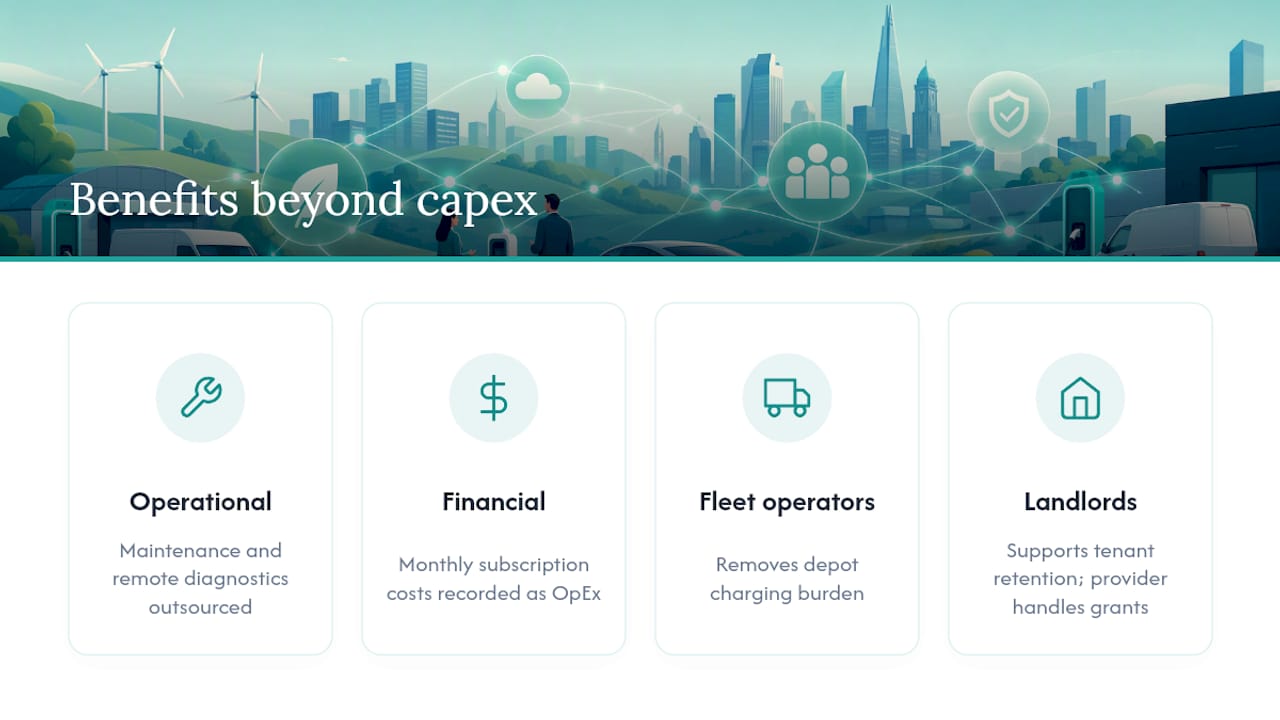
Operational benefits are the most immediate. Maintenance, remote diagnostics, firmware updates and driver support are all outsourced to the provider. Your facilities team does not need EV charging expertise, and you are not managing a spare-parts inventory or chasing engineers when a charger goes offline. Predictable uptime management, backed by a defined SLA, replaces the uncertainty of self-managed hardware.
Financial and balance-sheet benefits extend further than avoiding a capital purchase. Monthly subscription or usage costs sit cleanly in OpEx, which simplifies budgeting and avoids depreciation calculations. For destination and retail hosts, a revenue-share model can generate income from public charging without any investment at all.
For fleet operators, the strategic case is particularly strong. Moving to managed charging removes the internal resource burden of running a depot charging network, freeing transport managers to focus on vehicle operations rather than infrastructure. Faster EV adoption becomes commercially viable when the infrastructure cost is spread across a monthly service fee rather than a single capital commitment.
For landlords and property managers, managed charging supports tenant retention and attracts EV-driving tenants who expect charging as a standard amenity. The PA Housing case study illustrates how a managed installation can serve a tenanted property without placing operational demands on the landlord. Grant navigation is also simplified when a provider handles applications on your behalf, reducing the administrative burden on your team.
Pricing, contract terms and the SLA clauses that protect you
CaaS pricing takes several forms, and the contract terms around each model carry real commercial risk if you do not read them carefully.
Common pricing models:
Fixed monthly subscription per port: predictable cost, easy to budget, but you pay whether the charger is used or not.
Per-kWh usage pricing: scales with actual consumption, better for low-utilisation sites, but harder to forecast.
Blended energy and service tariff: the provider bundles electricity supply and service into a single per-kWh rate, simplifying billing but reducing your visibility of underlying energy costs.
Revenue-share: the provider funds everything; you receive a percentage of driver payment receipts. Best for public-facing destination sites with good footfall.
In most models, the host remains responsible for the electricity supply to the chargers. Clarify this in writing before signing, since some providers present blended tariffs that obscure where electricity cost responsibility sits.
Contract terms to read closely:
Contract length and exit terms: three-to-five-year initial terms are common. Check whether exit before term triggers a buyout of the remaining subscription, and what the handback conditions are for the hardware.
Grid upgrade costs: who pays if the DNO requires a supply upgrade? This can run to tens of thousands of pounds and is sometimes left ambiguous in provider contracts.
Performance guarantees: look for a defined uptime percentage (typically 95–99%) and explicit remedy or credit clauses when that threshold is missed.
Data ownership and portability: confirm you retain access to your energy and usage data, and that you can export it if you change provider.
Auto-renewal clauses: some contracts roll automatically into a new term without written notice. Negotiate a minimum notice window of 90 days.
Pro Tip: Insist on a defined mean time to repair (MTTR) — the maximum time from fault report to charger restoration — written into the SLA, not just a vague “best efforts” commitment. Also request clear handback conditions: what state must the hardware be in at contract end, and who bears the cost of removal?
How to evaluate and choose a CaaS provider
A structured procurement approach protects you from vague promises and makes provider comparison objective. Use this checklist when building your RFP or preparing for vendor meetings.
Site suitability and technical capability. Does the provider conduct a proper site survey before quoting? Can they handle DNO liaison and civil works, or do they subcontract everything? Ask for examples of comparable UK installations.
Hardware and interoperability. Are the chargers OCPP-compliant? Can you migrate to a different back-office platform without replacing hardware? Vendor lock-in through proprietary protocols is a long-term cost risk.
Software features. Does the platform offer access control (RFID, app, open access), real-time monitoring, per-vehicle cost allocation, energy reporting and driver billing? Can it integrate with your fleet management system?
Energy optimisation and load management. Can the system apply dynamic load balancing to avoid demand peaks? Does it support scheduled charging, smart tariff integration and, where relevant, solar PV or battery storage?
UK grid and utility experience. Has the provider managed DNO applications for supply upgrades? Do they understand the timelines and documentation requirements for UK network operators?
SLA detail and service delivery. What is the defined uptime commitment? What are the response windows for remote and on-site faults? Is there a dedicated spare-parts pool, or do engineers order parts reactively?
Driver support. Is there a 24/7 helpline for drivers? Who handles payment disputes and access issues out of hours?
Commercial red flags to watch for: vague uptime commitments without defined remedies; open-ended liability for grid upgrade costs; unclear data ownership; aggressive auto-renewal clauses with short notice windows; no reference sites in the UK.
For landlords and destination hosts, confirm the provider carries public liability insurance and handles all driver-facing compliance.
UK funding and regulatory checks for CaaS projects
UK grant and funding schemes for EV charging change regularly, so always verify current eligibility and deadlines directly on Gov before committing to a project timeline.
Funding signposts to investigate:
Workplace Charging Scheme (WCS): supports businesses, charities and public sector organisations with a contribution towards the cost of purchasing and installing EV charge points. Eligibility criteria and voucher values are updated periodically.
Local Electric Vehicle Infrastructure (LEVI) fund: administered through local authorities and Innovate UK, this supports public and semi-public charging infrastructure. Some CaaS deployments on publicly accessible sites may qualify.
Fleet and transport transition funds: various regional and sector-specific programmes support fleet electrification. Check with your local authority and sector trade body.
Home charging for company car drivers: in specific circumstances, a business can pay for an employee’s home charging point without creating a Benefit in Kind liability. Confirm the exact conditions with your accountant.
Regulatory and practical checks:
Building control notification may be required for significant electrical works.
Planning permission is sometimes needed for larger charger canopies or significant civil works, particularly in conservation areas or on listed buildings.
Meter ownership rules can affect eligibility for certain CaaS programmes, particularly where the provider wants to supply electricity directly.
Local planning policies increasingly favour EV infrastructure, but permitted development rights vary by site type.
Involving your CaaS provider early in grant applications and DNO liaison avoids the timing mismatches that delay projects. Providers with established UK grant support experience can identify which schemes apply to your site and manage the paperwork alongside the technical design.
How to future-proof your CaaS installation from day one
The most expensive mistake in EV charging infrastructure is under-specifying the first installation and paying to retrofit capacity later. Good site design during the initial works costs relatively little extra and saves substantially over a five-to-ten-year horizon.
Concrete site-design recommendations:
Install oversized conduits and spare cable trays during initial groundworks, sized for at least double your first-phase charger count.
Specify electrical distribution headroom: a main distribution board rated for future load, not just current demand.
Reserve metering capacity for sub-metering per charger or per zone, which supports accurate cost allocation and grant reporting.
Allocate physical space for a battery energy storage system (BESS) if solar PV or overnight tariff optimisation is a future possibility.
Designate reserved parking bays for EV charging from the outset, with clear signage and enforcement provisions.
Software and standards planning:
Specify OCPP 1.6 or 2.0.1 compliance as a minimum contract requirement. This keeps your back-office options open.
Require data portability: your usage, energy and billing data must be exportable in a standard format.
Confirm the provider’s back-office platform can integrate with your fleet management or property management system via API.
Pro Tip: Prioritise modest additional civils spend during the first installation. Adding a second conduit run and a larger distribution board at groundworks stage typically adds a small fraction to initial costs but avoids a full re-trench and board replacement when you scale up. Ask your provider to include a fleet future-proofing review as part of the feasibility study.
What good maintenance and monitoring looks like under a CaaS contract
Maintenance quality is where CaaS contracts diverge most sharply in practice. A provider that promises high uptime but lacks the service infrastructure to deliver it is a significant operational risk.
Typical maintenance services bundled into CaaS:
Preventative maintenance visits (at least annually, ideally twice yearly for high-utilisation sites).
Remote diagnostics and fault detection, with automatic alert escalation.
Firmware and software updates applied remotely without site visits.
Replacement chargers or loan units where a fault cannot be resolved remotely within the SLA window.
SLA metrics to look for and what they mean:
Uptime percentage: the proportion of time each charger is available and functional. 95% sounds high but allows up to 18 days of downtime per year per charger. For fleet depots, 97–99% is a more appropriate target.
Response time: the window from fault report to engineer attendance. Distinguish between remote response (minutes) and on-site response (hours or next business day).
MTTR (mean time to repair): the average time from fault identification to full restoration. This is the metric that most directly affects your drivers.
Remedy clauses: what credit or compensation applies when SLA thresholds are missed? A contract with no remedy clause is effectively an aspirational target, not a guarantee.
Monitoring and reporting should give you visibility of energy consumption per charger and per vehicle, scheduled maintenance dates, fault history and resolution times. This data supports cost allocation for fleet managers, sustainability reporting for property managers, and evidence for grant compliance where required.
Which types of organisation benefit most from CaaS
CaaS is not the right model for every organisation, but it suits a wide range of commercial profiles.
Fleet depots are among the strongest candidates. Subscription per vehicle or per depot gives transport managers a predictable monthly cost that scales with fleet size. Overnight dwell times mean chargers are heavily utilised, which justifies the provider’s investment. The Vanfridge fleet case study illustrates how a managed depot installation supports operational reliability without placing infrastructure management on the transport team.

Workplace charging suits a managed model when the employer wants to offer charging as an employee benefit without building internal expertise. Access control via RFID or app, per-employee billing and integration with payroll or expenses systems are all features a CaaS platform can deliver.
Retail and destination sites benefit most from revenue-share CaaS, where the provider funds the installation entirely and the host earns income from driver payments. Footfall-driven sites with good dwell times, such as hotels, leisure centres and retail parks, are well matched to this model. Destination charging resources can help you assess whether your site profile supports a revenue-share arrangement.
Landlords and multi-occupancy buildings need clean tenant billing separation and minimal landlord involvement in day-to-day operations. White-label CaaS platforms with tenant-facing apps and individual billing accounts address both requirements. The Tower Court case study demonstrates how a managed installation can serve a mixed-use property without operational complexity for the landlord.
Temporary or remote sites where grid connection would cause long delays are candidates for battery-backed CaaS, where a mobile or semi-permanent battery unit provides charging capacity without a full DNO application.
CaaS is likely your best option if: your CapEx budget is limited or committed elsewhere; you lack in-house electrical or EV expertise; you need chargers operational within weeks rather than months; or you want a single monthly invoice rather than a team managing hardware, software and maintenance separately.
Consider ownership or a hybrid approach if: utilisation is high and predictable enough that the long-term subscription cost exceeds the capital cost of ownership; you want to capture all driver revenue directly; or you are integrating charging tightly with on-site solar PV and battery storage under a single energy strategy.
Swift Charging’s perspective on delivering CaaS in the UK
Across our commercial installations, from workplace sites to fleet depots and destination charging projects, the pattern we see most often is this: organisations that plan thoroughly at the feasibility stage spend far less over the life of their installation than those who retrofit capacity later. A commercial installation like our Chichester project reflects the kind of end-to-end delivery, from site survey through to commissioning and ongoing management, that turns a complex infrastructure decision into a straightforward operational asset.
Swiftcharging handles site surveys, charger supply and installation, load management, software and back-office configuration, maintenance contracts, grant applications and energy consultancy including solar PV and battery storage. We work with businesses from initial feasibility through to long-term management, and we design every installation with future expansion in mind.
Swiftcharging: your end-to-end CaaS partner in the UK
For UK businesses ready to add EV charging without the capital risk or the management overhead, Swiftcharging delivers the full picture, from initial site survey and grant identification through to charger installation, software configuration, load management and ongoing maintenance.

Whether you are a fleet operator planning a depot, a facilities manager adding workplace charging, or a property manager looking to generate revenue from public charging, Swiftcharging designs every installation for long-term reliability and future expansion. Our team handles DNO liaison, building control, OCPP-compliant hardware and back-office integration, so you get a managed charging network that works from day one and scales as your needs grow.
See how we deliver in practice: explore our Carl Zeiss workplace installation or our commercial EV charging services across the UK. To get started, request a free site survey and we will assess your site, identify applicable grants and provide a clear proposal with defined SLAs.
Sources
Recommended