Commercial EV charger installation cost: your 2026 UK guide

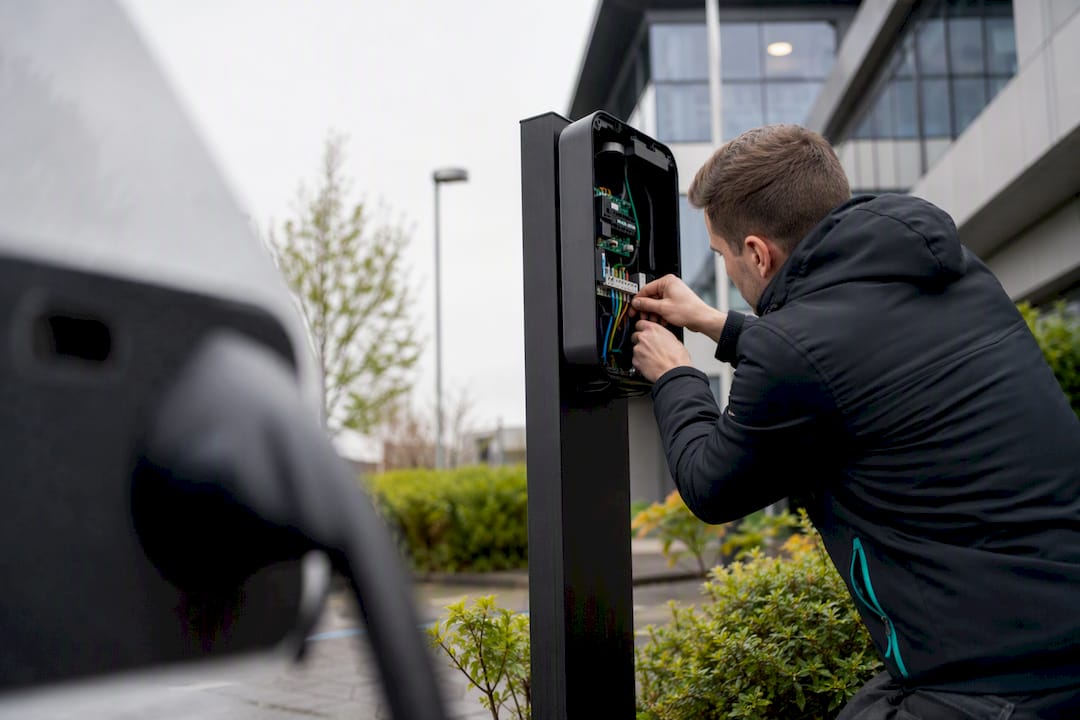
A single workplace fast charger typically costs several thousand pounds installed. A small multi-bay project runs from several thousand up to tens of thousands of pounds. Fleet depots and rapid or ultra-rapid hubs escalate into tens or hundreds of thousands of pounds. In almost every case, infrastructure, not the charger itself, decides which end of the range you land on.
The Workplace Charging Scheme, the Depot Charging Scheme, and capital allowances can each cut your net cost significantly.
Three unknowns swing every quote: your existing supply capacity, the distance from the charger to your distribution board, and whether the DNO needs to reinforce the local network.
Key Takeaways
Infrastructure and DNO reinforcement, not charger hardware, determine whether a UK commercial EV installation costs thousands or hundreds of thousands of pounds.
Point | Details |
Hardware bands are predictable | 7–22kW chargers cost £2,000–£4,500; 50kW rapid DC costs £15,000–£30,000 installed. |
Infrastructure drives overruns | Trenching, board upgrades, and DNO reinforcement usually exceed hardware costs on complex sites. |
Grants reduce hardware, not civils | WCS pays up to £500 per socket; Depot Charging Scheme funded 70% up to £1 million in its first window. |
Tax relief improves cashflow | Full expensing or AIA lets qualifying businesses claim charger costs against profits immediately. |
Swift Charging manages the full project | From feasibility and DNO liaison to grant applications and long-term maintenance across the UK. |
This article is general information, not a substitute for advice from a qualified financial advisor. Consult a qualified financial professional about your own circumstances before acting on anything here.
Table of Contents
What does commercial EV charger installation cost by charger type?
Charger hardware price bands are fairly predictable. What businesses underestimate is the gap between a “typical” quote and what their specific site actually needs.
7 to 22kW AC fast chargers cost several thousand pounds installed, according to MyBuilder’s commercial cost guide. These suit staff car parks, workplace bays, and low-turnover destinations such as gyms or small retail units, where vehicles sit for hours rather than minutes. A 22kW three-phase unit sits at the upper end of that band, usually costing more than a single-phase 7kW equivalent because it needs a three-phase supply, which not every commercial building already has.
50kW rapid DC chargers typically cost around tens of thousands of pounds, per the same MyBuilder data. 100kW+ ultra-rapid units can cost significantly more, depending heavily on the civils and grid work required. Rapid and ultra-rapid hardware only makes commercial sense for fleets needing quick turnarounds, or destination sites like retail parks and motorway-adjacent hubs where dwell time is short.
Low quotes routinely omit costs that show up later:
Payment terminals or RFID readers for public-facing chargers.
Mounting posts, bollards, and protective barriers.
Signage and EV bay line-painting, which some local authorities specify.
Ask any quote to itemise these separately rather than folding them into a vague “installation” line.
Why does infrastructure dominate the final quote?
Hardware is the easy part to price. Infrastructure is where budgets slip, and it’s the single biggest reason a £4,000 estimate becomes a £15,000 invoice.
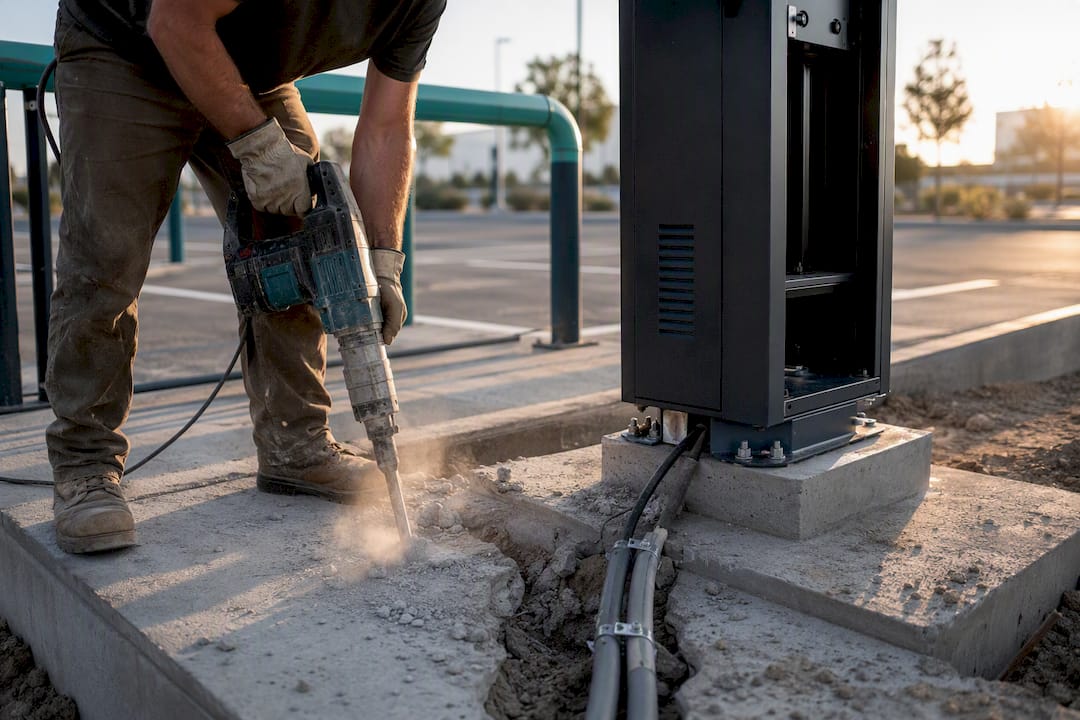
Trenching and ducting. Short runs of a few metres from an existing distribution board might add a few hundred pounds. Longer runs across a car park, especially through tarmac or landscaped areas, push costs up considerably per metre.
On-site electrical upgrades. A new distribution board, upgraded consumer unit, or additional metering can each add material sums, particularly on older commercial buildings never designed for high electrical loads.
DNO applications and reinforcement. Minor works, like a straightforward capacity check, are relatively cheap and fast. A full reinforcement, where the local network genuinely can’t take the extra load, is a different order of cost and time entirely.
Substation or transformer upgrades. Needed only for larger depot or multi-bay ultra-rapid projects, but when required, this is usually the single largest line item on the whole job.
Pro Tip: Ask your installer for an early, informal DNO capacity check before you commit to a design. It costs little and can save you from redesigning a scheme around a connection that was never available.
Which grants cut the cost of commercial EV charging in 2026?
Grant funding is where 2026 genuinely changes the maths for UK businesses, and it’s worth checking eligibility before you finalise any design.
Workplace Charging Scheme (WCS): from 1 April 2026, the Workplace Charging Scheme pays up to £500 per socket or 75% of the cost, whichever is lower, capped at a certain number of sockets per applicant. You apply through a voucher, and installation must be completed within the scheme’s claim window, so timing your project around the voucher matters as much as the design itself.
Depot Charging Scheme: aimed at fleet operators, this scheme funded a significant portion of charge point and civil costs up to a million pounds per applicant in its first 2026 application window, part of a wider multi-year programme, according to the Depot Charging Scheme page. Application windows are time-limited, so depot projects need to plan around them, not the other way round.
Business rates relief: eligible, separately assessed EV chargepoints in England can qualify for 100% business rates relief until 1 April 2036, according to the Subsidy Advice Unit’s assessment, reducing your ongoing operating cost rather than the upfront bill.
None of these grants typically cover major infrastructure works or DNO reinforcement charges. Budget for civils separately, and treat any grant as reducing your hardware bill, not your ground-up project cost.
How do capital allowances reduce the net cost of a charger?
Capital allowances can meaningfully improve cashflow in the year you buy. Limited companies can use full expensing, claiming 100% of qualifying costs against profits immediately, while unincorporated businesses typically use the Annual Investment Allowance or a 100% first-year allowance instead, per Holloway Davies’ 2025–26 guidance.
The charger must be new, not second-hand, and used for the business’s trade.
Qualifying costs usually include hardware, cabling, and installation labour where it’s capitalised alongside the asset.
Keep invoices, installation certificates, and a capitalisation schedule; your accountant will need them to support the claim.
For a small company spending £20,000 on a rapid charger and installation, full expensing can mean the entire sum reduces taxable profit in the same accounting year, rather than depreciating slowly over several years.
How long does a commercial EV charging project take?
Timelines vary enormously depending on whether the DNO needs to get involved beyond a routine check.
Site survey and design (1 to 2 weeks): confirms existing supply capacity and charger positioning.
DNO engagement: a formality for small single-charger jobs, but potentially the longest single step if reinforcement is needed.
Civils and cabling (1 to 3 weeks): trenching, ducting, and any electrical board upgrades.
Installation and commissioning (a few days): final wiring, testing, and handover.
Small workplace installs typically complete in 2 to 6 weeks. Projects requiring DNO reinforcement can stretch to 2 to 4 months or more, largely due to network operator lead times rather than the physical install itself, as UK Power Networks’ own guidance makes clear. The most common cause of delay isn’t the electrician; it’s incomplete site information submitted to the DNO on the first application, forcing a resubmission.
How should you budget and compare installer quotes?
A credible quote reads like a proper specification, not a single lump sum. Expect it to itemise hardware by model and power rating, civils and trenching by metre, DNO application fees, commissioning, and a clearly stated contingency.
Before signing, ask each installer:
What does the warranty cover, and for how long?
Are there ongoing software or management platform subscription fees?
How is payment processing handled for public-facing chargers, and at what cost?
Is the hardware OCPP-compliant, so you’re not locked into one management platform?
Treat a quote with no site survey, a vague “DNO costs TBC” line, or zero contingency as a red flag.
Pro Tip: Get at least two itemised quotes before comparing headline prices. A cheaper quote that omits DNO fees and contingency almost always costs more once the real bill arrives.
What are the ongoing running costs after installation?
Installation is only half the budget. Annual maintenance contracts typically cover firmware updates, fault callouts, and periodic electrical safety checks, and most chargepoint operators also charge a software or management platform subscription fee, particularly where RFID or payment processing is involved.
Load management systems reduce the electricity capacity you need to draw simultaneously, which can lower both your DNO reinforcement requirement and your ongoing demand charges.
Utilisation drives payback: a workplace charger used by a handful of staff cars pays back slower than a public-facing charger seeing consistent daily turnover, a dynamic reflected in Zapmap’s EV market data on rising charging demand.
Business rates relief on eligible chargepoints, discussed earlier, further improves the operating-cost picture for site hosts.
What does Swift Charging bring to a UK commercial project?
We’ve supported UK businesses through every stage of this process: feasibility, site survey, DNO liaison, design, installation, and long-term management. That end-to-end view is precisely why infrastructure costs, not hardware, tend to surprise businesses working with generalist electricians unfamiliar with DNO processes.
Full-service delivery from initial feasibility assessment through to commissioning and ongoing maintenance.
Support identifying and applying for workplace EV charging grants, including Workplace Charging Scheme vouchers.
Load management and charging software to control energy costs and simplify site management.
Additional renewable energy consultancy, including solar PV and battery storage, for sites looking to offset charging load.
If you’re planning a project in the south of England, our Chichester installation team can run a site survey and talk you through grant eligibility before you commit to a design.
Why the “cheapest quote wins” mindset gets 2026 projects wrong
The conventional advice on this topic still focuses almost entirely on hardware price, comparing charger units as though they’re interchangeable commodities. That misses where the real budget risk sits. Every figure in this guide points the same way: infrastructure and DNO reinforcement, not the charger itself, decide whether a project comes in at £4,000 or £40,000.
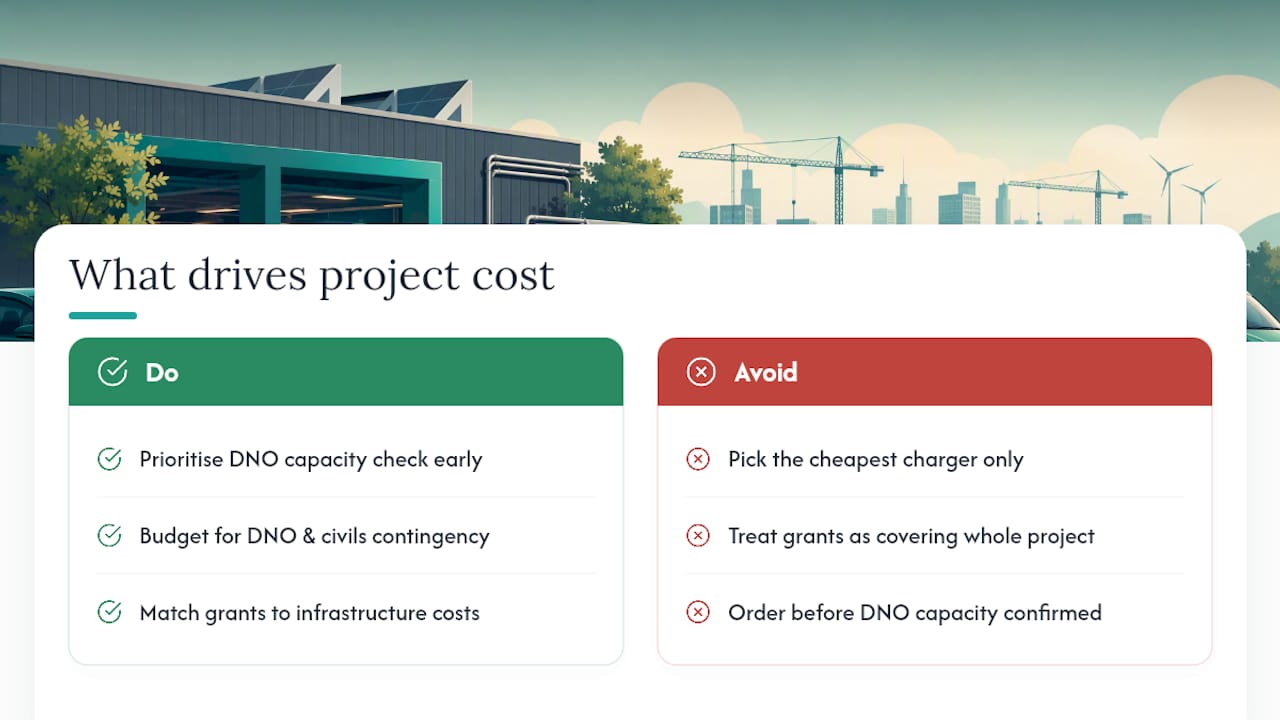
The grant landscape in 2026 makes this gap more forgiving, not less important. Businesses that treat grants as covering “the project” rather than “the hardware” are the ones who get caught out mid-build.
If you take one thing from this guide, prioritise the DNO capacity check before the charger spec sheet. Get that answer early, and every other budgeting decision, from grant applications to civils contingency, becomes far easier to get right.
— Swift Charging
Get a site-specific cost estimate for your business
The ranges in this guide are a starting point, not your number. Every site has a different distance to its distribution board, a different existing supply capacity, and a different answer from the DNO, which is exactly why generic online calculators can’t tell you what your project will actually cost. Swiftcharging runs a proper site survey before quoting anything, so the figure you get reflects your building, not a national average.

We handle the whole process in-house: feasibility, DNO liaison, design, installation, and ongoing management, plus support with Workplace Charging Scheme and Depot Charging Scheme applications where you’re eligible. That means one point of contact rather than juggling an electrician, a grant consultant, and a software provider separately. If you’re planning a fleet or workplace installation in Hampshire or Surrey, our Farnborough team can arrange a site survey and give you an itemised quote within days. Fleet operators managing vehicle logistics alongside charging infrastructure may also find UK fleet operational guidance useful when planning depot communications. Get in touch to book your survey and see exactly where your budget will go.
Sources
Recommended