Dynamic load balancing for EV charging: a practical UK guide

Updated: Aug 14
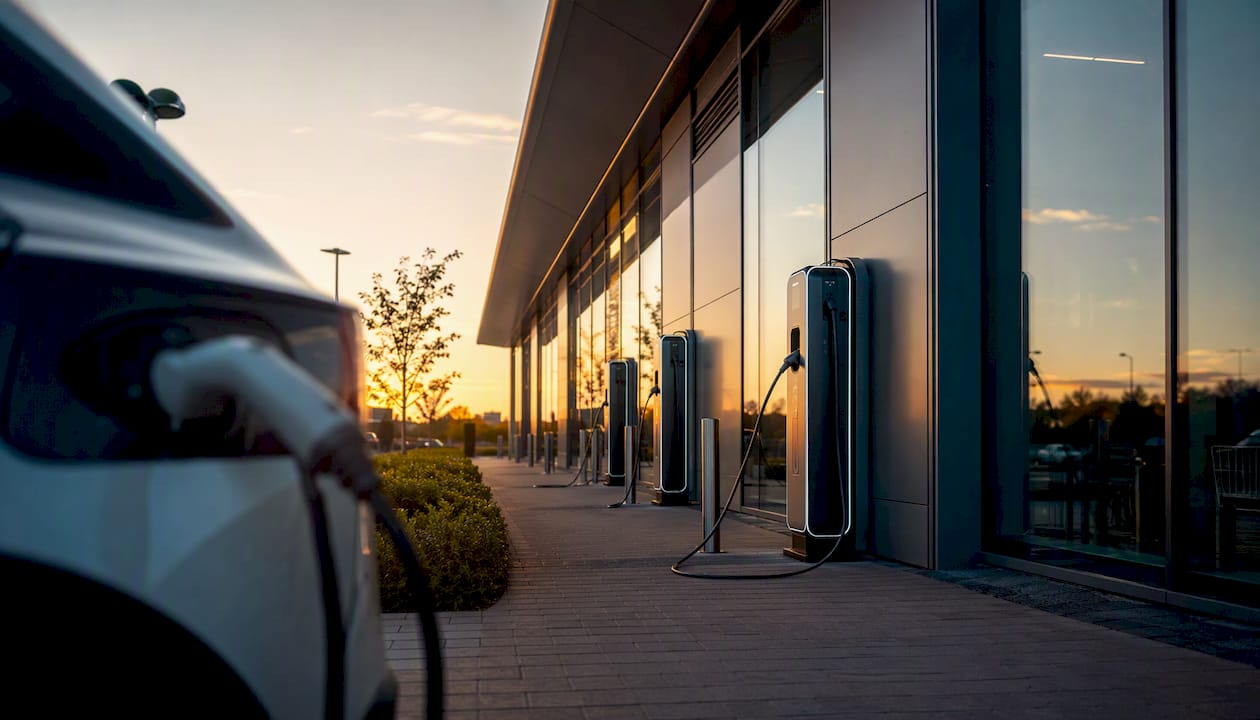
Dynamic load balancing (DLB) adjusts the power delivered to each EV charger in real time, keeping total site demand below your supply limit while maximising charging speed whenever capacity is available. If your site has more than one charger, shares a supply with other significant loads such as HVAC or production equipment, or you want to avoid a costly supply upgrade, DLB is worth deploying. For a single home charger on a generous supply, a fixed (static) limit is usually sufficient. For any workplace, fleet depot, or multi-unit residential block, DLB is the practical default.
Homes: DLB helps when you have two or more chargers, a solar PV system, or a tight supply shared with an electric heat pump.
Businesses and fleets: DLB is the right choice whenever multiple chargers compete for limited capacity or when avoiding a Distribution Network Operator (DNO) supply upgrade is a commercial priority.
Key takeaways
Dynamic load balancing is the most effective way to deploy multiple EV chargers on a limited supply, protect against overloads, and maximise the commercial return from your charging infrastructure.
Point | Details |
When DLB is required | Deploy DLB whenever multiple chargers share a limited supply or compete with other large site loads. |
Core hardware needed | CT clamps or a smart meter with a short reporting interval, OCPP-compatible chargers, and a reliable comms gateway are non-negotiable. |
Commissioning essentials | Simulate peak demand, test priority behaviour, and confirm fallback to a safe static limit before going live. |
Commercial value | DLB raises average delivered power per session, shortens dwell time, and increases charger turnover — treat it as a revenue tool, not only a safety feature. |
Swiftcharging | Swiftcharging provides end-to-end DLB deployment for UK businesses, including site surveys, software management, grant support, and ongoing maintenance. |
Table of Contents
What does dynamic load balancing mean for EV charging?
Dynamic load balancing uses current system state to distribute load continuously, rather than applying fixed rules. In an EV charging context, that means the system reads live power demand across your site and reassigns charging power to each charger every few seconds, keeping total consumption within your contracted supply limit.
This is fundamentally different from IT or network load balancing, which distributes data packets or TCP connections across servers. Electrical DLB manages physical power capacity and requires integration with site metering hardware — current transformer (CT) clamps or a smart meter — rather than packet or connection metrics. The time constants are different too: a network balancer may act in milliseconds; an EV charger setpoint change takes effect over several seconds to avoid mechanical stress on the vehicle’s onboard charger.
The four core components of any DLB system are:
Metering hardware: a smart meter, CT clamps on the incoming supply tails, or per-distribution-board metering that feeds live demand readings to the controller.
Charger controllers: firmware on each charge point that accepts remote power setpoints and can ramp up or down within defined limits.
Central management software: the platform that receives meter data, runs the balancing algorithm, and issues setpoint commands to each charger.
Communications link: typically OCPP (Open Charge Point Protocol) between charger and platform, with Modbus or MQTT used for meter gateways and some proprietary integrations.
The control loop runs continuously: sense (read live demand) → decide (calculate available headroom and allocate it) → command (send setpoints to chargers) → monitor (confirm chargers have responded and check for alarms). That loop repeating every few seconds is what makes the system genuinely dynamic rather than a one-time configuration.
How does dynamic load balancing actually work?
Understanding the mechanics helps you ask the right questions of any installer or platform vendor.
Metering options and their trade-offs
Your choice of measurement point shapes the whole system’s accuracy:
Main supply smart meter: the most accurate view of total site demand, but some smart meters have a 30-second or longer reporting interval, which can cause the controller to react slowly to sudden load spikes.
CT clamps on incoming supply tails: near-real-time readings (typically 1–5 seconds), lower cost than a full meter replacement, and compatible with most EMS gateways. Placement matters: CTs must sit on the supply side of the main distribution board, not downstream of sub-circuits.
Per-distribution-board metering: useful on large sites where EV chargers sit on a dedicated sub-board. Lets the system manage charger load independently of general building load, which simplifies the algorithm but can miss interactions with other large loads.
Scottish Power’s home DLB guide confirms that CT clamps are the standard approach for home installations, measuring household consumption and adjusting charger output so the combined draw stays within the fuse rating.
The control loop in practice
The management software calculates available headroom by subtracting current site demand (from the meter or CTs) from the configured supply limit. Each charger receives a setpoint in amps or kilowatts and ramps to that level over a few seconds.

Smoothing is applied to meter readings to prevent oscillation: if a kettle switches on briefly, the algorithm should not immediately slash charger power and then restore it two seconds later. A rolling average over 5–15 seconds is common.
Communications and protocols
AWS describes dynamic algorithms as those that evaluate current system conditions to assign load, making them more efficient than static approaches for variable workloads. In EV charging, OCPP 1.6 and OCPP 2.0.1 are the dominant protocols for charger-to-platform communication. OCPP 2.0.1 adds native smart charging profiles that make setpoint delivery more reliable. Modbus RTU or TCP is common for meter gateways. MQTT is used by some proprietary systems for lower-latency telemetry.
Reliability of the communications link is non-negotiable. If the charger loses contact with the management platform, it should fall back to a safe static limit — not continue at full power and risk a breaker trip.
Pro Tip: Place CT clamps as close to the main supply intake as possible and verify the meter reporting interval before commissioning. A 30-second reporting lag combined with a large variable load (such as a commercial kitchen) can cause the DLB controller to oscillate. If your smart meter reports slowly, a dedicated CT gateway with a 1–5 second interval is the more reliable choice.
Stale meter readings are one of the most common causes of DLB failure in the field. The system is only as accurate as the data it receives, and a 30-second-old demand figure on a site with fast-changing loads is effectively no data at all.
How do dynamic and static load balancing differ?
Static load balancing assigns a fixed maximum power to each charger at configuration time. If you have a 100A supply and four chargers, each gets a 25A cap regardless of whether one, two, or all four are in use. Simple to configure, but wasteful: a single vehicle charging at 25A when 75A is available is a missed opportunity.
Dynamic load balancing redistributes available capacity in real time. That same 100A supply with one active charger delivers up to 100A (minus other site loads) to that vehicle. When a second vehicle connects, the system rebalances to share the available headroom. AWS’s load balancing overview classifies dynamic algorithms — least connections, least response time, resource-based — as those that continuously evaluate current conditions, which maps directly to how EV DLB software monitors live demand and reassigns setpoints.
Criterion | Static balancing | Dynamic balancing |
Responsiveness | Fixed; no real-time adjustment | Adjusts every few seconds |
Configuration complexity | Low | Moderate to high |
Upfront cost | Lower | Higher (metering hardware + software) |
Supply upgrade avoidance | Partial | Strong |
Best suited to | Single charger or very predictable load | Multiple chargers, variable site demand, fleets |
Static is acceptable for a single home charger or a small site with a generous supply and predictable load. Dynamic is the right choice wherever multiple chargers compete for limited capacity, where other large loads vary throughout the day, or where the business case depends on avoiding a DNO supply upgrade.
What are the practical benefits of DLB for UK sites?
Safety and grid protection
The most immediate benefit is preventing main breaker trips. Without load management, a site with four 7.4 kW chargers all starting simultaneously draws nearly 30 kW, which can exceed a standard commercial supply and trip the incomer. DLB prevents this by capping total charger draw below the supply limit at all times.
Deferring or avoiding supply upgrades
A DNO supply upgrade for a commercial site can cost tens of thousands of pounds and take months to complete. DLB lets you deploy multiple chargers on your existing supply by managing how much power they collectively draw. For manufacturers and other energy-intensive businesses, grant support combined with DLB can make a multi-charger installation viable without any civil reinforcement works.
Higher average charging power
Because DLB allocates unused capacity to active chargers, vehicles charge faster on average than they would under a static per-charger cap. For public and fleet sites, this translates directly into higher charger turnover and better return on investment.
Solar and battery integration
DLB systems that observe the site’s import/export meter can prioritise charging from solar generation, reducing grid draw and carbon footprint. When the site is exporting, the system increases charger power; when it is importing heavily, it reduces it. Battery storage adds another layer: the EMS can dispatch stored energy to support charging during peak tariff periods.
Pro Tip: If you have or plan to install solar PV, confirm that your chosen DLB platform can observe both import and export readings from your meter. Some entry-level systems only read import, which means they cannot implement genuine solar-first charging.
What do you need on site to deploy DLB?
A successful DLB deployment depends on getting the hardware, software, and commercial checks right before installation day.
Essential hardware
Compatible chargers: charge points must support remote setpoint control via OCPP or a proprietary protocol. Check that the firmware version on your chosen hardware supports smart charging profiles — not all chargers do out of the box.
Metering hardware: CT clamps on the incoming supply tails or a smart meter with a sufficiently short reporting interval (ideally 5 seconds or less for commercial sites).
Communications gateway: a device that bridges the meter to the management platform, typically over Ethernet or 4G. On sites with poor Wi-Fi coverage, a wired connection to the gateway is strongly preferred.
Reliable site communications: OCPP requires a persistent connection between each charger and the platform. Dead spots or intermittent 4G will cause setpoint delivery failures.
Software requirements
A central management platform with OCPP support (1.6 or 2.0.1).
The ability to configure priority groups, per-charger limits, and schedules.
Remote diagnostics and alerting so you can detect a charger that has stopped responding to setpoints.
Data export for billing, reporting, and grant compliance.
Grid and compliance checks
For larger commercial installations, DNO engagement is advisable before committing to a design. While DLB reduces the risk of supply overload, the DNO may still require notification or approval for new large loads. Your installer should confirm the supply rating, available headroom, and any network constraints during the site survey.
Commercial checks
Grant eligibility: the Workplace Charging Scheme (WCS) and other available UK grants can significantly reduce installation costs. Confirm eligibility before finalising the specification.
Demand profile: understand when your site’s peak loads occur and size the DLB configuration accordingly.
Billing and revenue model: if you plan to charge users for energy, confirm the platform supports payment integration and metered billing.
Pro Tip: Ask your installer to confirm three things during the site survey: the supply rating and available headroom, the meter reporting interval, and whether your chosen charger firmware supports OCPP smart charging profiles. These three checks prevent the majority of post-installation problems.
What configuration modes does DLB support?
The flexibility of a DLB system comes from its configuration options. Juniper’s DLB documentation describes how rebalancing frequency and inactivity intervals affect system behaviour — in EV charging, the equivalent decisions are how often setpoints are recalculated and how quickly the system responds to a new vehicle connecting or disconnecting.
Priority and SLA-aware modes
Most commercial platforms allow you to assign chargers or charger groups to priority tiers. A fleet depot might reserve 60A for vehicles that need a quick turnaround, with the remaining capacity shared among long-stay staff chargers. When a priority vehicle connects, the system immediately reallocates capacity from lower-priority chargers.
Subgroups and per-group limits
On mixed-use sites — say, a hotel with both guest and staff parking — you can subdivide chargers into groups with independent power budgets. Guest chargers might have a guaranteed minimum of 7.4 kW per bay regardless of staff charger activity, protecting the guest experience.
Rate limiting, ramping and inactivity timers
Ramping: setpoint changes are applied gradually (typically over 5–30 seconds) to avoid mechanical stress on vehicle onboard chargers and to prevent oscillation.
Inactivity timers: if a charger is plugged in but the vehicle’s battery management system has paused charging, the platform can reclaim that charger’s allocation after a configurable timeout and redistribute it to active sessions.
Minimum floor: most systems allow a minimum setpoint per charger (e.g. 6A) so that a vehicle always receives at least a trickle charge rather than being cut to zero.
Solar and battery integration
When the site has solar PV, the DLB controller observes the export meter. During periods of high generation, it increases charger setpoints to absorb local generation before it is exported to the grid. When a battery is present, the EMS schedules discharge to coincide with charging peaks, effectively expanding the available power budget without increasing the DNO supply rating.
How do you commission and monitor a DLB system?
Getting commissioning right prevents the majority of operational problems. A staged approach is far safer than switching everything on at once.
Commissioning checklist
Verify baseline meter readings against a known load (a resistive heater of known wattage is useful).
Simulate a peak demand event by running all chargers at full power and confirming the system clamps total draw below the supply limit.
Test priority behaviour: connect a priority vehicle and confirm lower-priority chargers reduce output within the expected response time.
Confirm fallback behaviour: disconnect the management platform and verify each charger reverts to its configured safe static limit.
Document the firmware version on each charger and the management platform, and confirm the rollback procedure with your installer.
Monitoring metrics to collect
Site demand (kW): continuous, with alerts if demand approaches the supply limit.
Per-charger current (A): to detect chargers that are not responding to setpoints.
Setpoint latency: the time between a setpoint command and confirmed charger response. Latency above 30 seconds warrants investigation.
Denied or throttled sessions: sessions where a vehicle received significantly less than the requested power, which may indicate a configuration problem or a supply constraint.
Lifecycle alarms: firmware errors, communication dropouts, and CT fault flags.
EV charger maintenance best practice recommends regular review of these metrics as part of a scheduled maintenance programme, not just reactive fault response.
Common pitfalls
Poor CT placement: CTs installed downstream of the EV sub-board will not see general building load, causing the system to over-allocate power and risk a trip.
Comms latency: a 4G gateway with intermittent signal can cause setpoints to arrive late or out of sequence, leading to brief overloads.
Stale meter readings: as noted in the control loop section, a slow-reporting meter on a fast-changing site is a reliability risk.
Misconfigured priorities: if priority tiers are set incorrectly, some users may receive very little power for extended periods without any alert being raised.
Pro Tip: Run your first full-load simulation outside business hours. If the system oscillates (chargers repeatedly ramping up and down), increase the smoothing window on the meter readings before going live. Oscillation is almost always a measurement or latency problem, not a hardware fault.
What does DLB look like for different UK site types?
Home
A single smart meter plus one or two chargers. DLB is most valuable when a heat pump or electric shower shares the supply. The system reads household consumption via CT clamps and reduces charger output when other loads are high. For a single charger on a 100A supply with modest household loads, a static 7.4 kW cap is usually sufficient.
Workplace
Typical duty cycles mean most staff chargers are active for 6–8 hours. DLB allows short-stay visitor bays to be configured as high-priority, ensuring visitors get a meaningful charge in 1–2 hours while staff vehicles charge more slowly over the day. Smart scheduling can shift the bulk of charging to overnight off-peak tariff windows, reducing energy costs.
Fleet and depot
Fleet electrification case studies show that SLA-aware prioritisation is the critical differentiator for depot charging. Vehicles that need a quick turnaround receive priority allocation; overnight bulk charging uses lower-priority, lower-cost energy. Battery storage paired with a smart tariff can further reduce peak demand charges.
Destination and public charging
Maximising throughput is the commercial objective. DLB ensures that when one vehicle finishes charging, its allocation is immediately redistributed to other active sessions rather than sitting idle. Revenue-aware prioritisation can give faster charging to users on premium tariffs, which is configurable on most OCPP-compliant platforms.
Residential blocks and multi-tenancy
The PA Housing case study illustrates how a residential block with a shared supply can support multiple chargers through DLB without a supply upgrade. Per-flat or per-bay billing is handled by the management platform, and the landlord retains visibility of total site demand.
Does DLB raise utilisation and protect commercial returns?
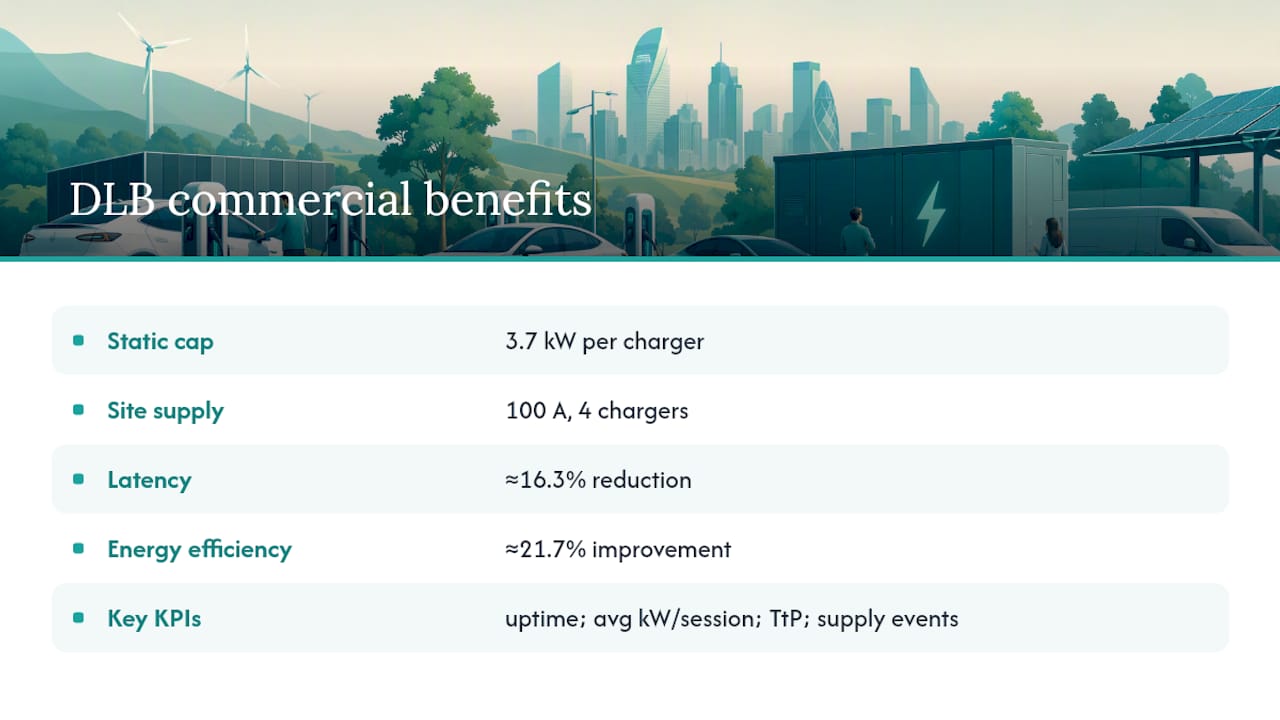
Treating DLB purely as a safety feature misses most of its commercial value. The “utilisation window” — the proportion of a session during which a charger delivers meaningful power — directly determines charger turnover and revenue per bay. A static per-charger cap of 3.7 kW on a site with a 100A supply and four chargers leaves most of the available capacity unused. DLB raises the average delivered power per session, shortens dwell time, and increases the number of vehicles a site can serve per day.
Research supports the case for algorithmic optimisation. ML-driven load balancing experiments demonstrate improved imbalance metrics, reduced execution time, and better energy efficiency compared with static or simpler dynamic methods. A 2026 study on AI-driven multi-agent real-time load balancing reported approximately 16.3% latency reduction and approximately 21.7% energy efficiency improvement in evaluated traces — results from a research setting, but a coherent signal that adaptive algorithms outperform fixed rules in heterogeneous, variable-demand environments.
Software-defined DLB is the most practical future-proofing tool available to a site operator today. Adding chargers later requires a configuration change and possibly a CT upgrade, not a new civil works programme.
For procurement teams, the KPIs worth including in any DLB contract are: uptime percentage, average delivered kW per session, time-to-priority (how quickly a priority vehicle receives its full allocation after connecting), and number of supply limit events (ideally zero after commissioning).
The Dropbox engineering approach to real-time load balancing illustrates how piggybacking live backend metrics onto routing decisions improves outcomes in other domains — the same principle applies when an EV management platform uses live battery state-of-charge data from vehicles (where available via ISO 15118) to refine setpoint decisions.
Software-defined DLB also enables expansion without major rework. Adding two more chargers to a site with an existing DLB system means registering them on the platform and adjusting group limits — not rewiring the distribution board or renegotiating the DNO connection.
Do you need DLB? A quick decision checklist
Work through these questions before speaking to an installer.
Binary decision questions
Do you have, or plan to install, more than one charger? If yes, DLB is worth specifying.
Is your available supply headroom less than the combined maximum output of all planned chargers? If yes, DLB is required.
Do other large loads (HVAC, production, catering) share the same supply? If yes, DLB is required.
Would a supply upgrade be prohibitively expensive or slow? If yes, DLB is the practical alternative.
Do you have solar PV or battery storage on site? If yes, DLB enables solar-first charging.
Technical questions to ask your installer
What meter type and reporting interval will you use, and why?
Which OCPP version does the charger firmware support?
How does the system behave if it loses contact with the management platform?
What is the upgrade path if we add more chargers in 18 months?
Can you provide remote diagnostics and alerting as part of the service?
Commercial questions
Who owns the management software and the data it collects?
What is the data retention policy and how do we access historical demand reports?
Is maintenance included, and what is the response time for a charger fault?
Can you support our grant application under the Workplace Charging Scheme or other available funding?
Next steps by answer
Mostly yes: proceed to a full site survey with DLB specified from the outset.
Mixed: discuss with an installer whether a phased approach (static now, DLB-ready hardware for later) makes sense.
Mostly no: a static per-charger limit may be sufficient; revisit when you add more chargers or loads.
The case for treating DLB as a revenue tool, not just a safety net
The conventional advice on DLB focuses almost entirely on preventing breaker trips. That framing is accurate but incomplete, and it leads facilities managers to underinvest in the software and metering side of the system while spending freely on hardware.
The more useful frame is this: DLB is a site-level resource allocation engine. Every kilowatt-hour that a static cap leaves on the table is a kilowatt-hour that did not charge a vehicle, did not generate revenue for a public host, and did not reduce a fleet operator’s fuel bill. The gap between a well-configured DLB system and a poorly configured static one is not marginal — on a busy workplace or depot site, it can mean the difference between a charger that pays for itself in three years and one that takes six.
What most guides also miss is the importance of SLA-aware configuration from day one. Priority groups are not a luxury feature for large fleets; they are the mechanism by which you guarantee a minimum service level to the users who matter most to your business. A hotel that cannot guarantee a meaningful overnight charge to guests will lose those guests. A depot that cannot guarantee a quick-turnaround charge to priority vehicles will face operational disruption. Getting the priority configuration right at commissioning, and testing it properly, is worth more than any hardware specification decision.
The future-proofing argument is equally underrated. A site that installs DLB-capable hardware and a software-defined management platform today can add chargers, integrate battery storage, and adopt vehicle-to-grid (V2G) functionality as those technologies mature — without returning to the DNO or rewiring the site. That optionality has real commercial value that rarely appears in a simple payback calculation.
How Swiftcharging supports your DLB project from survey to long-term management
Swiftcharging handles every stage of a commercial DLB deployment: site survey and feasibility, system design, charger supply and installation, management software configuration, payment and RFID integration, and ongoing maintenance. For eligible sites, we also support grant applications under the Workplace Charging Scheme and other available UK funding, helping to reduce your upfront installation costs.

Whether you are planning a new workplace installation, expanding an existing depot, or looking to migrate legacy chargers onto a modern management platform, Swiftcharging can provide a project KPI pack and case study evidence on request. Our installations span workplaces, fleet depots, destination sites, and residential blocks across the UK, including locations in Chichester, Eastbourne, and Farnborough. To get started, book a free site survey with our team at Swiftcharging.
Sources
Recommended