EV charger cable management for fleet and depot operators


For most depot and high-throughput sites, the right answer is a heavy-duty retractable reel or an overhead rail/gantry sized to your actual cable weight and daily session count. Retrofits with limited overhead space usually do better with a swivel-arm balancer. Megawatt charging and bus or truck depots increasingly need robotic or dock charging to keep cables off the ground entirely.
Get the sizing wrong and you inherit the classic depot failure mode: cables that don’t fully retract, sit in the yard, and get run over by the next vehicle in the queue. Parwatt’s research on high-traffic charging sites is blunt about this. Undersized mechanisms lead to incomplete retraction and continued ground contact, which is exactly the outcome a cable-management system exists to prevent.
Here’s how the shortlist maps to site type:
Retrofit public charging sites — swivel arm or balancer, low structural disruption, works within existing parking bays.
Workplace and short-dwell sites — retractable reel or spring-loaded retractor, moderate cost, minimal footprint.
High-throughput depots — overhead rail or modular gantry, built for repeated cycles and mixed vehicle lengths.
Megawatt/automated charging sites — robotic or dock charging, removes cables from the ground entirely.
The mechanism has to match the load. A domestic-grade retractor on a depot cable rated for hundreds of daily cycles isn’t a cost saving. It’s a maintenance bill waiting to happen.
Before you get a quote, run four checks: a site feasibility survey covering ground layout and overhead clearance, a cable-weight assessment against your actual charger power, a throughput estimate based on real vehicle movements (not nameplate capacity), and a request for the supplier’s cycle-rating data on any mechanism you’re considering.
Key Takeaways
Commercial cable-management works when the mechanism’s cycle rating and cable-weight capacity are matched to measured site throughput, not estimated from nameplate figures.
Point | Details |
Match mechanism to load | Specify cycle rating and cable-weight capacity against measured daily sessions, not assumptions. |
Oversize conduit now | Provision groundwork for four to six charger locations to avoid disruptive retrofitting later. |
Demand replaceable parts | Require replaceable rollers, springs and retraction mechanisms with spare-part stocking in the SLA. |
Test with real vehicles | Run full-motion trials using actual approach angles before finalising the design. |
Choose a full-service integrator | Swift Charging delivers site survey, design, installation, grant support and SLA-backed maintenance as one contract. |
Table of Contents
What are the main types of EV charger cable management?
Commercial cable-management hardware falls into a handful of categories, and each one solves a slightly different operational problem. Choosing between them without weighing daily session count against cable weight is one of the more common procurement mistakes on depot projects.
Retractable reels and posts — spring or motor-assisted retraction keeps the cable suspended between uses. Strong for AC and moderate-power DC. Struggles with heavy liquid-cooled cables unless specified with a higher-torque mechanism.
Spring-loaded cable retractors — a simpler, lower-cost version of the reel, often used on workplace and short-dwell sites. Limited cable length range compared with motorised reels.
Swivel arms and balancers — suspend the connector on a pivoting arm, giving the driver reach without a reel mechanism. Ideal for retrofits where structural mounting options are limited. Less suited to very heavy DC cables or wide parking bays.
Overhead rails and gantries — fixed or motorised rail systems that carry the cable across a bay, including parallel-rail variants for multiple vehicle lengths. Siemens’ depot charging whitepaper recommends this pattern for scalable depot design, provided the structure and clearance are planned in from day one.
Cable reels (fixed installation) — permanently mounted units suited to sites with predictable vehicle positioning and limited connector-position variance.
Guided channels and rails — ground or wall-mounted channels that route cable without full suspension, cheaper but less protective against wear.
Holsters and posts — simple connector storage for low-throughput sites, offering minimal mechanical complexity but no active cable management between uses.
Dock charging — the vehicle docks directly, largely eliminating loose cable. Works well for standardised fleet vehicles with fixed inlet positions.
Robotic charging — an automated arm connects without driver intervention, particularly relevant for megawatt and bus/truck depots, though it demands vehicle-side interoperability and adds system complexity.
Outdoor exposure, cable weight, connector reach and cycle volume all push you towards a heavier-duty category, even where the site footprint looks similar to a lighter-duty installation.
How do you choose the right cable-management system?
Six variables decide almost every specification decision on a commercial site: daily session volume, charging power and resulting cable mass, vehicle mix and connector position variance, parking geometry, overhead clearance, and environmental exposure. Get these measured, not estimated, before you write a tender.
Daily session volume. A site running 40 charging events a day needs a fundamentally different cycle rating to one running four.
Charging power and cable mass. Liquid-cooled DC cables are considerably heavier than AC cables, and that weight has to be matched to the retraction mechanism’s rated capacity.
Vehicle mix and connector position. Mixed fleets with varying CCS inlet locations need more reach and flexibility than a single standardised vehicle type.
Parking geometry and approach angles. Narrow bays or tight turning circles limit which mechanism types physically fit.
Overhead clearance. Gantries and rails need confirmed structural headroom, not an assumption from a floor plan.
Environmental exposure and IP rating. Outdoor, unsheltered sites need a higher IP rating and UV-resistant components than covered depots.
Your procurement checklist should ask suppliers for specifics, not marketing language:
Cycle rating (in number of operations, not years)
Replaceable rollers, springs and retraction components
Mounting options and confirmed structural compatibility
Cable length range against your actual parking geometry
Compatibility with your charger type and connector standard
IP and environmental rating for the installation location
Warranty terms and defined SLA response times
Maintenance schedule and spare-parts availability
Pro Tip: Specify replaceable wear components and a defined maintenance cadence directly in the contract. A cosmetic warranty on the housing means nothing if the retraction spring fails at month fourteen and there’s no spare-parts commitment behind it.
Which cable-management solutions work best for depots and fleets?
Depot design comes down to trade-offs, and there’s rarely a single right answer across an entire site. Most depots end up mixing two or three approaches across different bay types rather than standardising on one.
Drive-through bays with overhead gantries suit high-throughput logistics hubs where vehicles move continuously and ground-level cables would create a bottleneck. Siemens’ whitepaper recommends modular gantry design here specifically because it scales as fleet size grows, without requiring a full structural rebuild.
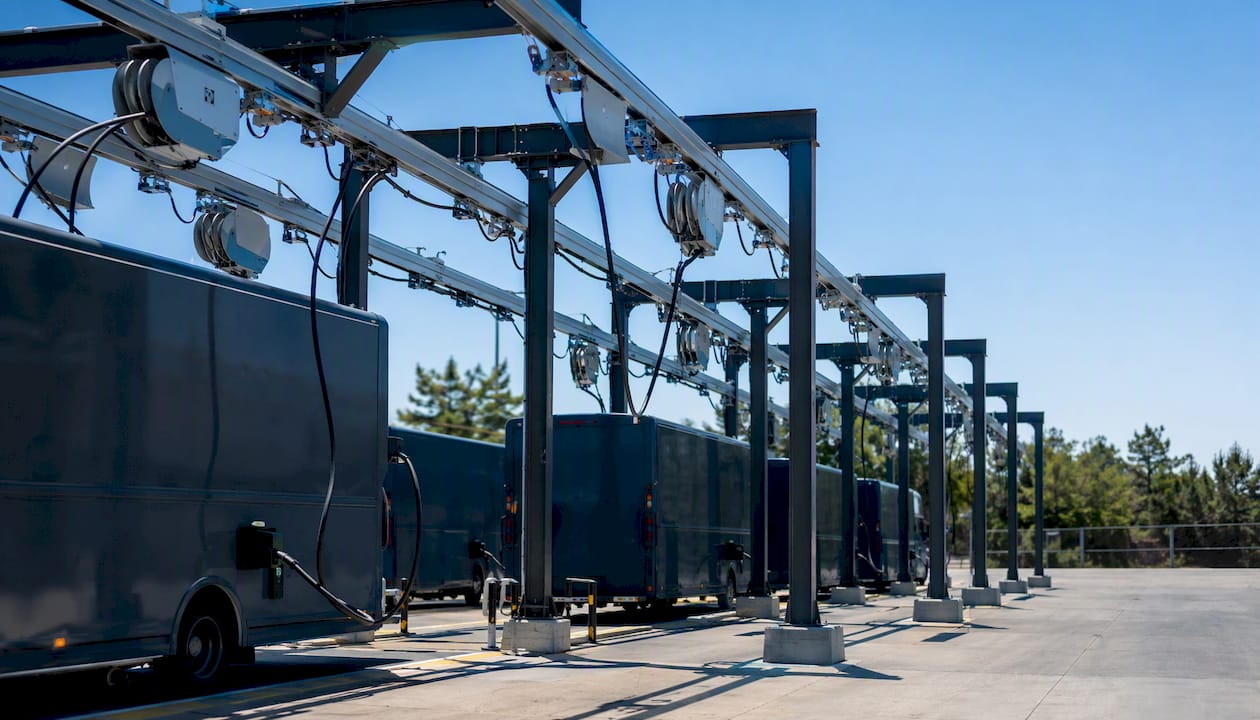
Modular gantries with parallel rails handle mixed vehicle lengths, a common depot reality when vans, box trucks and rigid vehicles share the same yard. The trade-off is space footprint: parallel rails need wider bay allowances than a single-rail system.
Dock-charging bays remove ground-level cables almost entirely, which matters most where forklifts, trailers or heavy foot traffic cross charging areas repeatedly through a shift.
Robotic charging suits megawatt sites and standardised fleets where hands-free connection saves driver time across dozens of daily sessions, though it carries higher upfront complexity and needs vehicle-side compatibility confirmed early.
Three scenarios illustrate how this plays out:
A small LCV fleet on overnight charging rarely needs anything beyond swivel-arm balancers. Low session frequency, predictable dwell time, minimal structural investment.
A high-throughput last-mile hub with rapid opportunity charging during shift changes justifies overhead gantries, because downtime from tangled or damaged cables directly costs delivery capacity.
A bus depot needs long reach and minimal obstruction to manoeuvring, which typically points towards overhead rail systems or dock charging depending on fleet standardisation.
What should you plan for during installation and maintenance?
Every installation plan needs four elements confirmed before groundworks start: a site feasibility survey, structural checks for any overhead mounting, conduit and cable-routing provision sized for future expansion, and full-motion testing using real vehicle approach angles rather than theoretical geometry.
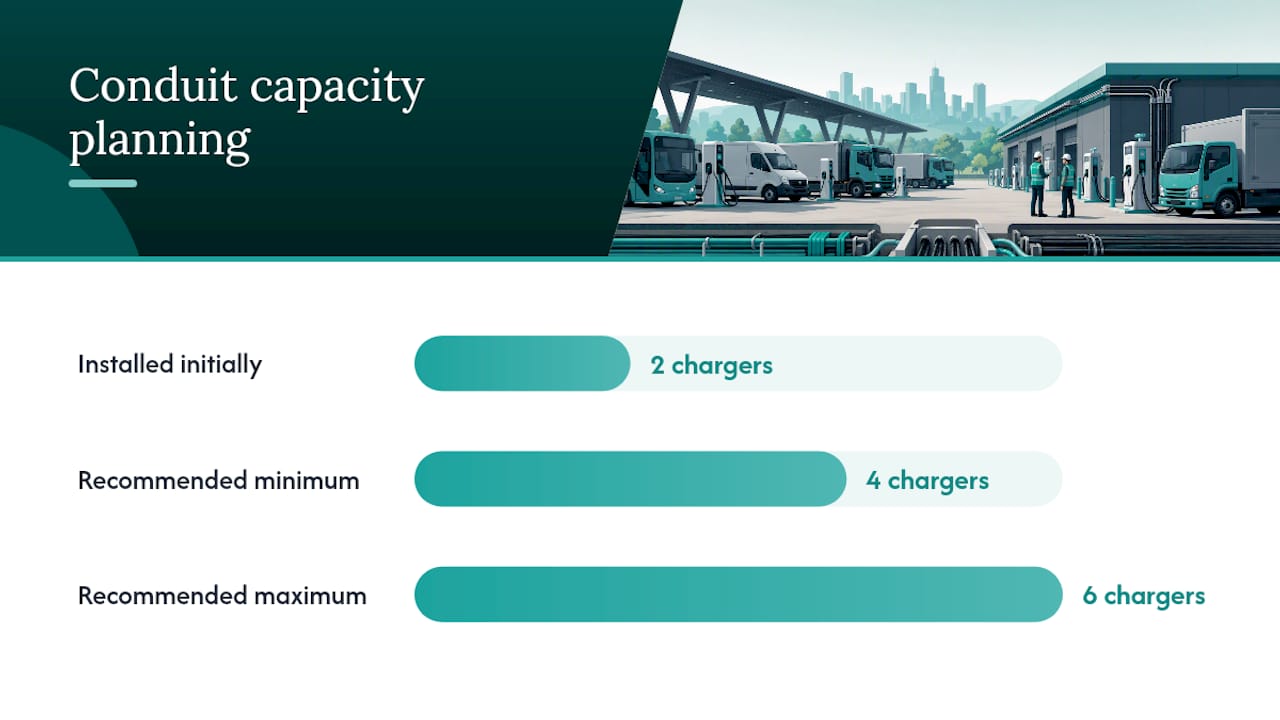
Aeversa’s depot infrastructure guide makes a strong case for over-provisioning conduit capacity at this stage, recommending groundwork sized for four to six charger locations even when only two are installed initially. Retrofitting conduit later means re-trenching an operational yard, which is far more disruptive than a slightly larger initial civils bill.
Maintenance planning should be built around a fixed inspection cadence, not reactive callouts:
Inspect retractors, rollers and springs for wear at a defined interval.
Check retraction force against the manufacturer’s original specification.
Assess cable abrasion and insulation condition, particularly on ground-contact points.
Replace consumable components before failure, not after.
Stock spare parts in advance for cycle-based replacement, rather than ordering on demand.
Safety planning shouldn’t be an afterthought bolted onto the mechanical spec. Trip hazards from loose cable, run-over risk in busy yards, and securing connectors during idle periods all need explicit mitigation in the design brief. EKDA’s analysis of maintenance costs links properly designed cable-management directly to reduced ground contact, lower run-over risk and longer cable service life, which is where the maintenance-budget savings actually come from.
What drives the cost of an EV cable-management project?
Six factors drive most of the budget variance between a straightforward workplace installation and a full depot rollout: mechanism specification, structural works for gantries or ceiling mounts, cable length and whether it’s liquid-cooled, civil works like trenching and conduit, automation for robotic or dock systems, and integration with existing energy-management software.
Heavy-duty, cycle-rated mechanisms cost more upfront than domestic-grade equivalents but avoid the repeat-failure costs Parwatt’s guidance associates with undersized systems.
Structural works for overhead gantries add cost but reduce ground-level wear across the system’s working life.
Liquid-cooled DC cables cost more to manage mechanically because the retraction system needs higher torque capacity.
Civil works, particularly conduit sized for future chargers, are cheaper to over-provision now than to retrofit later.
Robotic and dock systems carry the highest automation premium but the biggest reduction in manual handling time.
Software integration for smart charging and load management adds a modest cost but materially reduces operating costs over the system’s life.
A typical implementation runs through five phases:
Feasibility survey — site assessment, structural checks, throughput measurement.
Detailed design — mechanism selection, gantry or conduit layout, connector-position planning.
Civils and electrical groundwork — trenching, conduit installation, power distribution.
Mounting and system testing — installation of mechanical hardware, full-motion trials with real vehicles.
Commissioning and driver trials — final handover, staff familiarisation, snagging period.
On the CAPEX versus OPEX question, most operators choose between an upfront purchase paired with a maintenance contract, or a managed charging-as-a-service model where the mechanical hardware, software and maintenance sit under one recurring fee. Grant funding support can meaningfully offset the upfront figure for eligible UK businesses, which is worth factoring into the capital case before deciding which model suits your balance sheet.
How do you evaluate an EV charging cable-management supplier?
The supplier checklist for a commercial cable-management project should cover seven things: on-site feasibility survey capability, bespoke design experience, civil and structural competence, clearly defined warranty and SLA terms, spare-parts provisioning, evidence of depot pilots or comparable case studies, and integration with software or energy-management platforms.
A full-service integrator gives you a single point of responsibility from initial concept through to ongoing maintenance, rather than juggling separate contracts for design, installation and servicing. That matters more than it sounds on paper: when a retraction mechanism fails eighteen months in, you want one number to call, not three.
A depot project with three separate contractors for design, install and maintenance almost always ends up with someone pointing at someone else when something breaks.
Ask any prospective supplier to walk you through a real depot pilot or comparable project. Swift Charging’s own Vanfridge and Carl Zeiss case studies show how design decisions on real sites carried through into installation and ongoing management, which is the kind of evidence worth requesting from any supplier you’re shortlisting.
How an integrator actually scopes a cable-management project
Scoping a depot project properly starts with a site walk, not a spec sheet. You watch how vehicles actually approach the bays, not how the drawings say they should. Then a cable-weight test against the proposed charger power, because nameplate figures rarely match the connector and cable combination that ends up specified.
The surprises tend to cluster in two places: connector positions that don’t match the vehicle manufacturer’s published data, and overhead clearance that looks fine on a structural drawing but fails once racking, ductwork or lighting is accounted for. Both change the recommended hardware, sometimes significantly, from what the initial brief assumed.
On one anonymised depot pilot, a modular gantry recommendation replaced an originally specified swivel-arm layout once the traffic observation showed vehicles approaching from a wider range of angles than the site drawings suggested. The redesign added modest upfront structural cost but cut cable-related downtime substantially across the following operating period, because the mechanism no longer had to cope with approach angles it wasn’t rated for.
Conduit oversizing gets recommended on almost every project now, in line with Aeversa’s build-for-six, install-for-two principle. It rarely costs much more at the initial trenching stage and it removes the single biggest source of disruption on a phase-two expansion.
How Swift Charging supports your cable-management project
Swift Charging runs your cable-management project end to end, from the first site feasibility survey through to the maintenance contract that keeps it running years later. That’s the practical difference against piecing a project together across separate design, installation and servicing contracts: one team accountable for the whole system, including the mechanical parts most suppliers treat as an afterthought.

Our scope covers depot design, gantry and overhead rail installation, retractable reels and balancer systems, feasibility assessment for robotic or dock charging, support with applicable UK grant funding, and SLA-backed maintenance contracts with spare parts stocked against your specific hardware. For depots comparing on-site solutions against outsourced alternatives such as mobile fleet fuelling services, a properly specified fixed installation still tends to give better long-term cost control for high-throughput sites.
If you’re planning a new depot, expanding an existing installation, or replacing cable-management hardware that’s failing under real traffic volumes, request a site feasibility survey through our commercial EV charging installation service and we’ll give you an installer-led cost-to-implement estimate before you commit to a spec.
Sources
Procurement and technical teams validating a specification should go beyond supplier marketing copy. The Siemens depot charging whitepaper remains one of the more rigorous surveys of modular gantry design and IEC compliance for depot-scale projects. Parwatt’s 2026 guidance covers cycle-rating requirements for high-traffic sites in practical detail, while EKDA’s maintenance-cost analysis is worth citing directly in any tender document that needs to justify lifecycle cost over lowest upfront price.
A properly specified system reduces ground contact and run-over risk, which is the mechanism behind most of the maintenance-cost savings cited in that analysis.
Product pages like BESSUN’s cable retractor give a useful baseline for what “purpose-built” actually means in commercial hardware terms, and are worth using as a comparison point when a supplier’s spec sheet is vague on cycle rating. Any technical team writing a spec should request cycle-rating data and environmental IP ratings directly from suppliers rather than accepting general durability claims, and should ask specifically whether those figures come from field trials or depot pilots rather than laboratory conditions alone.
FAQ
What is the most durable cable-management option for a busy depot? Overhead rails and modular gantries generally hold up best under high daily session counts, provided the structure and cycle rating are specified for your actual traffic volume rather than a generic commercial rating.
Do retractable reels work for DC fast charging? Yes, but liquid-cooled DC cables are heavier than AC cables, so the reel’s retraction mechanism needs a higher torque rating specifically matched to that cable weight.
How much conduit capacity should we install now versus later? Most depot guidance recommends provisioning conduit for multiple charger locations beyond those initially installed, since retrofitting trenching later is far more disruptive to an operational site.
What should a maintenance SLA for cable-management hardware include? A defined inspection cadence, replaceable wear-part provisions (rollers, springs, retraction mechanisms), spare-parts stocking, and a stated response time for callouts.
Can EV charging grants help cover cable-management costs? Where eligible, UK businesses can offset a portion of installation costs through available grant schemes, which Swift Charging can help identify and apply for as part of a wider installation project.
Recommended