What is EV charger uptime and why does it matter to operators?

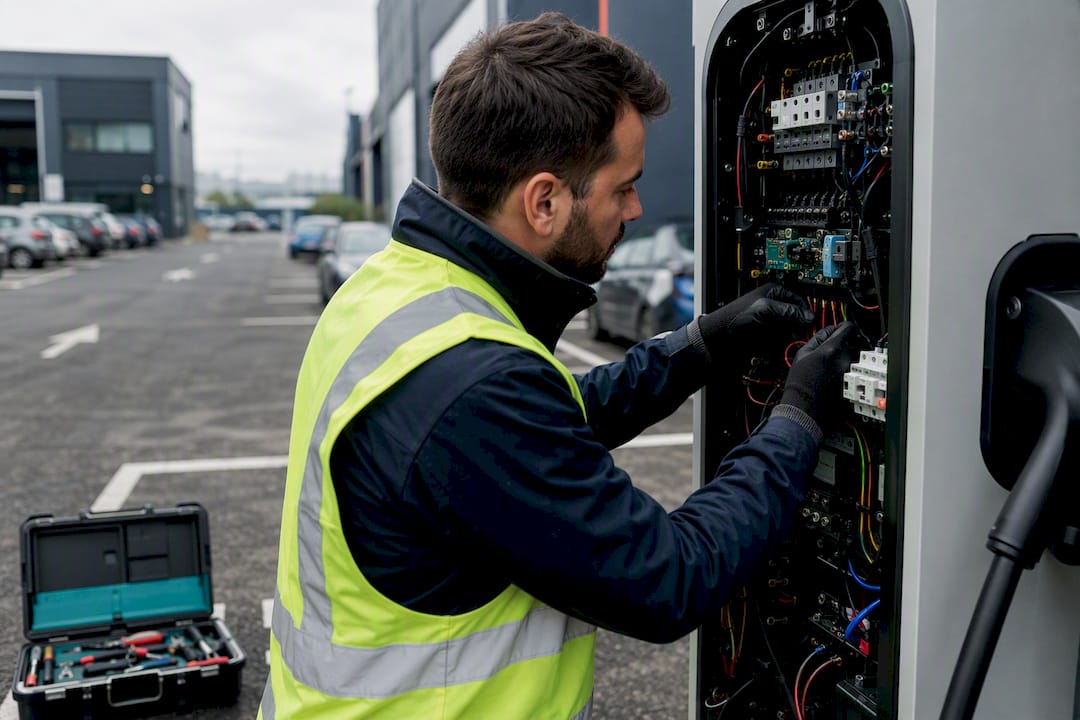
EV charger uptime is the percentage of time a charging port is functioning and ready to deliver a session, excluding agreed downtime such as scheduled maintenance. The commonly cited industry benchmark sits around 97% uptime, the figure written into several funding programmes as a minimum standard for supported charge points (commonly 97% or higher).
If you operate charge points, three things need doing now: measure uptime using a consistent, documented formula; measure session success alongside it, because a “live” charger can still fail a driver; and assign a named fault owner with a clear response window. Get these three right and everything else in this guide becomes easier to act on.
Measure uptime correctly and document your exclusions
Track session success, not just port status
Give one person or team ownership of faults, with a response SLA
Pro Tip: A charger reporting 98% uptime can still be failing one in five drivers if payment authorisation keeps timing out. Uptime tells you the port is alive. It doesn’t tell you the driver got a charge.
Key Takeaways
Reliable EV charging depends on tracking Fault Time, Fault-Reason Time and Unreachable Time alongside uptime, because uptime alone hides the failures drivers actually experience.
Point | Details |
Uptime alone isn’t enough | A charger can meet the 97% uptime benchmark and still fail one in five sessions through payment or authorisation errors. |
Track session success | First-time session success measures whether drivers actually charge on their first attempt, not just whether the port responds. |
Target the worst assets | A small subset of chronically faulty stations typically causes most downtime hours, so remediation should be targeted, not spread evenly. |
Build in resilience | Edge-capable authorisation, connectivity redundancy and scheduled cable replacement prevent the most common failure modes. |
Get expert support | Swiftcharging designs and maintains commercial charging infrastructure with reliability built in from the site survey stage onward. |
Table of Contents
Why does charger reliability affect revenue and funding eligibility?
How can operators improve EV charger uptime and session success?
How Swiftcharging supports uptime from design through to daily operation
Why do software updates and cybersecurity affect reliability?
How should operators communicate with drivers during downtime?
How is EV charger uptime calculated?
Most operators calculate uptime as total operational minutes divided by total minutes in the reporting period, expressed as a percentage, minus agreed exclusions. The formula sounds simple. The exclusions are where the arguments start.
Utility outages — downtime caused by grid failures is usually excluded, since the operator has no control over it.
Scheduled maintenance — planned outages, if communicated in advance, typically don’t count against the score.
Vehicle-side faults — a charger that’s ready but rejected by the car’s onboard system is often logged as available, even though the driver didn’t charge.
Hours of operation — a site that closes overnight may only count uptime during operating hours, inflating the headline figure.
Reporting cadence matters too. Daily or weekly figures are useful for spotting operational problems fast; monthly or annual figures are what funders and compliance schemes such as NEVI-style reporting standards with a requirement of high nineties uptime actually require.
Why does charger reliability affect revenue and funding eligibility?
Low uptime doesn’t just annoy drivers. It quietly erodes the commercial case for the whole site.
Driver trust drops fast — one failed visit is often enough for a driver to avoid a location altogether, and word travels through EV community apps quicker than most hosts expect.
Revenue leaks silently — every failed session is a missed transaction; on a busy destination charger, that adds up to real money over a quarter, not just a bad afternoon.
Utilisation figures suffer — a charger with a poor reputation gets skipped even when it’s technically working, which depresses the usage data you’ll eventually need to justify expansion.
Funding and procurement hinge on it — many grant schemes and fleet contracts now write uptime thresholds directly into eligibility criteria and SLAs, so a chronically unreliable site can lose access to future funding rounds.
Newer fast-charging networks are proving reliability can improve with better design and investment, with falling non-charge visit rates reported by several industry reports. That’s the direction every operator should be pushing toward.
What’s the difference between uptime and session success?
Uptime measures whether the hardware is switched on and responding. It says nothing about whether a driver who plugs in actually gets a charge.
Independent analysis shows software-reported uptime frequently overstates real driver experience, because it often excludes payment failures, authorisation timeouts, and app connectivity issues. Some studies find as many as one in five visits ends without a successful charge, even on sites reporting strong uptime.
This is why session success and first-time session success matter more than uptime alone. Session success tracks the proportion of attempted charges that complete without error. First-time session success narrows that further, measuring whether the driver succeeded on their first plug-in attempt, without a retry, a phone call, or a walk to another bay.
Three diagnostic metrics make this actionable, proposed in research on operator-scale performance metrics:
Fault Time — total time a charger spends in a faulted state, regardless of cause
Fault-Reason Time — fault time broken down by cause, so you can see whether it’s hardware, network, or payment driving the number
Unreachable Time — time the charger can’t be reached by the back office at all, often the clearest signal of a network problem rather than a hardware one
These metrics reveal persistent issues that a single annual uptime figure hides completely, including so-called “zombie” chargers that appear live but silently fail every session.
What causes low uptime and failed charging sessions?
Most downtime traces back to a small number of recurring failure types, and most sites have a small number of specific stations responsible for a disproportionate share of it.
Connectivity failures — cloud-dependent authorisation means a dropped cellular or Wi-Fi connection can strand an otherwise healthy charger.
Payment and authentication faults — card readers, RFID modules and app-based authorisation are frequent points of failure, often causing session timeouts drivers mistake for a broken charger.
Cable and connector wear — physical wear from thousands of plug cycles, plus deliberate vandalism, remains one of the most consistently cited causes of downtime in field studies.
Local site constraints — insufficient electrical capacity, poor cellular signal (“RF dead zones”), and general environmental wear all contribute.
A small subset of problem stations — a handful of chronically faulty units often account for most of a site’s downtime hours, rather than failures being evenly spread.
Pro Tip: Before buying more spare parts, pull a fault log by station, not by site. If two chargers out of twelve are responsible for 80% of your downtime hours, that’s a targeted repair or replacement decision, not a maintenance-budget problem.
How should operators measure and report uptime?
Reliable reporting starts with good data sources and a defined process, not a spreadsheet cobbled together at month-end.
Charger logs — the on-device record of state changes, faults and resets.
Session telemetry — start and stop timestamps for every attempted and completed session.
Payment terminal logs — authorisation attempts, failures and timeouts, which uptime figures alone often miss.
Network health pings — regular checks confirming the charger can actually be reached by the back office.
Run diagnostics daily or weekly for operational purposes, and roll figures up monthly or annually for compliance and funder reporting, matching the cadence expected by programmes built around the 97% uptime standard.
Document every exclusion applied to your figures, with a timestamp and reason code
Publish uptime and fault data through an API wherever possible
Use a consistent error-reason taxonomy so faults can be compared across sites and quarters
How can operators improve EV charger uptime and session success?
Improving reliability is rarely one fix. It’s a stack of smaller measures that compound.
Run daily health checks — a five-minute remote status sweep catches faults before a driver does.
Stock a spare-parts kit on site or nearby — cables, connectors and card readers are the parts that fail most often, so keep them ready rather than ordering after a breakdown.
Replace cables on a schedule, not on failure — proactive replacement based on cycle counts avoids the worst driver-facing failures.
Build in connectivity redundancy — a charger with both cellular and Wi-Fi fallback paths avoids the single point of failure that causes Unreachable Time spikes.
Push authorisation to the network edge — edge-resilient charger design lets a unit authorise a known card or app locally during a cloud outage, avoiding a full “brick” state.
Use store-and-forward telemetry — sessions logged locally and synced once connectivity returns prevent data loss during outages.
Give payment hardware the same attention as the charger itself — a robust terminal with offline fallback prevents the authorisation failures that quietly wreck session success.
Assign clear fault ownership — one team or contractor should own response and resolution, with SLA windows written down, not assumed.
Target remediation at your worst assets — fix the two or three stations generating most of your Fault Time before spreading budget evenly across the fleet.
Pro Tip: Set a fault SLA that’s realistic and enforced, not aspirational. A four-hour response promise nobody actually meets is worse than an honest 24-hour SLA your team consistently hits.
How Swiftcharging supports uptime from design through to daily operation
Uptime is largely decided long before a charger’s first session, in the choices made at survey and specification stage. Swiftcharging works with UK businesses from feasibility through to long-term management, which means reliability gets built in rather than retrofitted.
That covers site surveys that flag electrical capacity and signal issues early, specification of chargers with edge-capable authorisation and resilient connectivity, and maintenance contracts that keep response times contractual rather than optional.
For operators assessing an existing site, the practical route looks like this:
Baseline audit — establish current uptime, session success and fault patterns before changing anything
Remediation plan — target the specific stations and failure modes causing most of the downtime
Ongoing O&M contract with a defined SLA — lock in response times and ownership so reliability doesn’t quietly decay again
Do weather and temperature affect charger uptime?
Environmental exposure is one of the more predictable causes of downtime, and one of the easiest to plan around if you specify for it upfront.
Extreme cold slows the electronics inside a charger and can affect battery management communication with the vehicle, sometimes triggering fault states that resolve once temperatures rise. Extreme heat carries a different risk: charging hardware generates its own heat during a session, and if ambient temperatures push components past their rated range, the unit may throttle output or shut down to protect itself. That’s a deliberate safety response, not a fault, but it still shows up as downtime in your reporting if you’re not tracking the reason code.
Rain and humidity are less of a concern for properly rated hardware. Most commercial chargers carry an IP54 or higher ingress protection rating specifically because they’re designed to sit outdoors permanently. The bigger risk tends to be water ingress at connector points after long-term wear, which is a maintenance issue as much as a weather one.
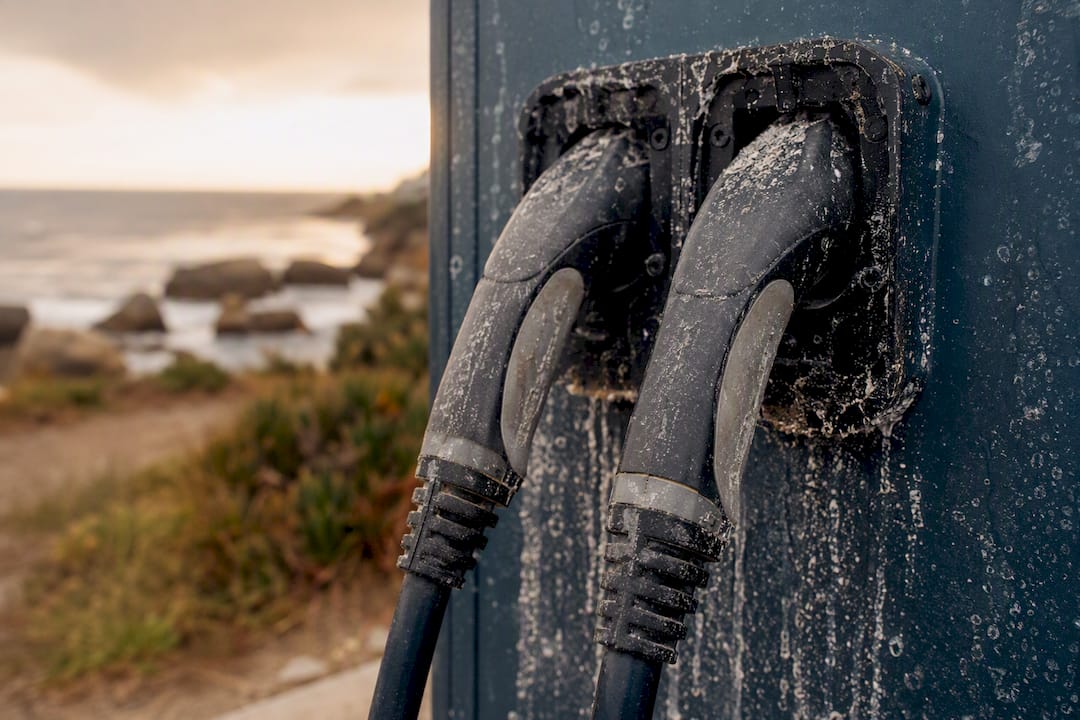
Coastal and exposed sites face an added factor: salt air and wind-driven grit accelerate connector corrosion and cable sheath wear compared with sheltered inland locations. Sites in these conditions often see higher Fault-Reason Time attributed to hardware wear, which is worth flagging at the specification stage so enclosures and connectors are rated accordingly rather than discovered as a recurring repair bill eighteen months in.
Why do software updates and cybersecurity affect reliability?
A charger’s uptime depends as much on its software stack as its physical hardware, and that dependency is growing.
Firmware updates fix known bugs, patch communication protocols, and often improve compatibility with newer vehicle models. Skipping updates doesn’t just mean missing new features. It leaves known fault conditions unresolved, which shows up over time as recurring Fault Time that a simple patch would have prevented.
Cybersecurity matters here in a very practical way. Chargers that communicate with back-office systems and payment networks are a target, and a successful attack on a charge point management system can take an entire fleet of connected chargers offline simultaneously, turning an isolated problem into a site-wide outage. Standards such as ISO 15118, which governs communication between vehicle and charger including secure authentication, are increasingly relevant to procurement decisions precisely because they reduce this exposure.
The practical takeaway for operators is straightforward: treat firmware and security updates as part of the maintenance schedule, not an occasional afterthought. A charger that hasn’t been updated in a year is carrying accumulated risk that eventually surfaces as downtime, often at the worst possible moment, such as a payment terminal vulnerability discovered during a busy bank holiday weekend.
How should operators communicate with drivers during downtime?
Silence is the single biggest driver-experience failure during an outage, worse in many cases than the outage itself.
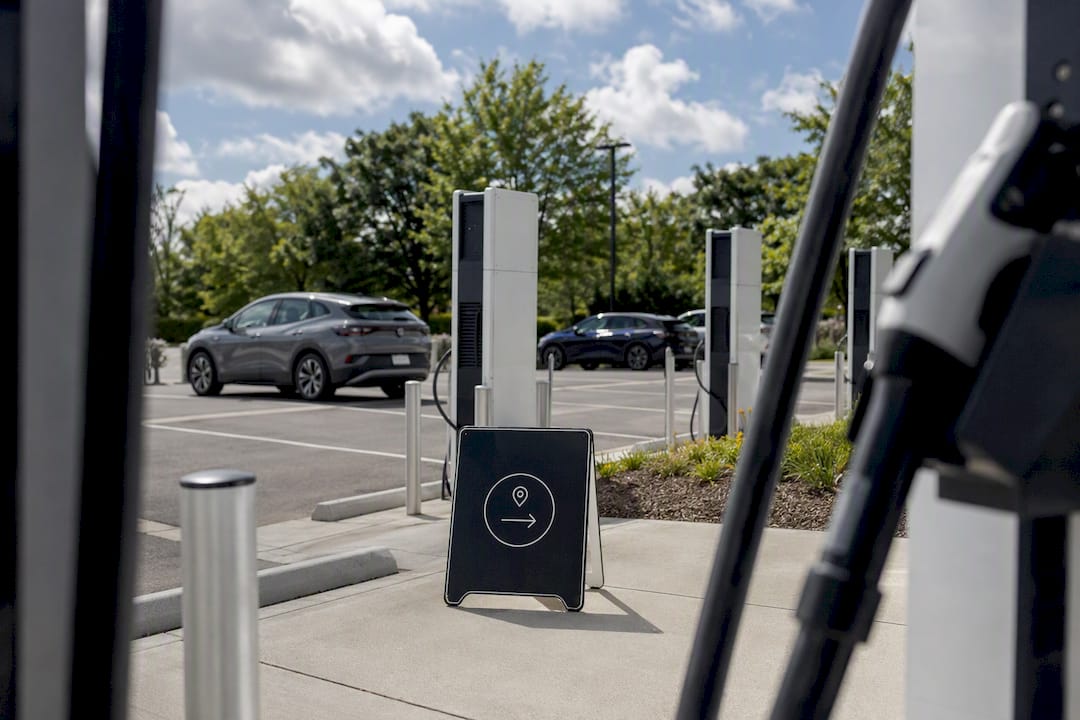
A driver who arrives at a faulted charger with no information wastes time, loses trust, and often shares that frustration publicly before your team even knows there’s a problem. Real-time status feeds through your charging app or network partner’s platform are the first line of defence: if a port is faulted, that status needs to reach the driver before they’ve driven to the site, not after.
On-site signage matters for the drivers who arrive anyway, particularly at destination sites such as hotels or leisure venues where charging is a secondary reason for the visit. A simple sign directing drivers to the nearest working port, alongside a contact number for support, converts a bad experience into a merely inconvenient one.
For fleet and workplace operators, direct communication channels matter even more, since fleet drivers often rely on scheduled charging windows to keep vehicles on the road. Keeping accurate, up-to-date driver contact records means a fault notification actually reaches the person affected rather than sitting unread in a general inbox.
The strongest sites treat downtime communication as a documented process: a status update within minutes of detection, an estimated resolution time where possible, and a follow-up once the fix lands. That consistency is what separates a site drivers tolerate from one they actively avoid.
What do real-world uptime improvement efforts look like?
Reliability gains tend to come from specific, targeted fixes rather than blanket investment, and the pattern shows up repeatedly across the sector.
Industry reporting on non-charge visit rates shows measurable improvement at newer fast-charging networks that have invested in better hardware design and monitoring, reinforcing that reliability responds to deliberate engineering choices rather than being a fixed characteristic of the technology.
At site level, the improvement pattern is usually the same: operators identify a small number of chronically faulty stations, apply targeted remediation such as connector replacement, payment terminal upgrades or connectivity redundancy, and see a disproportionate improvement in fleet-wide Fault Time as a result. That mirrors the wider finding that a minority of problem stations drives the majority of downtime hours across most site portfolios.
Workplace and fleet charging sites offer a slightly different case. Because usage patterns are predictable, scheduled overnight or shift-based charging, operators can schedule maintenance windows that never touch a live session, and can catch faults through routine daily checks before a driver ever encounters them. That’s a structural advantage public destination sites don’t always have, and it’s part of why fleet-focused installations often report steadier uptime once initial commissioning issues are resolved.
The common thread across every improvement case is the same: fix the worst-performing assets first, and measure the result in Fault Time, not just a headline uptime percentage.
What operators consistently get wrong about uptime
Most operators treat uptime as the finish line. It should be the starting point of a diagnosis, not the verdict on how a site is performing.
The conventional advice, hit the 97% benchmark and move on, misses that a charger can technically satisfy that number while still failing drivers regularly through payment timeouts or authorisation errors that never register as “downtime” in the formula. That gap between the report and the reality is where most operator frustration actually comes from, and it’s why the research consistently points toward Fault Time, Fault-Reason Time and Unreachable Time as the metrics worth building operational habits around.
What we’d prioritise first, based on everything the data shows, is fault ownership. Not more monitoring dashboards, not another software layer. A named owner with a real SLA, backed by targeted remediation of the worst-performing stations rather than uniform maintenance across the fleet. Sites that get this structural piece right tend to see Fault Time drop faster than sites that simply buy more monitoring tools without changing who’s accountable for acting on what those tools report.
Get a reliability audit for your charging site
There’s no shortage of ways to chase better uptime: swap hardware vendors, bolt on another monitoring dashboard, or renegotiate an existing maintenance contract and hope it improves things. Swiftcharging takes a different starting point. We design reliability in from the site survey stage, specifying edge-capable chargers and resilient connectivity before a single unit goes in the ground, rather than trying to patch it in afterwards.
For businesses with an existing site underperforming on uptime or session success, we run a baseline audit that identifies your worst-performing assets and the specific failure modes behind them, whether that’s payment hardware, connectivity, or worn connectors. From there we build a remediation plan and, where it makes sense, an ongoing maintenance contract with a defined SLA and named fault ownership, the exact structure this guide recommends. If your site serves a specific region, our Chichester installation team can arrange a site visit and give you a clear view of what’s driving your downtime and what it will take to fix it.
Frequently asked questions
What is a good EV charger uptime percentage?
Most funding programmes and industry benchmarks treat 97% uptime as the minimum acceptable standard for a well-run site. Anything meaningfully below that suggests a systemic issue worth investigating rather than a one-off fault.
Is EV charger uptime the same as reliability?
No. Uptime measures whether the hardware is switched on and responding. Reliability, in the sense drivers actually experience it, depends on session success, including whether payment and authorisation systems work every time a driver plugs in.
How often should uptime be reported?
Daily or weekly for internal operational purposes, and monthly or annually for compliance and funder reporting. Most funding schemes specify the exact cadence and format required, often via an API feed.
What causes most EV charger downtime?
Hardware wear on cables and connectors, payment and authorisation terminal failures, and network connectivity issues account for the majority of downtime across most studies, with a small number of chronically faulty stations often responsible for a disproportionate share.
Can weather affect charger uptime?
Yes. Extreme heat can trigger protective shutdowns, extreme cold can slow onboard electronics, and coastal or exposed sites see faster connector corrosion, all of which show up as Fault-Reason Time if properly logged.
Sources
Recommended