EV charging signage: what UK sites must install and why

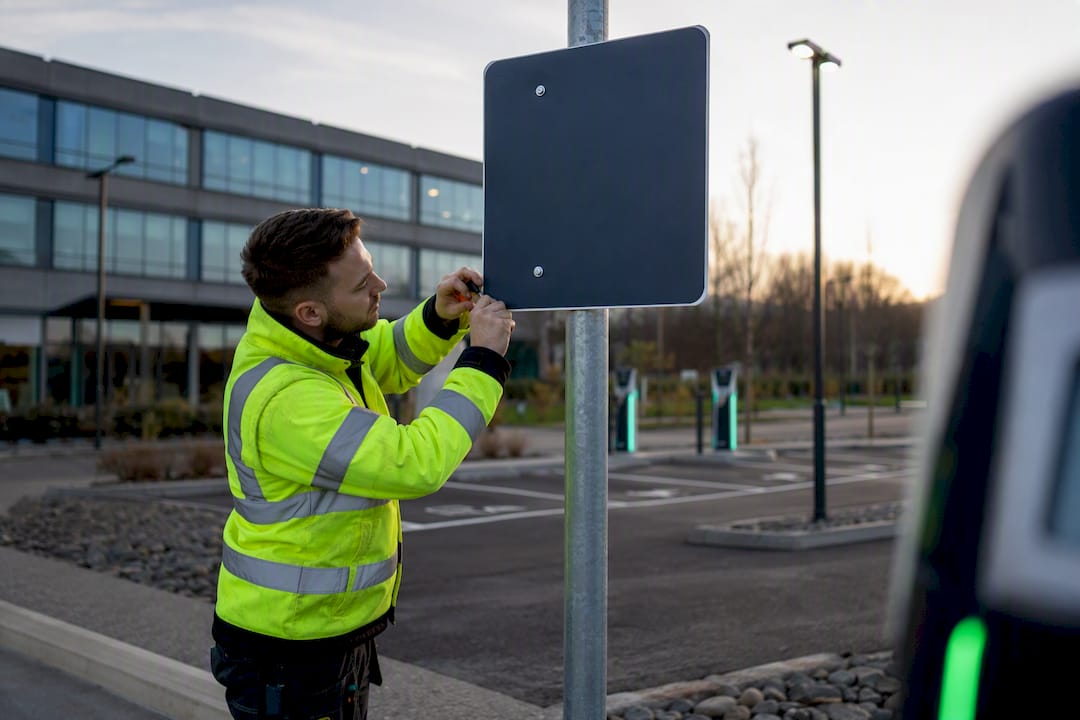
Every commercial EV charging site needs three signage elements as standard: clear on-site charger identification, an enforceable “no parking except for charging” notice, and wayfinding signs where drivers need directing from an entrance or road. Before ordering anything, check Department for Transport symbol guidance, National Highways rules for any road-facing signage, and accessible design guidance for inclusive placement.
Two things to do this week:
Commission a site survey covering sightlines, mounting points and existing parking restrictions.
Decide your enforcement policy (time limits, penalties, who manages breaches) before you specify wording, because signage that doesn’t match your enforcement contract is often unenforceable.
Pro Tip: Order signage and chargers together. Specifying both in one contract avoids a second site visit and a second invoice.
Key Takeaways
Compliant UK EV charging signage combines a DfT-tested symbol, clear enforcement wording matched to your parking contract, and accessible placement agreed before installation begins.
Point | Details |
Confirm symbols first | Match on-site signage to DfT-tested symbols before ordering artwork to avoid reprints. |
Separate sign categories | Plan wayfinding, station ID, regulatory and pavement markings as distinct requirements, not one sign. |
Match wording to enforcement | Draft “no parking except for charging” notices against your enforcement provider’s exact contract terms. |
Inspect on a schedule | Run quarterly visual checks and annual symbol/compliance reviews, with dated records kept. |
Specify accessibility early | Follow Designability’s accessible guidance at the design stage, not as a retrofit. |
Integrate with installation | Swiftcharging surveys, specifies and installs signage alongside chargers under one contract. |
Table of Contents
Where should EV charging signs be placed for best visibility?
How do you word an enforceable “no parking except for charging” sign?
What materials and specifications should you request from suppliers?
How do you plan procurement and installation from start to finish?
How Swiftcharging handles signage on commercial installations
Are digital or smart EV charging signs worth the investment?
Get your signage specified alongside your charger installation
Types of EV charging signage you need to plan for
Signage for electric vehicle charging splits into four distinct jobs, and mixing them up is the most common procurement mistake we see.
Wayfinding signage guides drivers from a road or car park entrance to the charging bays. This is directional, arrow-led, and often the only category that might require highways authority involvement.
Station identification signage marks the bay itself: charger type, connector, operator branding and the DfT-tested symbol.
Regulatory and enforcement signage states parking rules, time limits and penalties for non-EV vehicles or overstaying.
Pavement markings reinforce the bay boundary and are often required by parking enforcement contracts as supporting evidence.
A workplace car park usually needs categories two and three only. A hotel or retail destination charging site typically needs all four, since visiting drivers won’t know the layout. Multi-storey car parks need extra wayfinding at each level change, and roadside hubs may need highways authority sign-off if any signage faces a public road. Swift Charging’s destination charging guidance covers hospitality sites in more depth.
What do UK standards say about EV charging symbols?
The Department for Transport tested three candidate symbols for electric vehicle charging points and published its findings on 18 March 2025, giving the UK its first authoritative reference for symbol selection on signage. Before this, operators and sign manufacturers were working from a patchwork of interpretations, which is partly why UK charging signage has looked inconsistent compared with sites elsewhere in Europe.
Where a symbol has been through DfT testing, using it consistently across a site does more than tick a compliance box. It reduces the split-second confusion a driver feels when a symbol looks almost right but not quite, which matters most at speed or in poor light.
For road-facing signs, National Highways sets eligibility criteria covering when a charging site can be signposted from the strategic road network, and what information those signs must carry.
Public highway signage must go through the relevant highways authority and follow prescribed symbols.
Private land signage isn’t legally bound by the same approval process, but matching the DfT-tested symbol still helps recognition and avoids looking like an unofficial or unreliable site.
Industry commentary has flagged that UK road signage still lags some European countries for rapid charging hubs, so expect some friction if you’re pursuing highway-facing signs.
Where should EV charging signs be placed for best visibility?
Placement failures are usually about height and sightline, not the sign itself. A well-designed sign mounted where a driver can’t see it in time is wasted money.
Mount bay-identification signs at a height that clears vehicle sightlines but stays legible from a seated position, typically on a post or wall bracket adjacent to the bay rather than overhead.
Use larger symbols and high-contrast lettering on any sign viewed at approach speed, and reserve smaller, denser text for signs read at a standstill.
Place advance directional signs with arrows before the final turn into the bay, particularly where multiple charger types exist on one site.
In multi-storey car parks, account for low ceilings, artificial lighting and covered bays, all of which reduce a driver’s ability to spot a sign at a glance.
Design guidance consistently points to the same conclusion: large symbols, strong contrast and minimal wording beat a busy, information-heavy sign every time.
Pro Tip: Walk the site at dusk before finalising sign positions. Daytime sightlines can be misleading once lighting and shadows change.
How do you word an enforceable “no parking except for charging” sign?
An enforceable notice needs specific, unambiguous wording. “EV charging only” alone rarely holds up, because it doesn’t state consequences or time limits. A stronger version reads something like: “Electric vehicle charging bay. Vehicles must be actively charging. Maximum stay 2 hours. Non-compliant vehicles may be issued a parking charge notice.”
On public highways, only the highways authority can approve enforceable regulatory signage.
On private land, enforcement typically relies on a parking management contract, CCTV or photographic evidence, and signage that clearly states the terms before a vehicle enters the bay.
Keep tariffs, time limits and penalties on one sign in short lines rather than spreading rules across multiple boards, which drivers tend to skim past.
Most UK parking enforcement providers will only act on breaches if the signage wording matches their contract terms exactly, so involve your enforcement firm before finalising artwork.
What materials and specifications should you request from suppliers?
External signage takes a battering from UK weather, so specification matters as much as design.
Choose aluminium composite or engraved aluminium for durability, or UV-stable plastics for lower-cost, shorter-term installations, and add anti-graffiti coating on any sign at ground level.
Ask suppliers for UV stability data, corrosion resistance, warranty length and, for illuminated signs, an IP rating suited to outdoor exposure.
Size signage to the approach distance and vehicle speed on site: a sign read from a slow-moving car needs a larger symbol than one read on foot.
UK sign suppliers market weatherproof, compliance-focused EV signage as standard, but always request a written conformity statement for the symbol artwork rather than assuming it matches DfT specification.
How do you plan procurement and installation from start to finish?
A structured process avoids the two most expensive mistakes: ordering signage before the enforcement policy is settled, and installing signs that a highways authority later asks you to remove.
Commission a site survey to map sightlines, mounting points and any road-facing elements.
Decide your access and enforcement policy, including time limits and penalties, before specifying wording.
Produce a signage specification covering symbols, materials, sizes and mounting.
Seek highways authority approval only where signage faces a public road.
Place the order, ideally alongside your charger installation contract.
Install, photograph the finished layout, and keep records for future enforcement or audit purposes.
Involve your facilities or legal team, your parking enforcement provider, your installer and the charge point operator early, since each has requirements that affect wording or placement.
Pro Tip: Bulk-ordering signage across multiple sites in one contract often reduces per-unit cost and guarantees consistent branding across your estate.
How Swiftcharging handles signage on commercial installations
Swiftcharging builds signage into the site survey stage of every commercial project, rather than treating it as an afterthought once chargers are live. That means specification, symbol selection and mounting positions get agreed alongside the electrical design, not weeks later.
Site surveys assess sightlines and mounting points for both charger identification and wayfinding signage.
Grant application advice covers how signage costs can sometimes be bundled into wider infrastructure funding.
Specifications are checked against current DfT symbol guidance to reduce the risk of rework or refusal.
Early signage planning avoids the common delay of enforcement providers rejecting a scheme because wording wasn’t agreed before installation.
How often should EV charging signage be inspected?
Signage degrades faster than most facility managers expect, particularly on sites exposed to salt spray, heavy traffic, or direct sun. A sign that looked crisp on installation day can fade, crack or become illegible within two or three years, and a faded regulatory notice weakens any enforcement action taken against it.
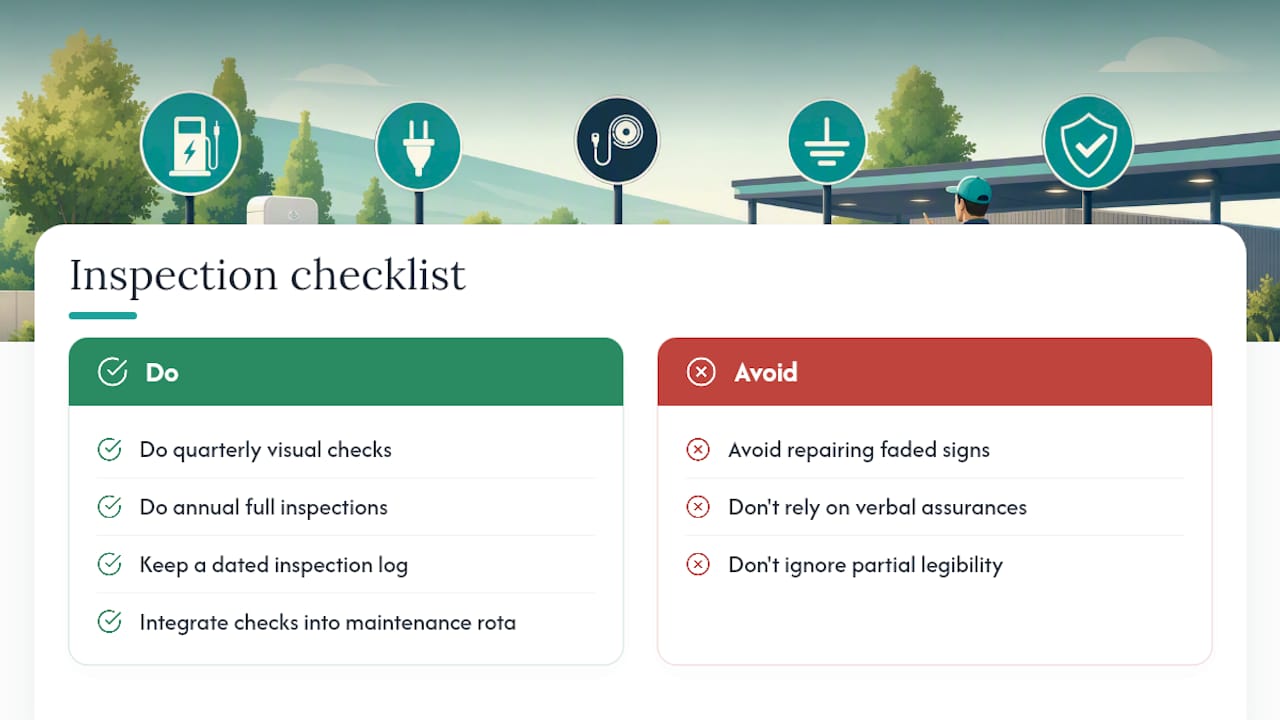
Build signage checks into your existing car park or building maintenance schedule rather than treating it as a separate task. A quarterly visual check covering fading, cracking, graffiti and physical damage catches most issues before they affect legibility. Annual checks should go further: confirm the symbol still matches current DfT guidance, check mounting brackets for corrosion, and test any illuminated sign’s power supply and IP-rated housing.
Keep a simple log of inspection dates and any remedial action taken. This matters more than it sounds. If a parking charge is ever disputed, an enforcement provider or adjudicator will often ask whether the signage was legible and compliant at the time of the alleged breach. A dated inspection record is far stronger evidence than a verbal assurance that “the signs are fine.”
Replace rather than repair once contrast has visibly dropped. A sign that’s merely dirty can usually be cleaned, but one where the lettering or symbol has faded unevenly should be swapped out, since partial legibility is often worse than an obviously old sign, which at least signals to drivers that they should look for confirmation elsewhere.
What accessibility standards apply to EV charging signage?
Accessible signage isn’t a nice-to-have addition, it’s a duty-of-care issue for any commercial site with visitors, staff or customers. Designability’s accessible EV charging guidance sets out specific recommendations for format, information and placement that many standard signage schemes miss entirely.
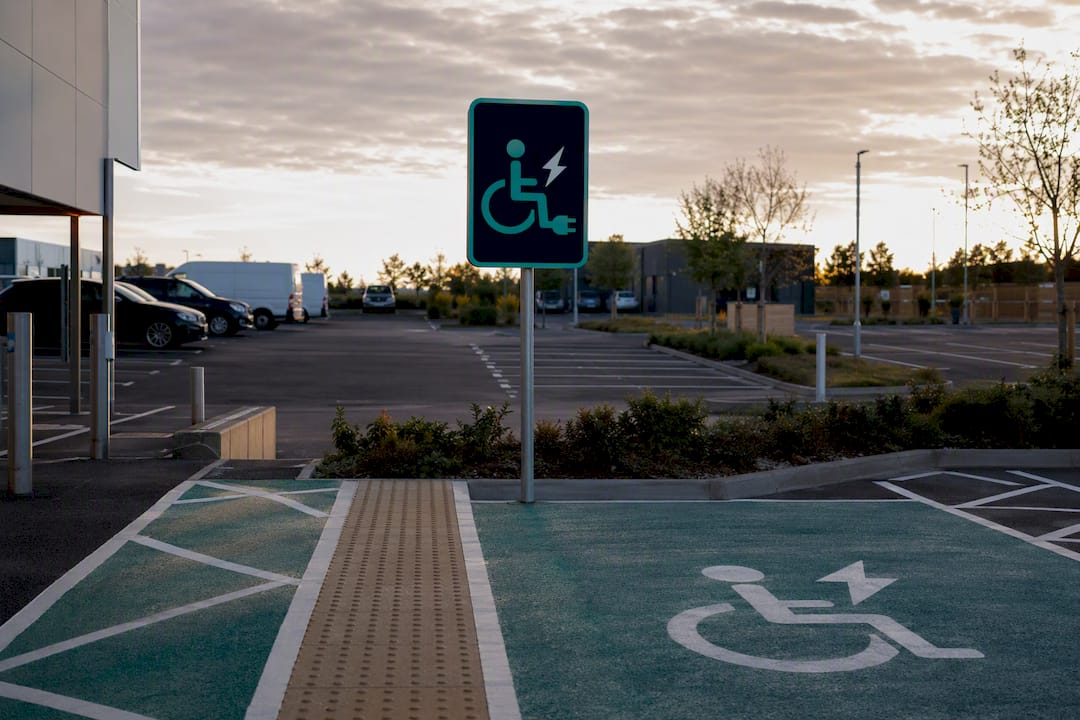
Practical points that matter most for facility managers: signage should use high-contrast colour combinations rather than relying on colour alone to convey meaning, since a meaningful proportion of drivers have some form of colour vision deficiency. Text should be large enough to read from a seated position without leaning forward, which is a particular issue for drivers using adapted vehicles who may not be able to exit easily to check a low or poorly positioned sign.
Bay-level information should include clear indication of accessible bay dimensions, any additional space for wheelchair transfer, and straightforward wording rather than technical charging terminology. Where a site has both standard and accessible charging bays, signage needs to distinguish them clearly from a distance, not just at the bay itself, so drivers don’t approach the wrong bay and have to reverse or manoeuvre awkwardly.
Following this guidance reduces the risk of unintentionally excluding disabled drivers from your charging infrastructure, and it’s a straightforward addition at the specification stage rather than a costly retrofit once bays are marked out and signs are ordered.
Are digital or smart EV charging signs worth the investment?
Digital signage is moving from novelty to genuinely useful tool on larger commercial sites, particularly where charger availability changes throughout the day. A static sign can only ever say “charging bay here.” A digital display can show which bays are occupied, expected wait times, or real-time pricing, which matters most at destination charging sites like hotels and retail parks where drivers are making a decision about whether to stop.
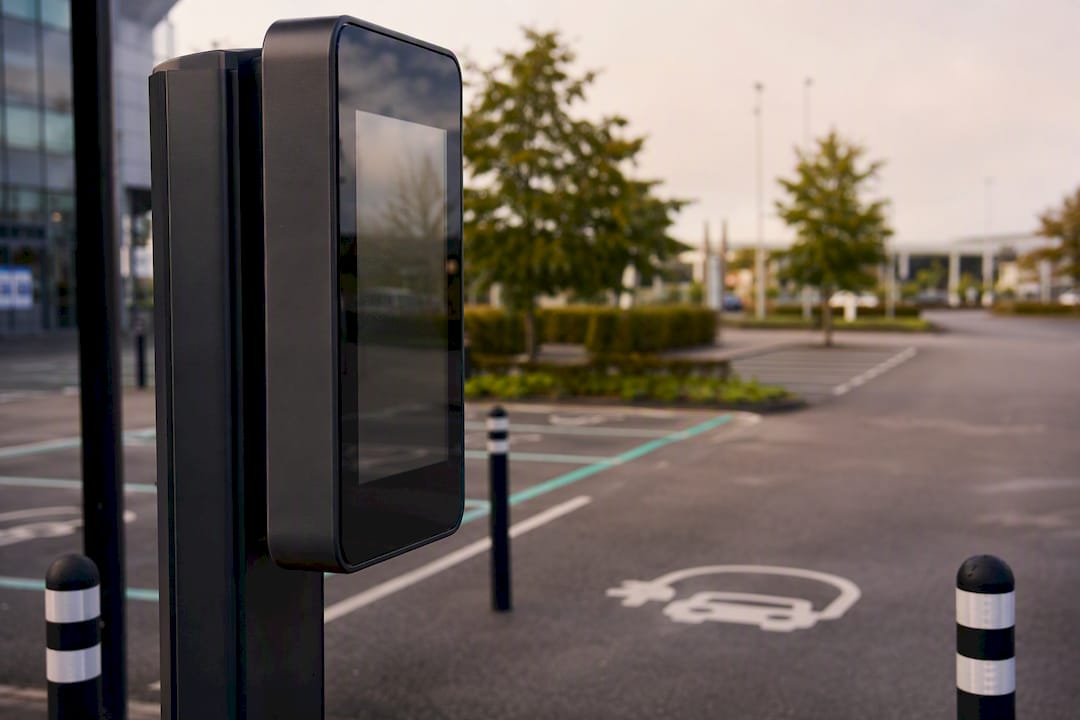
The clearest benefit is reducing wasted journeys around a car park. Drivers circling to find a free bay create congestion and frustration, and a digital indicator at the entrance showing live bay status solves that without needing an app or additional infrastructure beyond the sign itself.
Smart signage also allows faster updates when tariffs, time limits or operator branding change. A static sign requires a reprint and a maintenance visit. A digital sign can be updated remotely in minutes, which matters on multi-site estates where policy changes need to roll out consistently.
The trade-off is cost and maintenance complexity. Digital signs need a power supply, weatherproof housing with an appropriate IP rating, and occasional software or hardware servicing that a static aluminium sign never requires. For a single workplace car park with fixed bays and no pricing changes, static signage is usually the more sensible choice. For larger, higher-traffic destination sites where conditions change regularly, the operational benefit of digital signage tends to outweigh the added running cost.
What legal rules govern EV charging signage in the UK?
There’s no single piece of legislation that covers all EV charging signage, which is precisely why so many facility managers get the compliance picture wrong. The legal framework splits according to where the sign sits and what it’s asking a driver to do.
Any sign facing or visible from a public highway falls under traffic sign regulations, meaning it generally needs approval from the relevant highways authority and must use recognised symbols, including those confirmed through DfT symbol testing. Installing an unauthorised sign that resembles an official traffic sign on or near a public road can result in it being removed, and potentially in enforcement action against the site owner.
On private land, there’s no equivalent approval requirement, but enforceability depends on contract law rather than traffic law. A parking charge issued on private land is only enforceable if the signage clearly communicated the terms before the driver parked, which is why vague or poorly worded notices routinely get overturned at adjudication.
Accessibility isn’t optional either. Under the Equality Act 2010, commercial premises have a duty to make reasonable adjustments for disabled visitors, and inaccessible or unclear signage for accessible charging bays can form part of a wider accessibility complaint. Getting signage specification right at the outset, rather than treating it as a formality, is the single most effective way to avoid disputes, rejected planning conditions, or enforcement notices that don’t hold up.
What most facility managers get wrong about signage
The biggest mistake we see isn’t poor design, it’s sequencing. Facility managers commission chargers first and treat signage as a finishing touch, when it should be part of the same specification conversation from day one. Get enforcement policy and symbol choice agreed before hardware goes in the ground, and the whole project moves faster with fewer reworks.
Conventional advice tends to focus heavily on symbol aesthetics and largely ignores enforceability. A beautifully designed sign that doesn’t match your parking enforcement provider’s contract wording is decorative, not functional. If enforcement matters to your site, that conversation needs to happen before artwork is finalised, not after a dispute arises.
Prioritise three things in this order: get your enforcement policy settled, confirm your symbols match current DfT guidance, and only then move to materials and mounting. Skipping straight to procurement because a supplier’s catalogue looks comprehensive is how sites end up reordering signs within eighteen months.
Get your signage specified alongside your charger installation
Swiftcharging is the practical alternative to ordering signage and chargers as two separate projects. Because we run site surveys, specification, installation and grant support under one contract, signage gets designed against your actual sightlines and enforcement policy from the outset, not bolted on afterwards by a different supplier working from guesswork.

That matters most on sites where a rejected road-facing sign or a mismatched symbol causes weeks of delay. Our surveys check mounting points and wayfinding needs at the same time as electrical design, and we can advise on how signage costs fit within available grant funding where eligible. If you’re planning a commercial installation, get in touch through our Chichester or Eastbourne project pages, or contact us directly to arrange a site survey and see how signage fits into your overall charging project from the start.
Frequently asked questions
Do I legally need EV charging signage on private land in the UK? There’s no blanket legal requirement for signage on private land, but without clear signs, any parking enforcement or charging policy becomes very difficult to apply consistently or defend if challenged.
Can I put up my own road-facing EV charging signs? No. Any sign visible from a public highway needs approval from the relevant highways authority, and National Highways sets specific eligibility criteria for the strategic road network.
What symbol should I use on my EV charging signs? Use the symbol confirmed through the Department for Transport’s testing, which is now the standard UK reference for driver recognition.
How much does EV charging signage typically cost? Costs vary widely depending on material, size and whether signs are illuminated, so request itemised quotes from suppliers covering materials, artwork and installation alongside your charger contract.
Do accessible charging bays need different signage from standard bays? Yes. They need high-contrast, clearly distinguishable signage visible from a distance, following accessible EV charging design guidance to support drivers with disabilities.
Sources
Recommended