Beat the £1,000,000 Cap: Full Expensing vs AIA for UK Companies


For most UK businesses spending under £1,000,000 a year on plant and machinery, the Annual Investment Allowance is the simpler and often more valuable choice, including for special-rate or second-hand assets. Full expensing matters once a limited company’s new main-pool spend pushes past that £1,000,000 cap, but it carries a real balancing charge risk if you sell the asset later. Get the order wrong and you leave relief on the table.
TL;DR:
The Annual Investment Allowance is generally more beneficial for businesses spending under £1 million annually, especially for second-hand or mixed assets.
Full expensing is only available to companies investing heavily in new main-rate assets above the £1 million cap, with no monetary limit but higher risk of balancing charges if assets are sold early.
Prioritizing AIA claims on second-hand and special-rate assets before applying full expensing to new main-pool equipment can maximize tax relief in the first year.
Businesses should carefully plan asset purchases and timing within accounting periods to avoid losing relief or triggering balancing charges, especially for assets likely to be sold.
Incorporating or planning multi-year capex cycles can optimize relief, with the current rules offering long-term stability for businesses’ tax planning strategies.
Table of Contents
Full expensing vs AIA: the quick comparison
The two allowances overlap in purpose, front-loading tax relief into year one, but they diverge sharply on eligibility, ceiling and asset treatment.
Full expensing is available only to companies paying Corporation Tax, giving 100% first-year relief on qualifying new main-rate plant and machinery. The Annual Investment Allowance gives 100% relief on qualifying spend up to £1,000,000 per accounting period, and it’s open to sole traders, partnerships and companies alike.
Factor | Full expensing | AIA |
Who can claim | Companies only | All business structures |
Monetary cap | None | £1,000,000 per accounting period |
New vs used assets | New and unused only | New or second-hand |
Special-rate assets | 50% first-year relief | 100% relief, within the cap |
Disposal treatment | Balancing charge applies | Different disposal rules apply |
Best for | Large new main-pool spend above £1m | Most spend, especially mixed or used assets |
A few things stand out once you put them side by side:
Full expensing is uncapped, which makes it the tool for genuinely large capital programmes.
AIA is the only route to full relief on second-hand equipment.
Special-rate assets, think integral building features or long-life items, only get half the FE relief in year one, so AIA usually beats it there.
Sole traders and partnerships have no access to full expensing at all; it’s a company-only relief.
How the rules actually work: eligibility, qualifying assets and exclusions
The statutory boundary between the two allowances comes down to who you are and what you’re buying. Full expensing sits inside Corporation Tax legislation, so only companies qualify. AIA has no such restriction, which is why it remains the default relief for sole traders and partnerships investing in vans, tools or office equipment, subject to its permanent qualifying limits.
Asset type matters just as much as business structure. Plant and machinery splits into the main pool (most equipment, machinery, vans) and the special-rate pool (integral features such as electrical systems and lifts, thermal insulation, and long-life assets with an expected working life beyond 25 years). Full expensing gives 100% relief on new main-rate items and 50% on new special-rate items, never more.
Full expensing excludes second-hand assets entirely, and it also carries restrictions around leased or hired-out equipment. AIA, by contrast, applies to both new and used qualifying plant and machinery, which is why a business buying a mix of new chargers and a second-hand van in the same year will usually lean on AIA for the older asset regardless of company structure.
Pro Tip: Before assuming an asset qualifies, check HMRC’s capital allowances guidance on qualifying expenditure categories; integral features and fixtures catch out more businesses than any other exclusion.
Main pool: machinery, most plant, vans, computer equipment.
Special-rate pool: integral features, thermal insulation, long-life assets, some cars.
Excluded from FE: second-hand assets, most leased equipment.
Excluded from both: assets bought purely for leasing to another business in most cases.
Deciding which allowance to claim first
Once you know both allowances are available, the order you apply them in changes your year-one tax bill. A sensible priority list looks like this:
Claim AIA on special-rate and second-hand assets first. These only get 50% relief under full expensing, so using your £1,000,000 AIA cap here captures the biggest gap between the two reliefs.
Apply full expensing to new main-pool spend once AIA is exhausted. This is where FE earns its keep: no cap, 100% relief, and no competition from other assets for the allowance.
Check disposal plans before claiming FE on anything you might sell soon. Assets claimed under full expensing trigger a balancing charge on disposal, effectively clawing back some of that year-one benefit as a taxable receipt.
Remember AIA is shared across connected companies. For groups, the £1,000,000 limit splits between related businesses, while full expensing carries no such sharing restriction, a meaningful advantage for larger groups with multiple entities investing simultaneously.
Accountants consistently favour AIA-first sequencing because full expensing’s 50% treatment on special-rate assets and its balancing charge exposure make it the weaker option wherever AIA headroom exists.
Pro Tip: If your capex programme exceeds £500,000 in a single year, run an NPV model before deciding. A capital allowances comparison calculator can show exactly how much earlier relief is worth in cashflow terms, not just in headline percentages.
Worked examples: what the numbers actually look like
Numbers make the stacking logic concrete faster than any rule list.
Example A: sole trader spending £400,000. A sole trader can’t claim full expensing at all, but AIA can cover qualifying spend up to its cap at 100%, delivering the entire deduction against profits in year one where within the limit. No stacking decision needed, since AIA alone does the job comfortably within its £1,000,000 ceiling.
Example B: limited company spending £2,000,000. Say £1,600,000 is new main-pool equipment and £400,000 is special-rate. Total year-one relief: £2,000,000, against roughly £1,800,000 if FE alone had been applied to the special-rate portion.
Scenario | Spend | Allowance used | Year-one relief |
Sole trader | £400,000 | AIA | £400,000 (100%) |
Company, special-rate | £400,000 | AIA | £400,000 (100%) |
Company, main-pool | £1,600,000 | Full expensing | £1,600,000 (100%) |
If that company sells the FE-claimed equipment three years later, the sale proceeds become a taxable balancing charge, clawing back part of the original relief.
AIA-claimed assets follow different, generally less punitive, disposal treatment.
How to claim, timing and recordkeeping
Getting the claim right is as much about paperwork as it is about picking the correct allowance.
Your claim falls within the accounting period in which the expenditure was incurred, so purchases made close to your year-end deserve a second look. Bringing a purchase forward or pushing it back by a matter of weeks can shift which cap year it lands in, which matters if you’re close to exhausting your £1,000,000 AIA for the current period.
Keep invoices showing the asset is new and unused if you intend to claim full expensing on it.
Retain import paperwork for any equipment sourced from outside the UK.
Log which pool (main or special-rate) each asset belongs to at the point of purchase, not months later.
For groups, agree how the shared £1,000,000 AIA cap will be allocated across connected companies before the accounting period ends.
Pro Tip: If a single purchase mixes qualifying and non-qualifying costs, such as a charger unit plus unrelated groundworks, get an itemised invoice. HMRC expects clear apportionment, and a vague lump sum invoice is the most common reason claims get queried.
Involve your accountant formally once capex exceeds roughly £250,000 in a period, or whenever disposal of a previously-claimed asset is likely within five years.
What this means for commercial EV charger investment
New EV charger hardware and the civil works around it, groundworks, cabling, sometimes new electrical intake, typically split across main and special-rate pools depending on the specific component. For a limited company buying new chargers outright, full expensing usually applies cleanly since the equipment is new, giving 100% relief with no cap in the year it’s installed.
That timing matters. Swift Charging supports businesses through feasibility and site assessment, grant applications, and installation scheduling, so the commissioning date lines up with the accounting period you want the claim to fall in.
Feasibility and site survey to confirm asset classification before you commit spend.
Grant support to reduce net qualifying expenditure ahead of any allowance claim.
Installation timed to your accounting period, not just your operational deadline.
Documentation handed over in a format your accountant can use directly.
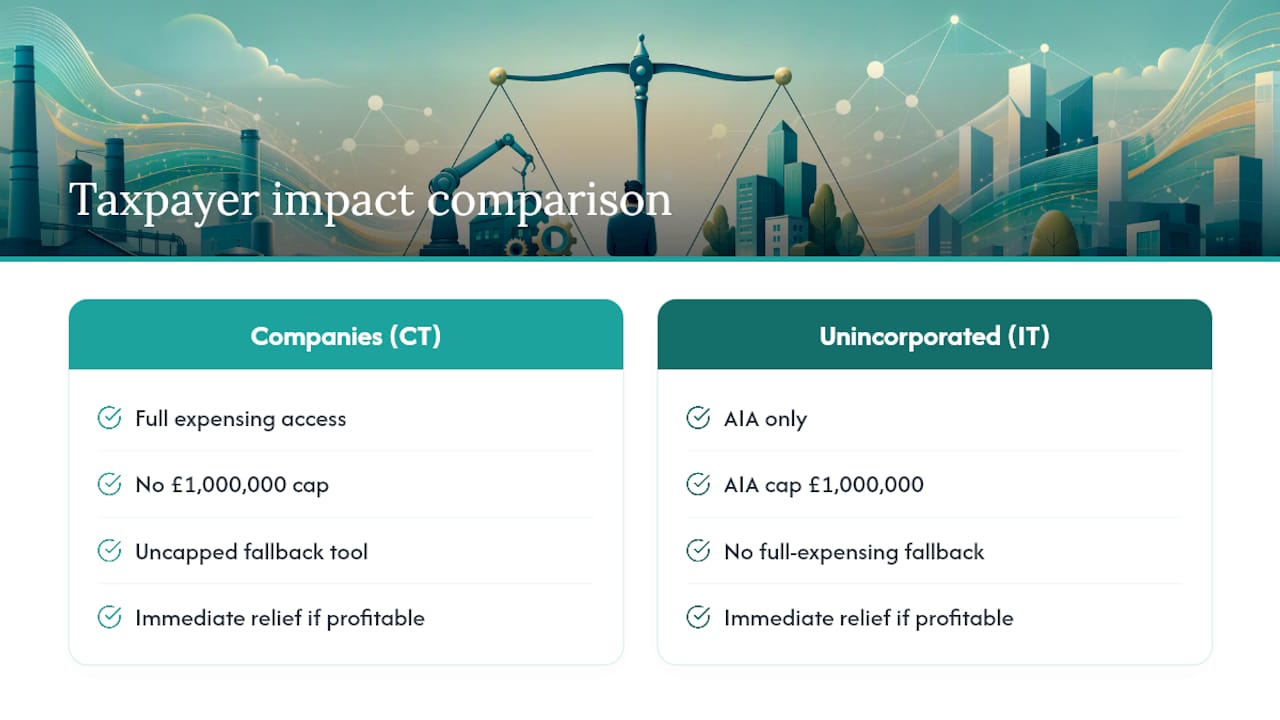
Impact on corporation tax vs income tax payers
The gap between the two allowances is sharpest at the point where business structure meets tax regime. Companies pay Corporation Tax, and only they can access full expensing, meaning an incorporated business investing heavily in new main-pool equipment has a second, uncapped tool that sole traders and partnerships simply don’t get.
Income tax payers, sole traders and partners, are restricted to AIA. For most of them this isn’t a real limitation, since spend rarely exceeds £1,000,000 in a single year. Where it does become relevant is in fast-growing partnerships scaling up fleet or premises investment; without incorporation, there’s no full expensing fallback once AIA is used up, and remaining spend falls to writing down allowances at much slower annual rates.
For companies, the interaction runs the other way. A profitable company with taxable profits well above its capital spend gets immediate value from either allowance, since the deduction offsets tax due now rather than in future years. A company with thin or negative profits gets less immediate benefit from either, because there’s less tax to shelter, though losses created can often be carried forward.
The practical takeaway: incorporation itself is a lever worth reviewing if your income tax structure is regularly capping out AIA and forcing spend onto slower relief. That’s a decision for your accountant, not something to change purely for allowance purposes, but it’s worth putting on the agenda.
Planning capital spend across multiple years
Capital allowances reward businesses that plan capex in multi-year cycles rather than reacting purchase by purchase. Because AIA’s £1,000,000 cap resets every accounting period, spreading planned purchases across two periods, where genuinely possible, can capture two full caps instead of exhausting one and falling back to writing down allowances for the rest.
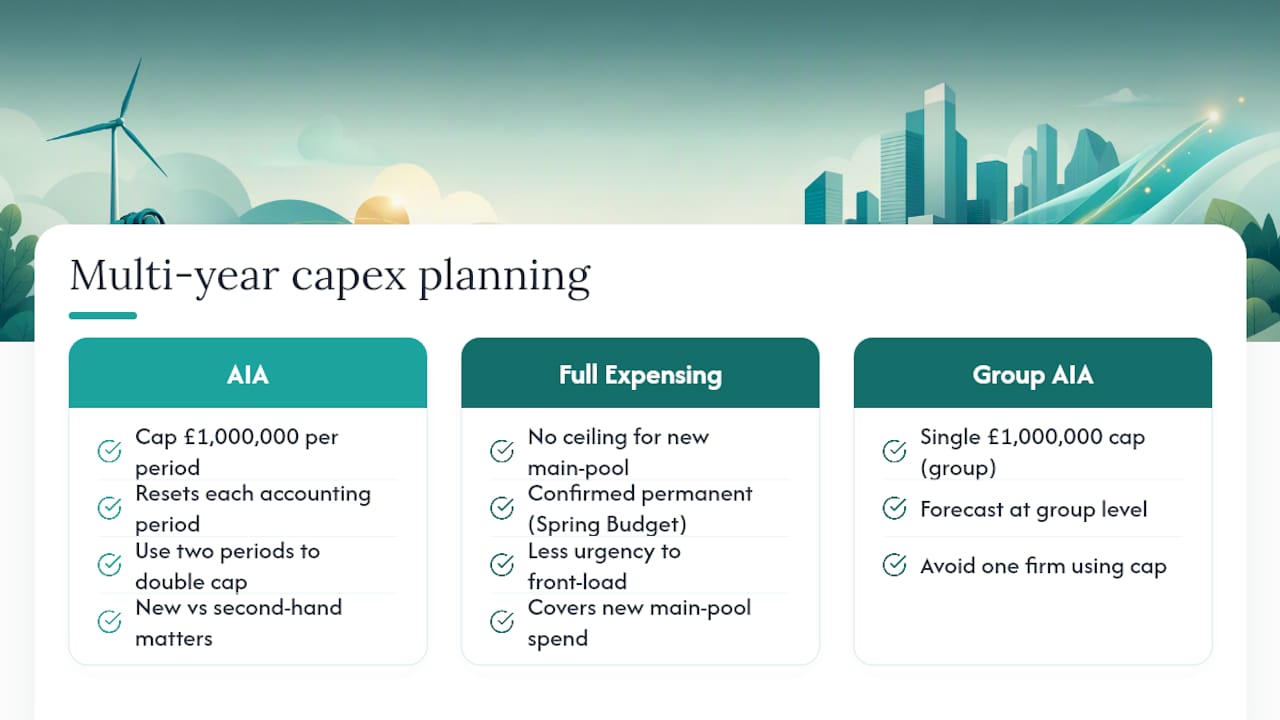
Full expensing removes that pressure for new main-pool spend since it has no ceiling, but its permanence, confirmed at the Spring Budget, means there’s less urgency to front-load large purchases into a single year purely to catch the relief before it disappears.
For businesses running fleets, depots or multi-site expansion, the forecasting question becomes: which years will special-rate and second-hand spend cluster, and which years will new main-pool spend dominate? Fleet operators expanding depot infrastructure, for instance, often face exactly this mix of new equipment alongside civil works and second-hand vehicle stock, a pattern explored in broader terms in Jagelo Haulage’s analysis of depot investment. Mapping that mix against your AIA and FE eligibility a year or two ahead avoids the scramble of trying to reclassify spend after the accounting period has closed.
Groups face an added layer: the shared AIA cap across connected companies means multi-entity forecasting has to happen at group level, not per subsidiary, or one company will unintentionally use up allowance that another needed more.
Recent changes and where the rules are heading
Full expensing was introduced as a temporary measure before being made permanent at the Spring Budget, removing what had been the single biggest planning headache: an expiry date that forced rushed year-end purchasing decisions. AIA’s £1,000,000 cap is likewise now permanent, having previously moved between lower temporary levels and the current figure over several years.
That stability is the real story for 2026. Businesses no longer need to model a cliff-edge reduction in relief, which means multi-year capex planning can be built on the current rules with reasonable confidence rather than hedged against a looming sunset clause. The current guide to capital allowances confirms both reliefs sit on permanent footing.
Any future Budget could adjust rates or caps, but the fundamental architecture, cap versus no cap, all business types versus companies only, looks settled for the medium term.
Comparative benefits across business scenarios
The relief lands exactly when the tax saving matters most.
A lower-profit or loss-making business faces a different calculation. Excess relief typically converts into a loss that can be carried forward, useful, but less immediately valuable than relief that offsets tax due this year.
A sole trader or partnership scaling a small operation, perhaps a growing fleet or a new depot, sits in the AIA-only category regardless of profit level, since incorporation is the gateway to full expensing. For these businesses, the practical benefit lever isn’t which allowance to choose, it’s timing purchases within accounting periods to maximise use of the annual £1,000,000 cap before it resets.
Across all these scenarios, the constant is that relief only has value where there’s tax to offset. Modelling profit forecasts alongside capex plans, rather than treating the allowance decision in isolation, is what actually protects the value of either relief.
Why the stacking conversation gets oversimplified
Most guidance on full expensing vs AIA treats the choice as binary, pick one, but the real skill is sequencing both correctly within the same accounting period. That’s the gap in conventional advice: articles explain the eligibility rules well enough, but few walk through the order of operations that actually maximises relief when a business has a mixed asset purchase in one year.
The overlooked risk isn’t picking the wrong allowance. It’s claiming full expensing on an asset you’ll sell within a few years without modelling the balancing charge that follows. That clawback can meaningfully erode the year-one advantage, and it’s the detail accountants raise most often when reviewing FE claims after the fact.
If there’s one thing worth prioritising above everything else in this comparison, it’s sequencing: AIA first on special-rate and used assets, full expensing second on the new main-pool remainder, and a disposal check before either claim goes in. Businesses that treat this as a single-year decision, rather than a multi-year cashflow plan, consistently leave relief on the table or get caught by a clawback they hadn’t modelled.
— Swift Charging
Getting your EV charging investment tax-ready
Choosing between AIA and full expensing only pays off if your installation timing actually lines up with the accounting period you’re planning around, and that’s where most businesses lose value without realising it. Swift Charging works through feasibility, system design, installation and commissioning, then helps you time that commissioning date to match the tax year you’re claiming against.

Our team also handles grant applications to reduce your net qualifying spend before any allowance claim goes in, and provides the invoicing and documentation your accountant needs to support a clean full expensing or AIA claim. If you’re planning a workplace or fleet charging installation and want the timing and paperwork sorted from the outset, get in touch about commercial EV charging installation in Portsmouth or speak to us about a feasibility review for your site.
Sources
FAQ
Is it better to claim AIA or full expensing?
Full expensing becomes the stronger option once new main-pool spend exceeds that cap and your business is incorporated.
What is AIA in the UK?
The Annual Investment Allowance lets UK businesses claim 100% tax relief on qualifying plant and machinery up to £1,000,000 per accounting period, deducted from profits before tax.
What is AIA in UK accounting?
In accounting terms, AIA is a capital allowance that allows the full cost of qualifying equipment to be written off against taxable profits in the year of purchase, rather than depreciated gradually over several years.
What is the Annual Investment Allowance in the UK?
It’s a permanent relief, currently set at £1,000,000 per accounting period, available to sole traders, partnerships and companies alike on both new and second-hand qualifying assets.
Recommended