Avoid costly DNO upgrades: Business park EV charging with 4–8 AC bays

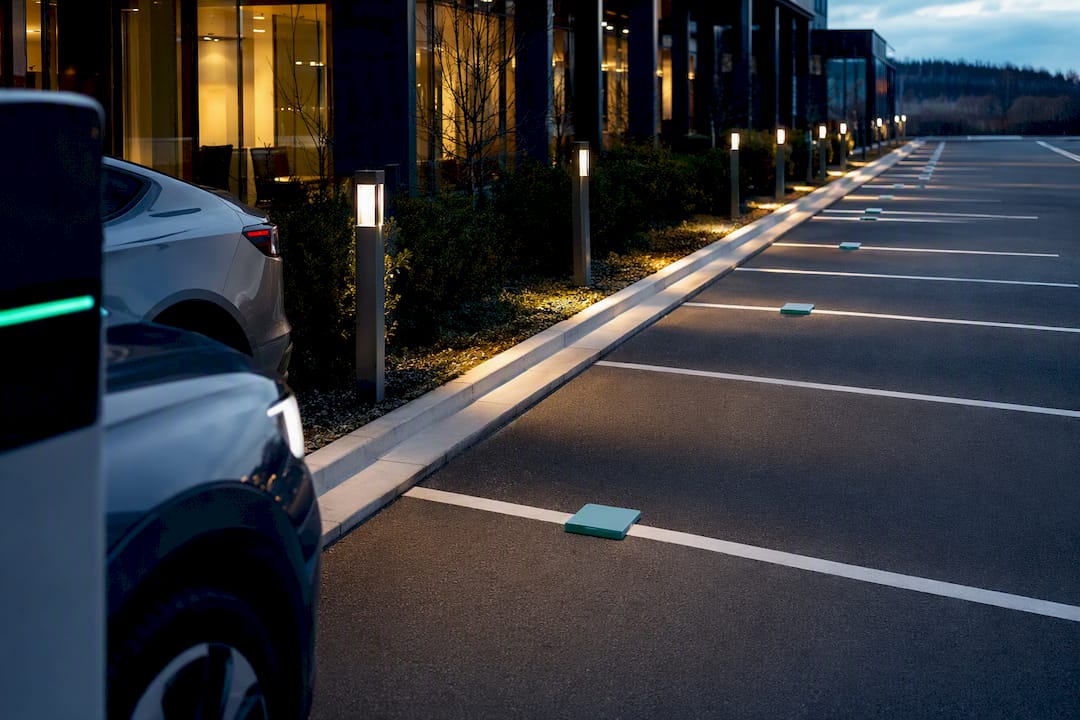
The right approach for most business parks is a modular AC network with load management from day one, DC or ultra-rapid chargers added only where usage data justifies them, and phased expansion built into the design. Approved Document S and the Public Charge Point Regulations 2023 set the technical and legal baseline. Feasibility surveys and installations along these lines are available for commercial sites across the UK.
TL;DR:
Most business parks should start with 4 to 8 AC chargers for staff and add one or two DC fast chargers where visitor demand or fleet vehicles require quick top-ups.
Ultra-rapid chargers are strategic investments only justified by high demand, as they risk underuse and overpowered grid connections if installed unnecessarily.
Grid capacity is a common project limiter, but dynamic load management and energy storage can often avoid costly reinforcement work through smarter demand balancing.
Proper signage, lighting, and reserved bays are essential to ensure high user uptake and prevent misuse, which is critical for revenue and operational efficiency.
Installation timelines range from a few weeks for small sites to several months for larger, DNO-reinforced projects, emphasizing the importance of early planning.
Table of Contents
How much business park EV charging capacity do you actually need?
Will your grid connection cope with a business park charging rollout?
What will business park EV charging cost, and where’s the funding?
How long does an EV charger installation take at a business park?
Keeping chargers running: maintenance and the KPIs that matter
User experience considerations and signage within the business park
Legal, safety and compliance requirements specific to business park installations
Author perspective: why a managed, modular approach cuts long-term risk
How Swiftcharging helps: from feasibility survey to managed rollout
How much business park EV charging capacity do you actually need?
Sizing a site correctly starts with understanding who is charging, not just how many spaces you have. Employees typically park for six to nine hours, which makes them well suited to slower AC charging that tops up gradually across the working day. Visitors behave very differently: turnover is faster, dwell times are shorter, and expectations around speed are higher.
Fleet vehicles bring a third pattern entirely, often needing a full charge within a defined overnight or midday window to hit the next shift or delivery run.
A sensible starting configuration for most parks is:
4 to 8 AC bays (7 to 22 kW) for staff parking, scaled against total headcount and expected EV uptake.
1 to 2 DC bays (50 kW+) where visitor turnover is high or fleet vehicles need a rapid top-up mid-shift.
Conduit and spare capacity left in the ground for future bays, so expansion doesn’t mean digging up the car park twice.
If fleet duty cycles are tight, or visitor parking rarely exceeds an hour, that’s the signal to weight the mix towards DC rather than AC.
Choosing between AC, DC and ultra-rapid chargers
Charger speed should follow behaviour, not ambition. Business parks that install ultra-rapid hardware without the demand to match it end up with expensive, underused assets and a bigger grid connection than the site needs.
AC chargers (7 to 22 kW) suit long-stay parking. A 22 kW unit can add roughly 100 miles of range across a typical eight-hour shift, which covers the vast majority of commuting patterns.
DC fast chargers (50 kW and above) deliver a meaningful top-up in 30 to 60 minutes, making them the right fit for visitor bays, courier fleets and any vehicle that can’t sit still all day.
Ultra-rapid HPC (150 to 350 kW+) charges most EVs to near-full in under 20 minutes. IONITY’s installation of six 350 kW units at Shawfair Business Park shows how this tier works well at a destination hub serving both local staff and long-distance travellers, but it’s a strategic investment, not a default choice.
Cable-sharing and bay layout matter too. Dual-socket AC units with shared cabling cut installation cost per bay, but only work where two vehicles genuinely charge at once rather than fighting over the same lead.
Will your grid connection cope with a business park charging rollout?
Grid capacity trips up more business park projects than almost anything else. A site survey should flag early whether the existing fuse and supply can handle the planned bay count, or whether a DNO reinforcement application is coming. Reinforcement work can add months to a timeline and tens of thousands of pounds to a budget, so it needs identifying at the feasibility stage, not after chargers are ordered.
Smart load management reduces the need for that upgrade in many cases. Dynamic phase balancing spreads demand across three phases automatically, while scheduled charging shifts fleet or overnight loads away from daytime peaks. Both techniques let a site run more chargers on the same connection than a naive install would allow, which is exactly the kind of infrastructure design Approved Document S expects installers to plan around.
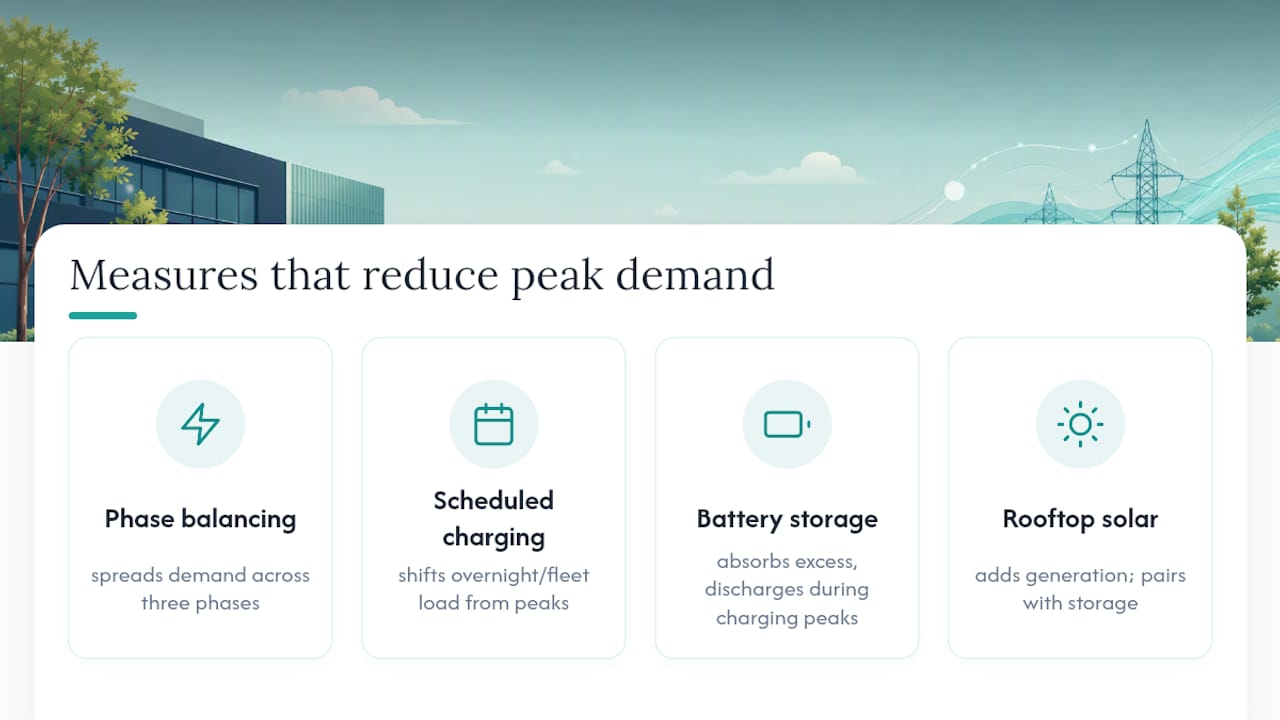
On-site battery storage and rooftop solar add another layer of resilience. Storage absorbs excess generation and discharges it during charging peaks, smoothing demand spikes that would otherwise trigger a costly grid application. Industry reporting on business park hubs increasingly shows chargers paired with storage and renewables rather than installed in isolation.
Pro Tip: Ask any prospective installer to model your peak demand under full charger utilisation before you sign off on a connection size. Undersizing now is far cheaper to fix on paper than on site.
Getting paid: access control and revenue models that work
A business park charger that nobody can pay for, or that gets blocked by a parked car for six hours, isn’t generating revenue or goodwill. Access and tariff design need as much thought as the hardware itself.
Practical access methods include:
RFID cards for regular staff and fleet drivers who need frictionless daily access.
App authorisation for visitors and occasional users, linked to contactless payment.
ANPR to tie bay occupancy to vehicle registration for enforcement and reporting.
Tariffs can be structured around straightforward energy recovery, time-banded pricing that discourages daytime loitering, or idle fees once a vehicle is fully charged but still occupying the bay. Backend software is what makes any of this workable: management platforms that support flexible tariffs, loitering enforcement and automated reporting let hosts recover costs without staffing every site. For fleets, that same reporting layer allows cost allocation back to individual vehicles or departments, which finance teams tend to appreciate more than a spreadsheet of manual readings. Idle fee policy is worth setting deliberately rather than as an afterthought, and background on how idle fees typically work is useful before deciding your own rules.
What will business park EV charging cost, and where’s the funding?
Budgeting for a business park rollout means accounting for more than the chargers themselves. Civil works, cabling runs, any distribution board upgrades, and ongoing software licensing all sit alongside hardware cost, and civils in particular can vary enormously depending on how far chargers sit from the existing supply.
Cost items to plan for:
Civils and groundworks, often the single largest variable cost on a multi-bay site.
Cabling and distribution upgrades, especially where existing infrastructure predates EV demand.
Charger hardware and installation, which scales with charger type and bay count.
Software and management licensing, covering access control, tariffs and reporting.
UK government guidance, including the Public Charge Point Regulations 2023, sets the compliance backdrop, and grant schemes have historically reduced upfront costs for eligible workplace and public installations. Beyond grants, commercial models such as charging as a service, revenue-share hosting, and staged capital rollouts let a business park spread cost over time rather than funding everything at once.
How long does an EV charger installation take at a business park?
A realistic timeline starts well before any digging happens. Skipping the early steps is the most common reason projects overrun.
Feasibility and site survey — capturing occupancy patterns, existing fuse size, cable routes and available grid capacity, typically taking one to two weeks.
Design and quotation — translating survey data into a bay layout, charger specification and cost estimate.
Civils and electrical works — trenching, cabling and any distribution board upgrades, the phase most affected by site complexity.
Commissioning and user testing — verifying every charger authenticates, bills and reports correctly before handover.
Small single-bay jobs can complete in a few weeks. Medium deployments of multiple bays typically take several weeks to a few months. Large fleet or hub-scale projects requiring DNO reinforcement may extend to several months.
Keeping chargers running: maintenance and the KPIs that matter
Chargers that sit broken for a fortnight cost you goodwill as well as revenue, so maintenance terms deserve as much scrutiny as installation quotes. Look for cover that includes remote monitoring, preventative maintenance visits, and a defined service level agreement for fault response, ideally with a same-day or next-day target for anything customer-facing.
The metrics worth tracking monthly are:
Uptime, the clearest single measure of whether your maintenance contract is actually working.
Utilisation and energy dispensed, which tell you whether current bay counts match real demand.
Average session length and idle occupancy, flagging where tariff or bay-turnover rules need adjusting.
Reporting on these figures does double duty. It supports accurate billing and fleet cost recovery, and it builds the evidence base you need when deciding whether to renew a maintenance contract or expand the network at renewal time.
User experience considerations and signage within the business park
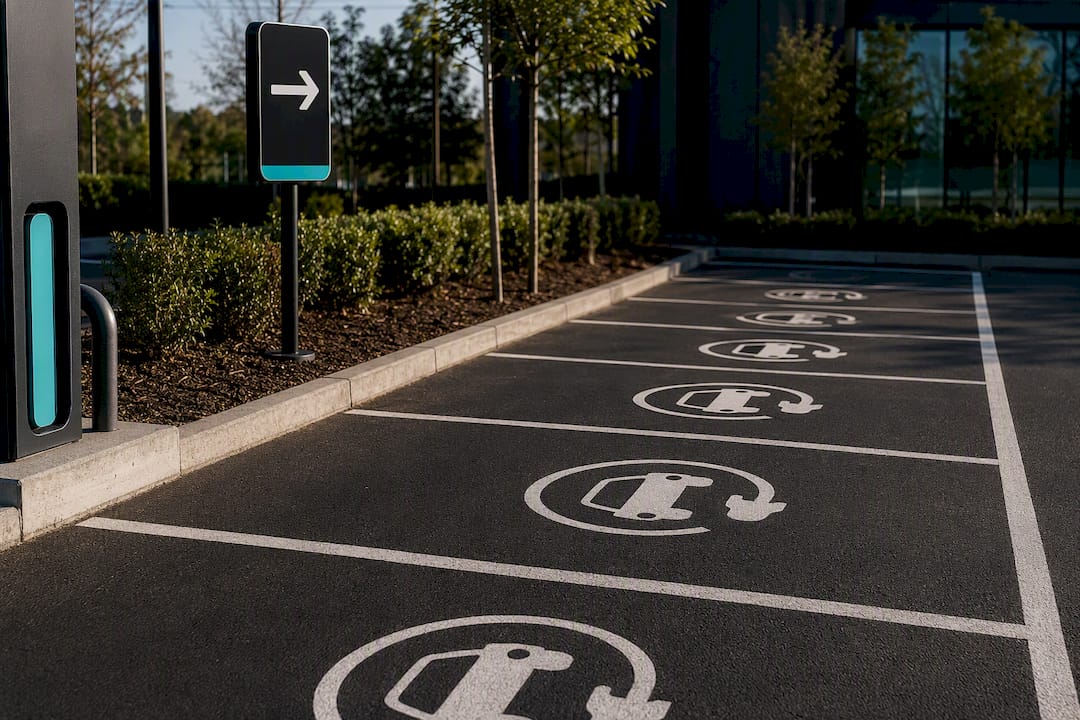
Chargers that are hard to find or confusing to use get avoided, even by drivers who genuinely need them. Clear directional signage from the site entrance, not just at the bay itself, cuts down on cars circling car parks looking for a charger that’s been there for months.
Bay markings need to distinguish charging spaces from standard parking unmistakably, ideally with floor paint and upright signage rather than one or the other. Where you’re running a mix of AC and DC, label speed and connector type at the bay so drivers aren’t guessing whether their cable will reach or their vehicle will accept the plug.
Instructions for starting a session should be visible without a phone signal, since basement car parks and some business park layouts have patchy coverage. A simple QR code backed up with a printed RFID or contactless option covers most scenarios without forcing every visitor to download an app before they can charge.
Lighting matters more than most site managers expect. EV bays used outside daylight hours, particularly by shift workers or fleet drivers on early starts, need enough illumination to read a screen and plug in safely. It’s a small cost that avoids a steady trickle of complaints and reduces the chance of a slip or trip claim.
Finally, think about who gets priority. Reserved bays for fleet vehicles or contracted staff, clearly marked and time-banded, prevent casual visitors from occupying charging space meant for a delivery van that needs to leave on schedule. Getting this wrong doesn’t just frustrate drivers, it undermines the whole business case for the installation.
Legal, safety and compliance requirements specific to business park installations
Compliance for business park charging sits across two main sources: the Public Charge Point Regulations 2023, which govern public-facing charge points, and Approved Document S, which covers the building infrastructure side of any new installation.
If any bays on your site are accessible to the public rather than restricted to staff or fleet vehicles, the 2023 regulations apply directly. Getting this wrong isn’t just a compliance risk, it’s a reputational one if visitors hit a broken charger with no way to report it.
Approved Document S governs the technical side: cable routing, electrical load calculations, and how charging infrastructure integrates with a building’s existing supply. Any new-build or major-renovation commercial property in England is now required to provide EV charging infrastructure under building regulations, which makes early engagement with this guidance essential rather than optional for larger developments.
Beyond the EV-specific rules, standard site safety obligations still apply. That means proper isolation and earthing on every installation, weatherproofing appropriate to an outdoor car park environment, and clear emergency shutdown procedures that site staff actually know how to use. Insurance providers increasingly ask for evidence of compliant installation and maintenance records before covering EV infrastructure, so keeping documentation from your installer isn’t just good practice, it’s often a contractual necessity.
Author perspective: why a managed, modular approach cuts long-term risk
Business parks that treat charging as a one-off capex project tend to overspend early and underuse half of what they’ve built. A phased rollout, backed by a managed service, lets you match hardware to real demand instead of guessing at year one. Pairing that with storage and renewables changes the economics too, softening peak charges and reducing exposure to grid reinforcement costs later. The parks getting this right are the ones treating energy infrastructure as an ongoing relationship with a supplier, not a single purchase order.
— Swift Charging
How Swiftcharging helps: from feasibility survey to managed rollout
If you’re weighing up whether to handle this in house or bring in a specialist, the practical answer is usually specialist support, because grid applications, tariff design and compliance all carry real cost if they’re got wrong the first time. The whole process can include feasibility survey, system design, installation, commissioning, and ongoing managed software, with support for identifying available grants.

Services available include:
Site survey and feasibility assessment for AC, DC and mixed deployments
Design and installation for workplace, fleet and public-facing chargers
Managed software covering tariffs, access control and reporting
Grant identification and application support where a site qualifies
For staff and fleet parking, the workplace EV charging service page covers what a feasibility survey involves. Business parks weighing up a public or revenue-share model can review hosting an EV charging site, and fleet operators with tighter duty cycles can look at fleet EV charging solutions. If your fleet management needs to extend beyond charging itself, practical fleet management guidance is a useful companion resource. The next step for most business parks is a feasibility survey, which gives you a clear cost and capacity picture before committing to any hardware.
Sources
Regulatory detail in this article draws on the Public Charge Point Regulations 2023 guidance and Approved Document S. The full gov.uk collection on EV charging infrastructure covers further technical updates as they’re published.
FAQ
Do you have to pay for parking if you’re charging an EV?
It depends on the site’s own policy rather than any national rule. Many business parks charge separately for parking and energy, while others bundle the cost into a single session fee, so check the specific site’s tariff before assuming either way.
Can I charge my electric car anywhere for free?
Some workplaces and retail sites still offer free charging as a perk or to drive footfall, but it’s increasingly rare as energy costs rise. Most business park chargers now apply a per-kWh rate, sometimes with an added idle fee once charging completes, managed through flexible tariff software.
Do I need to pay for parking specifically to use an EV charger?
Not always. If a bay is reserved solely for charging, payment usually covers the energy and the session, not separate parking. Where EV bays are just conventional spaces with a charger attached, standard site parking charges can still apply on top.
Are supermarket EV chargers still free?
Free supermarket charging has largely disappeared as networks shift to paid, tariffed models to cover running costs and fund network expansion. Always check current pricing on-site or in the relevant charging app before assuming a supermarket charger is free.
What’s the typical cost to install EV chargers across a business park?
Costs vary widely with bay count, cable runs and whether a grid upgrade is needed, so there’s no single flat figure. Swiftcharging provides bespoke quotes following a feasibility survey, with current details available on its workplace EV charging page.
Recommended