CDM for EV Charging: What UK Site Owners Must Do

If your business is installing EV chargers, you are almost certainly a client under the Construction (Design and Management) Regulations 2015, known as CDM. That means legal duties for health and safety sit with you, even when a contractor does all the work. The practical answer is to commission the project with a single team that designs, installs and commissions the chargers and documents each stage. We do that for UK businesses, from site assessment through to long-term management, so the CDM paperwork is built into the project rather than bolted on at the end.
TL;DR
CDM 2015 applies to EV charger installations of any size, because installing fixed electrical services counts as construction work.
As the client, you must make suitable arrangements to manage the project, give pre-construction information to designers and contractors, and make sure a construction phase plan exists before work starts.
With more than one contractor you must appoint a principal designer and a principal contractor in writing.
Notify HSE with an F10 only on larger projects: more than 30 working days with over 20 workers at once, or over 500 person days.
Keep a health and safety file afterwards, with charger locations and maintenance test records.
Table of Contents
What CDM means for an EV charging project
CDM stands for the Construction (Design and Management) Regulations 2015. They set out duties for clients, designers and contractors to manage health, safety and welfare on construction projects. The HEA’s guidance on EV charging client duties confirms they cover EV charging deployment.
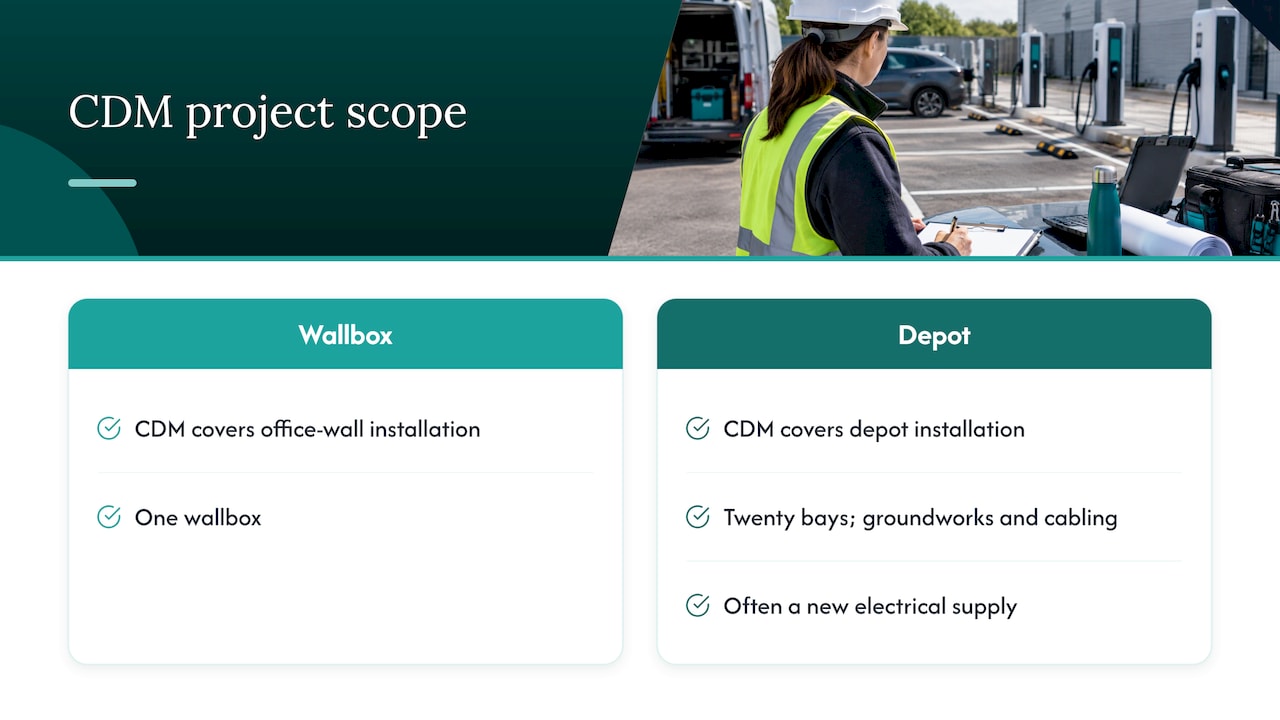
The key point is that CDM is triggered by the type of work, not its size, value or duration. Construction work includes the installation, commissioning, maintenance, repair or removal of fixed electrical services, and IOSH magazine notes this category often catches projects out. A single wallbox on a office wall is within scope. So is a depot with twenty bays, which adds groundworks, cabling and often a new electrical supply.
Maintenance is included too. Replacing a faulty charger or carrying out repairs is construction work under the definition, so CDM thinking applies throughout the life of your chargers, not only at first install.
Are you a client? Almost certainly
HSE defines a commercial client as any individual or organisation carrying out a construction project as part of a business. Whatever the project size, the client has contractual control: you appoint the designers and contractors and decide the money, time and resources.
That covers the readers we work with most: employers adding workplace charging, landlords and managing agents equipping car parks, fleet operators building depots, hotels, schools and business parks.
Your duties as the client
Under Regulation 4 of CDM 2015 you must:
Make suitable arrangements for managing the project, including enough time and other resources.
Make sure work can be carried out without risks to health or safety, so far as reasonably practicable.
Make sure welfare facilities are provided.
Maintain and review those arrangements throughout the project.
HSE adds that you must make sure any principal designer and principal contractor you appoint carry out their duties. You must also provide pre-construction information as soon as practicable to every designer and contractor appointed or being considered. In practice that means what you know about the site: existing electrical supply, underground services, parking layout, public access and any restrictions.
The HEA’s EV-specific guidance adds several points worth building into your plan:
Appoint competent duty holders.
Engage an installer and, where needed, the distribution network operator (DNO) early on electrical capacity, because upgrade lead times can be long.
Secure planning permissions and any traffic management permits.
Keep a health and safety file with charger locations and maintenance test records after completion.
A DNO is the company that runs the local electricity network and decides whether your site can take the extra load.
Principal designer and principal contractor
When a project involves more than one contractor, or it is reasonably foreseeable that more than one will work on it, you must appoint in writing a principal designer and a principal contractor, as soon as practicable and before the construction phase begins.
EV projects reach two contractors quickly. CCM’s client guide gives the example of a groundworks firm plus a specialist charger installer. If you do not make the appointments, the duties fall to you.
Role | Phase | What they do |
Principal designer | Pre-construction | Plans, manages, monitors and coordinates health and safety, identifies and controls foreseeable risks, makes sure designers carry out their duties, and shares information with other duty holders |
Principal contractor | Construction | Plans, manages and monitors the work, prepares the construction phase plan, coordinates contractors, provides inductions, prevents unauthorised access and provides welfare facilities |
The roles are set out in HSE’s summary of CDM duties. One organisation can hold more than one role if it has the skills, knowledge, experience and organisational capability. That is the strongest argument for a single point of delivery: one accountable team across design and installation is simpler to coordinate than several firms handing information to each other.
HSE’s own review has noted that uncertainty about principal designer competence has not driven up standards, so appoint on demonstrable experience of EV and electrical design, not on a cheap quote.
The construction phase plan
Every project needs a construction phase plan before the construction phase begins. HSE’s planning guidance says it sets out the health and safety arrangements, site rules and measures for higher-risk work, using the pre-construction information. On multi-contractor projects the principal contractor writes it. With a single contractor, that contractor does.
For a single-contractor project, such as a small workplace install, the plan can be short and proportionate, but it must exist and be in place before anyone starts. Typical content for an EV site:
Site access, segregation of pedestrians and vehicles, and car park closures
Isolation of the electrical supply and safe working near live equipment
Excavation and underground services checks
Welfare arrangements and emergency procedures
Where chargers with lithium-ion batteries are stored or sited. The Joint Code of Practice on fire protection of construction sites says charging stations on construction sites should sit in the open at least 10 m from buildings under construction and combustible storage, with a competent-person risk assessment where that cannot be achieved.
Our EV charging risk assessment guide covers the site hazards that feed into the plan.
When you must notify HSE with an F10
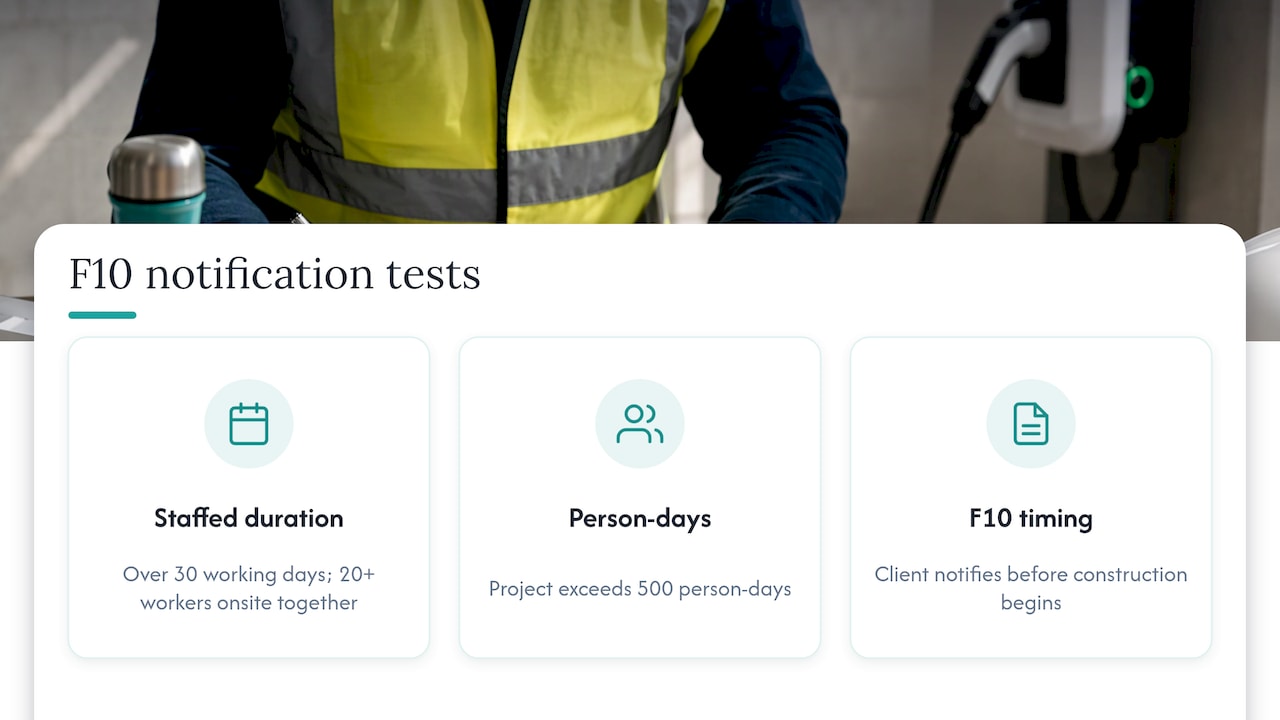
Notification is only for larger projects. A project is notifiable if the work lasts longer than 30 working days with more than 20 workers on site at the same time at any point, or exceeds 500 person days. The client notifies as soon as practicable before the construction phase begins, using HSE’s online F10 form; paper, email and post are no longer accepted.
Most single-site workplace installs fall well below this. A large multi-bay depot or a rollout across several car parks is where you should check the figures. Notifiable or not, the other duties apply in full.
Handover: the health and safety file
On projects with more than one contractor, a health and safety file is prepared and handed to you at the end. HSE’s L153 guidance describes its purpose: giving you the information anyone doing later construction work on the building needs to do it safely.
For EV charging, the HEA says the file should include:
Charger locations
Ongoing maintenance requirements and test records
End-of-contract or end-of-life requirements
Keep it somewhere your facilities team and any future maintenance contractor can find it. It is also what makes later repair, replacement or removal straightforward. See our guides to the EV charging maintenance checklist and EV charger decommissioning.
Choosing competent contractors
CDM requires you to appoint people with the skills, knowledge and experience for the job. The HEA recommends, for work on or near the highway, contractors registered with the Highway Electrical Registration Scheme (HERS), and designers familiar with the IET Code of Practice for EV Charging Equipment Installation and BS 7671, the UK wiring regulations. Our design standards guide and commercial requirements guide set out what a compliant commercial design looks like.
Has CDM changed?
No. HSE’s second post-implementation review of CDM 2015 recommends keeping the regulations without legislative change, and calls for stronger guidance on client obligations and principal designer competence. The law you work to is the same one that has applied since 2015. In England, separate Building Regulations duties introduced under the Building Safety Act 2022 sit alongside it, as RIBA’s practice note explains.
Where a single delivery partner helps
Each CDM step has a handover risk: survey to design, design to installation, installation to maintenance. Swift Charging designs, supplies, installs and manages commercial EV charging, and works with you from feasibility and site assessment through system design, installation and commissioning to long-term management. With one team across those stages, the information your pre-construction pack needs, the design decisions and the file you keep at handover come from the same place.
We also handle load management, charging software and maintenance, and help eligible businesses apply for OZEV grants, so the project is planned as a whole.
Start with a Commercial EV Feasibility Review, or see our workplace EV charging and fleet EV charging solutions.

Our view
CDM is not an obstacle to EV charging. It is a structure for doing the job properly, and the businesses that get the most from it treat it as part of project planning from day one. Our aim is to make commercial EV charging straightforward, reliable and commercially viable. That starts with a proper site assessment, a design that accounts for power capacity and load management, and a clear record of what was installed and where. We design, install, commission and manage chargers, and we support the maintenance that follows, so the file you keep at handover stays useful for the life of the installation. Swift Charging
FAQ
Does CDM apply to a single EV charger?
Yes. CDM is triggered by the activity, not project size. Installing fixed electrical services is construction work, so even one charger brings client duties. A short, proportionate construction phase plan is still needed before work begins.
Do I need a principal designer for an EV charger installation?
You need one when more than one contractor is, or may be, involved. If you do not appoint one, the duties pass to you as client. Many EV projects have a groundworks contractor and an electrical installer, so it is common.
When do I have to send an F10 to HSE?
When the work will last longer than 30 working days with more than 20 workers on site at once, or exceed 500 person days. Notification is made online before the construction phase starts.
What goes in the health and safety file for EV chargers?
Charger locations, maintenance requirements and test records, and end-of-life requirements, as the HEA advises. It should be kept for anyone doing later work on the site.
Sources
Recommended