Power Quality and EV Charging: A Guide for UK Sites

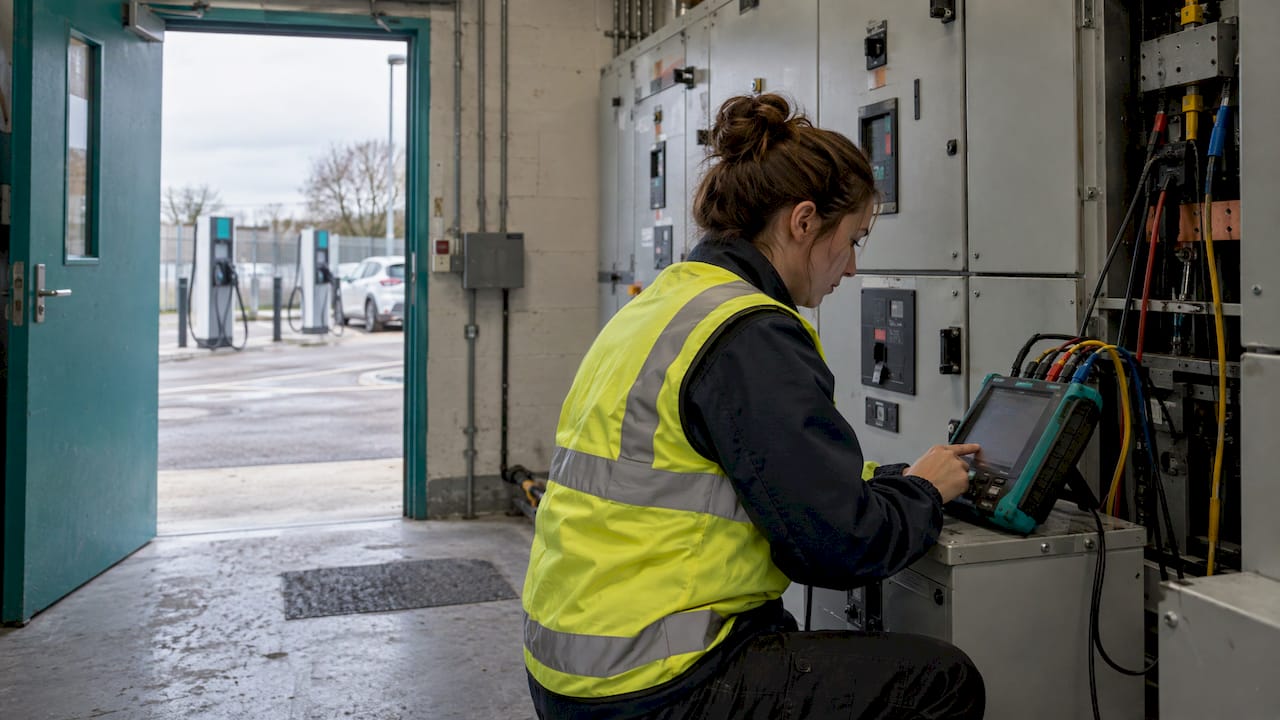
Power quality is how closely your site’s electricity follows a clean, steady supply: stable voltage, a smooth waveform and no sudden swings. Chargers are electronic loads, so they shape the waveform they draw, and on a commercial site that is managed through three things: a proper survey before installation, a design that spreads and shapes the load, and ongoing management afterwards. Get these right and your chargers, your other equipment and your network operator all stay comfortable. We design, supply, install and manage commercial EV charging, from feasibility and site assessment through to long-term management, so this is the way we approach every site.
TL;DR
EV chargers can add harmonics, flicker and voltage unbalance to a site supply. The effects are manageable when they are planned for at design stage.
In Great Britain the network operator (DNO) assesses most EV charging equipment as “potentially disturbing” and applies ENA engineering recommendation G5. The customer has to show compliance.
Measure your background supply before installation, then confirm afterwards, using a Class A instrument over at least a working week.
Load management, phase balancing and sensible charger selection are the everyday tools for keeping distortion low.
Fleet depots with many identical vehicles need the most careful assessment, because they do not get the natural mixing seen on public sites.
Table of Contents
What power quality means on a charging site
Mains electricity should be a smooth sine wave at 50 Hz and around 230 V per phase. Power quality is the measure of how far real supply departs from that. The parts that matter for charging are:
Harmonics: extra currents at multiples of 50 Hz (the 3rd, 5th, 7th and so on) created by electronic power converters. Chargers convert AC to DC, so they are a classic source.
Voltage distortion: what harmonic currents do to the voltage waveform as they pass through cables and transformers. It is usually expressed as total harmonic distortion (THD).
Flicker and fluctuation: rapid changes in load that make voltage wobble and lights blink.
Unbalance: uneven loading across the three phases, which is most likely where many single-phase chargers are connected.
Researchers at the Power Networks Demonstration Centre argue that as more devices connect through power electronics, power quality could become the limiting factor for new connections, even before cable or transformer capacity runs out. For a business, that means the quality of the connection can decide how many chargers you can install, not just the size of the supply.
What EV chargers can do to the supply
A review from Delft University of Technology sorts the effects by frequency. Flicker below 35 Hz can make lighting visibly blink, harmonics and interharmonics below 2 kHz add losses in cables and transformers and can upset protection devices, and supraharmonics between 2 and 150 kHz can cause residual current devices to malfunction.
The same pattern shows up in wider research: harmonic distortion from EV charging can lead to equipment failure and extra losses. On a site, that translates into practical symptoms:
Transformers and cables running warmer than their load would suggest.
Nuisance trips on RCDs or breakers.
Lighting flicker in offices, hotels or classrooms sharing the supply.
Sensitive equipment, such as controls, IT or production machinery, behaving unpredictably.
The type of charger matters. A 2023 overview in Energies notes that single-phase diode-bridge chargers have dominant 3rd and 5th harmonic currents, while three-phase diode chargers are dominated by the 5th and 7th. It also finds that unbalance from single-phase charging is greater on weaker grids, which is why the connection point and cable run matter as much as the charger.
Modern chargers can meet the limits
The picture for well-designed equipment is encouraging. PNDC tested a 1 MW charger and found voltage THD consistently below 8% in every test condition, with current THD of 3.01% at full 1 MW input, inside the IEEE 519-2022 limits. Good hardware, correctly specified, is the starting point.
Why diversity helps, and why depots differ
Harmonics from different vehicles are not perfectly in phase, so when several charge together they partly cancel. A Strathclyde study using one million simulated scenarios found that average THD is not directly proportional to the number of EVs because of this cancellation. It also found that capping charge at 80% state of charge reduces the chance of exceeding harmonic limits.
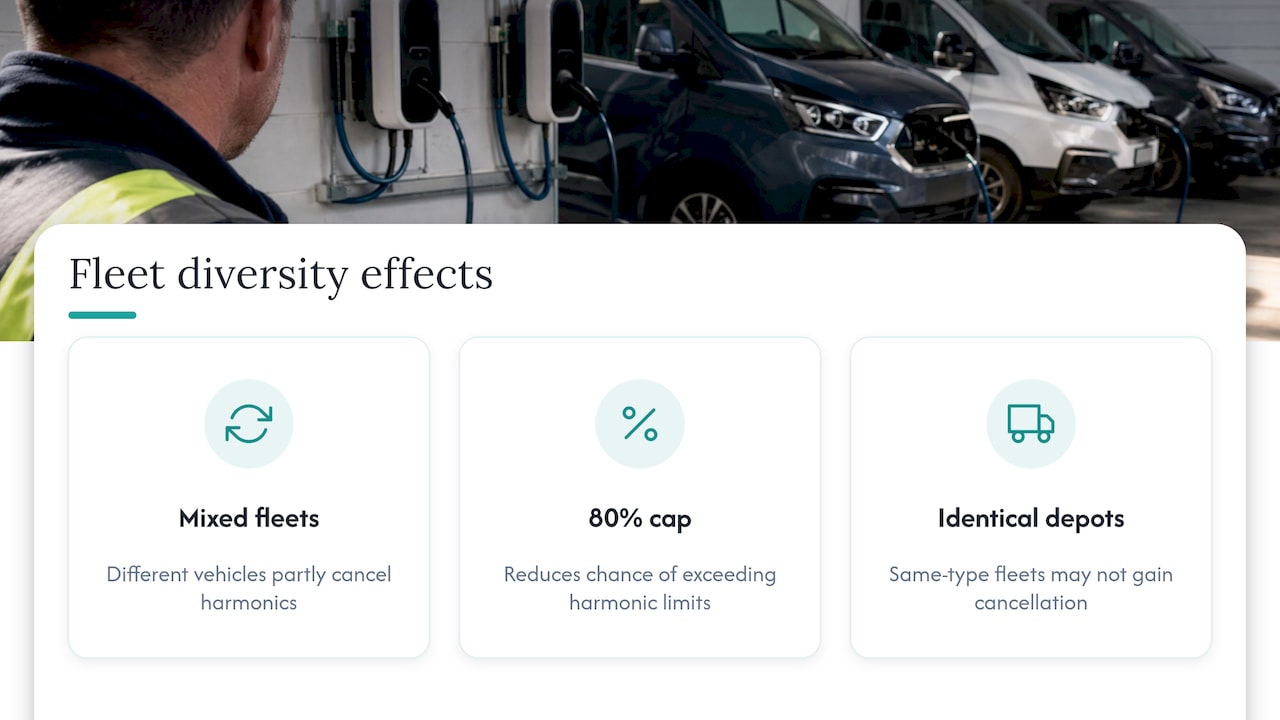
PNDC adds a warning for fleets: large depot deployments of the same vehicle type may not benefit from the cancellation seen in mixed public charging. A depot of identical vans plugged in at 6 pm deserves a proper assessment, not an assumption.
The UK rules: G5/5 and your DNO
In Great Britain, the rulebook for harmonics on the distribution network is ENA Engineering Recommendation G5. Issue 5, dated June 2020, governs harmonic voltage distortion and the connection of harmonic sources, and the ENA makes it free to download.
For EV charging, UK Power Networks’ connection guidance says most EV charging equipment falls into the “disturbing equipment” category, and a data collection form must go in with the application so a power quality assessment can be carried out. Other network operators publish their own versions of this process, so check the one covering your site.
The responsibility sits with you. The INA Low Voltage Design Standard 2024-25 requires new equipment to demonstrate compliance with G5 through its three-stage process and places that responsibility on the customer, with early discussion with the network operator if compliance is in doubt.
In practice the stages work like this:
Stage | What it asks | What it means for a typical site |
Stage 1 | A simple screen based on the size of the equipment against the supply | Small installations on a strong supply often pass here |
Stage 2 | A more detailed check using the equipment’s harmonic data | Common for multi-charger workplace and depot schemes |
Stage 3 | Network-specific study, with measurements and modelling | Large or fast-charging sites, or weak supplies |
The application stage is also where grid capacity is decided. Our guides on DNO applications for EV charging and grid capacity for EV charging cover how the timelines and capacity questions fit together.
How to assess power quality before and after installation
Treat this as a short routine, and have it carried out by a qualified electrical engineer.
Record your background supply first. Outram’s G5/5 guidance says a new user should forecast post-connection harmonic levels with a power system analysis tool and measure background harmonics before and during operation. For Stage 3 studies, measurements should cover at least seven contiguous days with a Class A instrument to IEC 61000-4-30.
Use the right instrument. Electrical Testing London recommends a Class A analyser with harmonic capability to at least the 50th order, logging across a representative working week. Class A means the measurement method is fully defined by the standard, so results are comparable.
Measure in the right places. Start at the point of common coupling, the main incomer where your site meets the network. Then work inwards to the transformer secondary, the main LV board and any suspect boards. In four-wire systems, include neutrals.
Quote the right numbers. Voltage distortion is reported as THDv, current distortion as THDi or TDD. The IEEE 519-2022 goals at the point of common coupling for systems up to 1.0 kV are 5% for any individual harmonic and 8% for voltage THD, per the same guide.
Use a current standard. BS EN IEC 61000-4-30:2025 is the UK implementation of the measurement-methods standard, and it includes guidance on monitoring locations and pre-monitoring site surveys. The 2015 edition with its 2021 amendment is due to be withdrawn on 31 December 2028.
Verify after commissioning. Repeat the measurements under real charging load and compare with the forecast.
Our Commercial EV Feasibility Review is where we start: feasibility and site assessment come before system design, so the supply and load questions are raised before any hardware is specified.
If you are also weighing up the wider electrical plant on your site, equipment marketplaces such as utilities, power and facility systems equipment can help you see what is available for supporting infrastructure.
Designing power quality in
Most of the work happens at design stage. The Delft review recommends several measures that translate directly into site design:
Limit charging power ramp rates so that load does not jump suddenly, which reduces flicker.
Avoid close switching frequencies between neighbouring chargers.
Check impedance matching and tune control loops to avoid resonance.
Use variable switching frequency or sinusoidal carrier modulation to attenuate supraharmonics.
On the site side, four choices do most of the work:
Balance across phases. Spread single-phase chargers evenly over L1, L2 and L3 to keep unbalance low.
Size cabling and the supply for the maximum foreseeable demand. The INA standard says that where a local constraint limits charging demand, the service must be sized for that maximum.
Choose chargers with documented harmonic performance. Equipment data feeds the Stage 2 assessment, so it should be at hand before you apply.
Use load management. Dynamic control keeps total site demand inside the limit, and it spreads vehicles across different power set points.
That last point has research behind it. PNDC found that smart charging can improve hosting capacity within G5/5 voltage harmonic limits through greater harmonic cancellation when EVs operate at different set points. Our charging software and load management are built for this kind of site-level control, and our guide to EV charging design standards for UK commercial sites shows how it fits into a full design.
Weaker supplies and smaller schemes
Business parks and small workplaces often connect a handful of AC bays to an existing supply. A modest AC scheme with managed loads can avoid heavy network upgrades, as we explain in our piece on business park EV charging with 4 to 8 AC bays. The same logic applies to schools and hotels: fewer, well-managed chargers on a sensible connection are easier to keep within limits.
Keeping it right after handover
Power quality is not a one-off event. Your site’s other loads change, you add chargers, and the network around you changes too. Ongoing management is what keeps the original design intent in place:
Monitoring charger status and faults through a management platform.
Reviewing load management settings when you add bays or vehicles.
Planned maintenance so that firmware, protection and connections stay in order.
Re-assessment when you expand, since additional equipment may need a fresh application.
Our EV charger maintenance services come in Basic, Standard and Fully Managed plans, and we can also migrate existing chargers onto a modern management platform.
Our view
Power quality has a reputation as a specialist subject, but for a site owner it comes down to decisions made in the right order. Survey the supply, design the load, then manage it. We start every project with feasibility and site assessment because the supply is where most charging projects are won or lost. Phase balance, connection strength and the number of vehicles charging at once all shape what is possible, and they are far easier to settle on paper than on site. We then pair well-specified AC and DC chargers with software and load management, so that demand stays within the capacity you have and the load is controlled rather than left to chance. For fleets, where identical vehicles plug in together, that control matters most. Where it suits the business, we also look at solar PV and battery storage alongside charging. Done together, they can reduce how much a site draws from the grid at peak times. The aim is simple: chargers that work reliably, a supply that stays healthy, and a network operator who has what they need first time. Swift Charging
Planning your site with us
Whether you run a workplace, a depot, a hotel or a business park, we handle the journey from feasibility and site assessment through design, installation, commissioning and long-term management. See our workplace EV charging and fleet EV charging pages, or check your eligibility for OZEV grants, where we help eligible businesses identify and apply for funding to reduce installation costs.

To start with the supply and your site’s load profile, book a Commercial EV Feasibility Review.
FAQ
Do all commercial EV chargers need a power quality assessment?
Not every scheme needs a detailed study. Network operators treat most EV charging equipment as potentially disturbing, so your application is assessed against G5, but small installations on a strong supply often pass at the first screening stage. Larger or fast-charging sites move to more detailed stages.
What is the difference between THDv and THDi?
THDv is the distortion of the voltage waveform and THDi is the distortion of the current a device draws. Voltage distortion is what other equipment on the supply experiences. Current distortion is what the charger contributes. Assessments quote both, with TDD often used for current across a demand period.
Can load management help with power quality?
Yes. It keeps site demand within your supply limit and avoids abrupt power steps, and research from PNDC found that smart charging can improve hosting capacity within G5/5 harmonic limits because vehicles charging at different set points cancel harmonics more effectively.
Why are fleet depots treated more carefully than public sites?
A depot often charges many identical vehicles at the same time, so their harmonics are similar and cancel less than in a mixed public setting. That is why depot schemes benefit from early assessment and a design that staggers or manages charging.
Who is responsible for demonstrating compliance?
The customer connecting the equipment. The network operator reviews the application, but you must show the installation meets the G5 requirements, which is easiest when your installer prepares the data and design together.
Sources
Network Level Management of EVSE Power Quality Impacts, PNDC
Review on Power Quality Issues in EV Charging, Delft University of Technology
Enhancing stability and power quality in EV charging stations, Scientific Reports
Power Quality Issues of Electro-Mobility on Distribution Networks, Energies
Probabilistic harmonic impact assessment, University of Strathclyde
Recommended