Company car vs salary sacrifice: the right call for EV rollout


For most UK employers aiming to scale EV uptake quickly, salary sacrifice plus workplace charging is the better short-term route. Company cars still suit high-mileage, centralised fleets where the business needs full control over the vehicle and its duty cycle.
The distinction that matters is capital exposure versus control. Salary sacrifice shifts the lease cost to the employee’s gross pay, so the employer avoids the capex hit of buying or leasing a fleet outright, while salary sacrifice schemes let employers retain governance over eligibility and approved vehicle lists. Company cars remain the stronger fit where mileage, safety or operational requirements demand a vehicle the business owns outright.
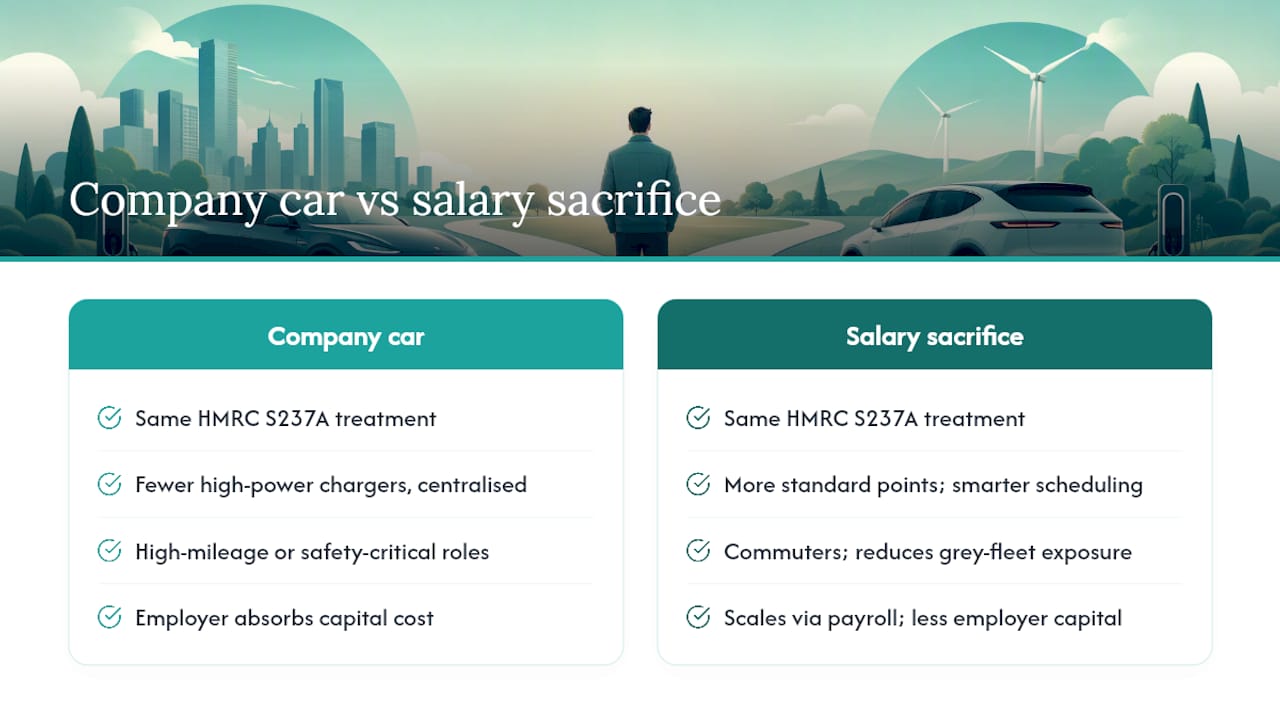
High business mileage, operational roles (vans, reps, on-call staff): company car, because the employer needs full spec control and predictable duty cycles.
Office-based staff, commuters, low-to-medium mileage: salary sacrifice, because it scales fast with no capital outlay and strong staff appeal.
Mixed fleets with duty-of-care concerns: a blended approach, moving commuters onto salary sacrifice while keeping operational vehicles as company cars.
Any model involving charging at work: check eligibility against HMRC’s workplace charging exemption (S237A ITEPA 2003) and the Workplace Charging Scheme before committing to hardware.
Red lines to flag early: capital budget approval cycles, grey-fleet and duty-of-care exposure, and who owns the reporting burden once vehicles start arriving. Get those answered before you pick a model, not after.
Key Takeaways
Salary sacrifice suits fast, low-capital EV rollout for commuting staff, while company cars remain the right call for high-mileage operational roles, and the charging design should follow that split.
Point | Details |
Match model to mileage | Use company cars for high-mileage operational roles, salary sacrifice for commuters and low-mileage staff. |
Charging is tax-free under S237A | Workplace charging offered generally to staff avoids Income Tax and employer NI under HMRC’s exemption. |
Capex vs opex drives speed | Salary sacrifice avoids capital outlay, which usually means faster scaling than a company car fleet order. |
Depot vs distributed load differs | Company car depots need fewer, high-power chargers; salary-sacrifice car parks need more units and smarter scheduling. |
Swift Charging supports both | Site survey, Workplace Charging Scheme grant support, installation and load management apply to either model. |
Table of Contents
Company car vs salary sacrifice: comparing the decision dimensions
Fleet, HR and facilities teams tend to ask the same seven questions when they’re choosing between models. Here’s how each one plays out.
Dimension | Company car | Salary sacrifice |
Cost to employer | Capex or lease liability sits with the business | Opex only; cost passed through payroll, near-zero capital outlay |
Scalability & speed | Slower, bound by procurement and budget cycles | Faster, scales with employee sign-up rather than fleet orders |
Control over spec | Full control over make, model and eligibility | Employer sets an approved vehicle list but employees choose within it |
Suitability by mileage/role | Best for high-mileage, operational or safety-critical roles | Best for commuters and low-to-medium mileage staff |
Tax & reporting | Benefit-in-kind reporting on the vehicle; standard employer duties | Employer NI savings on sacrificed salary; separate reporting obligations apply where charging isn’t provided under S237A |
Charging infrastructure | Centralised depot charging, predictable load | Distributed workplace or home charging, more variable demand |
— | Directly controlled. Easier to report at fleet level | Harder to aggregate but often drives strong uptake data |
Charging design follows the ownership model. Company cars concentrate at a depot with predictable overnight or shift-pattern charging, which suits fewer, higher-power chargers and tighter load management. Salary-sacrifice uptake spreads across a car park with less predictable arrival times, which usually means more standard workplace units and smarter scheduling to avoid a costly grid upgrade.
Tax treatment differs too. Workplace charging offered generally to staff is exempt from Income Tax and employer National Insurance under HMRC’s S237A guidance, regardless of which vehicle model sits underneath it. A payroll charging allowance, by contrast, is taxable and attracts employer NICs, so it pays to provide the physical charging point rather than cash for it.
Pros and cons at a glance:
Company car: strong operational control, but ties up capital and slows EV transition speed.
Salary sacrifice: fast uptake and no capex, but less direct control over which vehicles show up on-site.
Pro Tip: Moving commuting and low-mileage staff onto salary-sacrifice EVs while keeping company cars for operational roles is one of the simplest ways to cut grey-fleet risk and duty-of-care exposure in one move.
What Swift Charging sees on site with both models
Working with employers running company car fleets alongside salary-sacrifice schemes, we consistently see the same split: depot fleets create predictable, bulk charging windows that suit fewer high-power chargers and proper load management, while salary-sacrifice cohorts create distributed, harder-to-forecast demand across more workplace bays. A robust pilot starts with a proper site survey, a check against Workplace Charging Scheme eligibility, and a basic load assessment before any hardware goes in the ground.

Getting your charging infrastructure ready for either model
Whichever model your business leans towards, the charging side of the equation looks similar: survey the site, secure any available grant, install the right hardware, then manage the load as demand grows. Swift Charging works across each of those stages for UK employers running company cars, salary-sacrifice fleets, or a mix of both.

Our process starts with a feasibility and site survey, moves through system design and Workplace Charging Scheme grant support, and continues through installation, commissioning and ongoing maintenance. Grant capture reduces the upfront capital cost of charger hardware, and managed installations with proper reporting make HMRC compliance far simpler to demonstrate, whichever vehicle model sits behind the chargers. We’ve delivered workplace and depot projects for employers from Chichester to Eastbourne, and we can model the likely charging demand for a company car depot, a salary-sacrifice office car park, or both together.
If you’re weighing up a pilot, start with a free site survey. We’ll assess your site, flag grant eligibility, and give you a realistic view of what installation and load management will actually cost before you commit to either model.
Frequently asked questions
Is company car vs salary sacrifice mainly a tax decision or an infrastructure decision? Both. The tax treatment under HMRC S237A applies to workplace charging regardless of vehicle model, but the bigger operational question is whether your business can absorb the capital cost of a company car fleet or would rather scale through payroll via salary sacrifice.
Do we need different chargers for company cars versus salary-sacrifice vehicles? Not different chargers exactly, but different quantities and configurations. Depot-based company car fleets suit fewer, higher-power units with centralised load management; salary-sacrifice uptake across a staff car park usually needs more standard workplace points and smarter scheduling.
Can we run both models at once? Yes, and many employers do. A common approach keeps company cars for high-mileage or safety-critical roles while moving commuters onto salary sacrifice, which also helps reduce grey-fleet exposure.
Does the Workplace Charging Scheme cover salary-sacrifice employees too? The grant applies to the employer’s charger hardware and installation costs at the workplace, not to the vehicle scheme itself, so it supports charging infrastructure for staff under either model.
This article is general information, not a substitute for advice from a qualified financial advisor. Consult a qualified financial professional about your own circumstances before acting on anything here.
Sources
The employer’s guide to EV salary‑sacrifice schemes | Federation of Small Businesses
EIM01035: Exemption for workplace charging of electric and plug‑in hybrid vehicles | HMRC internal manual
Don’t confuse a payroll charging allowance with the workplace charging exemption: only the physical charging facility qualifies as tax-free, not a cash payment for charging.
Recommended