Cut fleet charging bills 35–55% with a depot first strategy


Prioritise depot-first Level 2 infrastructure with smart load management, add DC charging only where turnaround times demand it, and phase your build to a five-year scale plan. This approach, backed by depot charging economics research and Swiftcharging’s own project experience, keeps costs predictable and vehicles ready, which matters more than charger count.
TL;DR:
Most fleets should prioritize depot-first Level 2 infrastructure and phase build-out based on actual vehicle utilization data to control costs and ensure readiness.
Conduct early site load assessments and communicate with the distribution network operator 12 to 18 months before vehicle deployment to avoid costly retrofits.
Smart, departure-based load management can cut electricity costs by up to 55%, while demand charges remain the main financial concern.
Focus on vehicle readiness KPIs like on-time availability and session success rates rather than just charger count or utilization percentages.
Deploy charging infrastructure in phases, with electrical capacity sized for five-year growth, ensuring scalable hardware that matches real operational needs.
Table of Contents
Executive checklist: immediate steps to start a fleet charging strategy
Before you touch a spade or sign a hardware contract, get the groundwork right. A rushed fleet charging strategy tends to under-size infrastructure or trigger avoidable demand charges within the first year.
Start with these five actions, in order:
Pull telematics and duty-cycle data to map when vehicles are actually parked and available to charge.
Commission a site load assessment to check existing electrical headroom.
Contact your distribution network operator (DNO) 12 to 18 months before new vehicles arrive.
Specify OCPP 2.0.1-capable hardware and a fleet charging management system from day one.
Run a Phase 1 pilot with clear, written triggers for when to expand.
Two of these steps, the DNO conversation and the pilot triggers, are where most fleet electrification programmes lose months. Get them moving early and everything else follows a much smoother timeline.
Why depot-first works, and which charging profile fits your fleet
Depot charging isn’t just cheaper. It’s structurally where most fleets get the bulk of their energy, with NREL research pointing to roughly an 80/20 split between depot and en-route charging for many commercial operations. Public and en-route charging exist as backup, not backbone.
Fleets tend to fall into one of four charging profiles:
Overnight depot: vehicles return to base every night with 8 to 12 hours of dwell time. Level 2 AC is almost always sufficient.
Opportunity charging: shorter dwell windows during shift changes or loading, needing faster replenishment.
Corridor charging: long-haul routes that rely on public DC infrastructure between depots.
Mixed fleets: a combination that needs different charging treatment by vehicle class.
Home charging only makes sense for light commercial vehicles that overnight at an employee’s address rather than a depot.
Site assessment and power planning: what to check and when
Get this stage wrong and you’ll be paying for a retrofit within two years. Start with what you already have.
Audit existing site load. Measure background consumption over at least a full working week, including seasonal variation if your depot runs refrigeration or heating equipment.
Contact the DNO early. Ask about available headroom, the interconnection process, and realistic timelines for a supply upgrade. This conversation should happen 12 to 18 months before you need power live, because transformer procurement and grid reinforcement work rarely move faster than that.
Size conduit and panels for five-year growth, even if you’re only installing Phase 1 hardware now. Retrofitting trenches and switchgear later costs far more than over-specifying ducting today.
Factor in permits and engineering sign-off, which can run parallel to DNO works but still need three to six months in most cases.
Pro Tip: Ask your installer to design the electrical infrastructure for your full five-year vehicle count, then only fit chargers for Phase 1. The conduit and panel capacity cost far less to over-specify now than to dig up and replace later.
Charger mix and sizing: how many ports and which types
Level 2 AC charging is the cost-efficient default for any fleet with six or more hours of dwell time overnight. It covers the vast majority of return-to-base operations without the capital burden of DC hardware.
DC fast charging earns its place only where turnaround time is genuinely tight, think delivery vehicles doing two shifts a day or vehicles with limited dwell windows between routes. Capital cost differences between Level 2 and DCFC are substantial, so DC should be a surgical addition, not a default.
For port planning:
Start with a baseline ratio of one port to every two or three vehicles for standard single-shift fleets.
Tighten that ratio for multi-shift operations or vehicles that can’t tolerate any readiness failure.
Specify OCPP 2.0.1 compatibility across all hardware to keep future software and interoperability options open.
Plan cable runs and physical layout around driver walking distance and vehicle turning circles, not just electrical convenience. Guidance on cable management for depot sites covers this in more depth.
Energy management and smart charging: cutting bills without new infrastructure
This is where most of the money gets saved or lost. Unmanaged charging, where every vehicle plugs in and pulls full power the moment it arrives, creates sharp demand peaks that utilities bill heavily for. Managed, departure-based scheduling smooths that peak by prioritising which vehicles charge first based on when they actually need to leave.
Smart charging management can reduce electricity costs by 35% to 55% compared with unmanaged plug-in charging, largely because it avoids the demand charges that make up the bulk of a depot’s electricity bill.
The core tactics:
Departure-based prioritisation: charge the vehicles leaving soonest first, and stagger the rest.
Managed concurrency: cap how many vehicles draw full power simultaneously, which is the single biggest lever against demand charges.
Time-of-use optimisation: shift charging into off-peak windows wherever operational schedules allow.
Demand-response participation: some grid operators pay fleets to reduce load during peak system stress, an extra revenue line most operators overlook.
None of this works well without data. Integrating telematics and dispatch systems into your charging software lets scheduling decisions happen automatically rather than through a depot manager guessing at departure times.
Operations, KPIs and maintenance: protecting readiness
Charger count is a vanity metric. Vehicle readiness is the number that actually protects your operation. If a van isn’t charged and ready when its shift starts, nothing else about your infrastructure matters.
Track these operational KPIs from day one:
Ready-on-time percentage: the proportion of vehicles fully charged and available at their scheduled departure. This should be your north-star metric.
Session success rate: aim for 98.5% or higher, meaning charging sessions that start and complete without fault.
Infrastructure uptime: target around 99.9% across your charger fleet.
Build a simple runbook for drivers: how to connect, who to call if a charger faults, and what the escalation path looks like outside office hours. Behind that, agree spare-parts stock levels and service-level agreements with your maintenance provider before you need them, not after a charger has been down for a week.
Pro Tip: Track session success rate and ready-on-time percentage weekly rather than monthly. Faults that seem minor in isolation often cluster around specific chargers or shift patterns, and you’ll only spot the pattern with frequent data.
Cost, funding and grants: the economics behind the decision
Demand charges, the fee utilities levy based on your highest draw in a billing period, are usually the single biggest driver of your electricity bill, which is exactly why timing and load management matter more than raw kilowatt-hour rates.
On capital cost, Level 2 ports carry substantially lower per-port pricing than DC fast chargers, though DCFC can justify itself for vehicles with genuinely tight turnaround windows. Full cost breakdowns, including installation variables, are covered in a commercial EV charger installation cost guide.
Grant support is worth chasing early, not as an afterthought:
The UK’s transport decarbonisation plan sets the policy backdrop that shapes current and future grant availability.
Apply for make-ready and installation grants before you finalise your build, since many schemes require pre-approval rather than retrospective claims.
A guide to future-proofing fleets with grant support walks through eligibility and timing.
Managed charging itself is a funding lever: by cutting demand charges, it can shift spend from a costly capital upgrade to a smaller, ongoing operational cost.
Phased deployment and timeline: from pilot to full scale
Deploy in stages, not in one large build. Install electrical infrastructure sized for your five-year vehicle count, but only fit chargers for what Phase 1 actually needs.
Phase 1: install a Level 2 AC baseline, run it for three to six months, and collect utilisation and readiness data.
Phase 2: expand port count based on that data, and refine your load-management rules using real charging patterns rather than assumptions.
Phase 3: add DC charging or on-site battery storage, but only once operational evidence, not guesswork, justifies it.
Any one of those is your signal to move to the next phase.
What most fleet operators get wrong about charging strategy
Most fleet electrification plans fail not because the hardware is wrong, but because the sequencing is. Operators size for the vehicle count they’ll have in five years and try to build it all at once, then get stuck waiting 18 months for a DNO upgrade before a single van can charge. The smarter path is the opposite: build the electrical backbone for scale, but deploy hardware in restrained phases driven by real utilisation data.
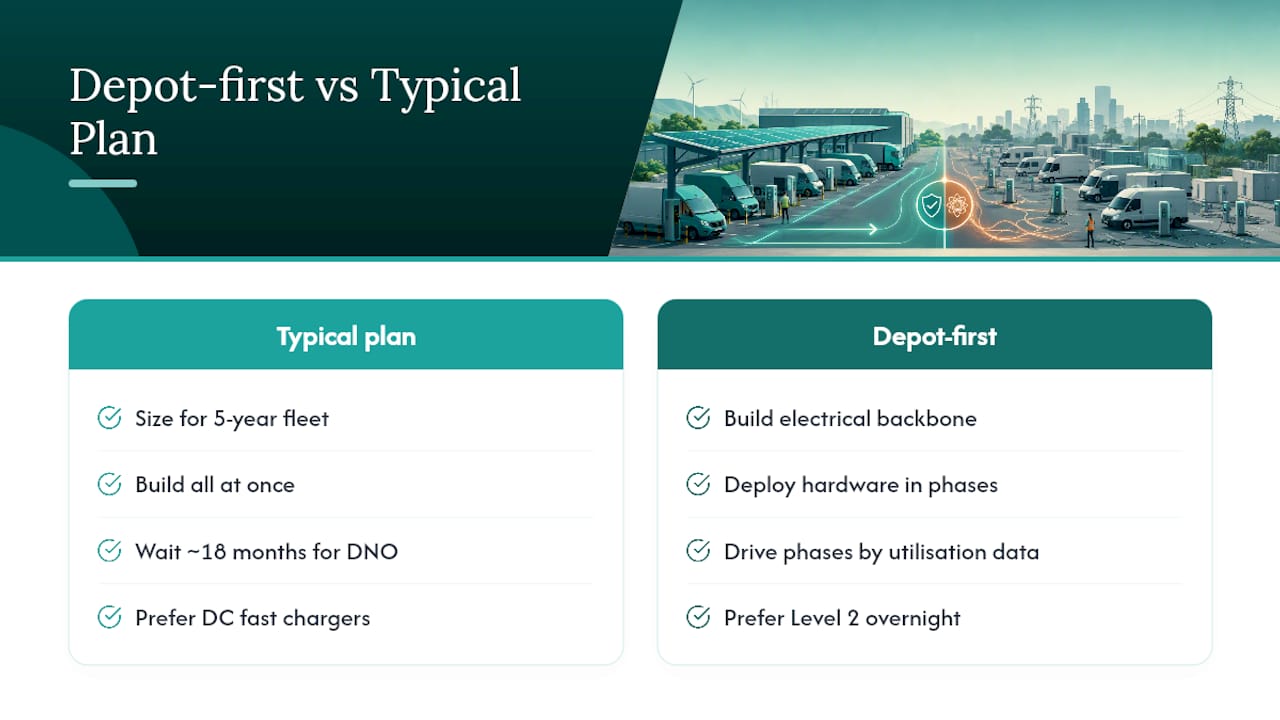
There’s also a persistent myth that DC fast charging is the “serious” choice for a commercial fleet, as if AC charging is a stopgap. For the vast majority of return-to-base operations, that’s backwards. Level 2 charging overnight is not a compromise, it’s the correct engineering answer, and DC should be reserved for the specific vehicles that genuinely need rapid turnaround.
The KPI conversation matters just as much. Fleets that fixate on utilisation percentages or charger counts often miss readiness failures building quietly in the background. A charger sitting at 40% utilisation with a 99% ready-on-time rate is a healthier system than one running at 90% utilisation with vehicles occasionally leaving half charged. Readiness, not throughput, is what your drivers and customers actually feel.
— Swift Charging
How Swiftcharging can help you build a fleet charging strategy that scales
Depot charging programmes designed the way this guide describes: site survey first, phased hardware second, and a management platform that keeps vehicles ready rather than just plugged in. Where an off-the-shelf installer might sell you a fixed charger count on day one, the electrical infrastructure can be built for a five-year plan and the actual chargers phased to match real fleet growth, to avoid costly retrofits.

Our team runs feasibility studies and depot surveys, handles DNO engagement, specifies OCPP-compliant hardware, and supports grant applications where your project qualifies. We also cover fleet depot charging design for operators still mapping out their site requirements. If your depot is in the Farnborough area, get in touch through our Farnborough commercial EV charging page to arrange a site assessment and start building your phased rollout plan.
Sources
Recommended