3 stage compliance for UK smart charging regulations: site teams


If you sell, install or specify domestic and workplace EV chargers in Great Britain, you are almost certainly bound by the Electric Vehicles (Smart Charge Points) Regulations 2021, in force since 30 June 2022. The core duties are straightforward: your charge point must have genuine smart functionality, default to off‑peak charging, apply a randomised start delay, measure and display usage data, and meet a defined security baseline. Sellers must also hand over a statement of compliance and keep a sales register for a decade, with the Secretary of State empowered to issue civil penalties for breaches.
TL;DR:
Relevant smart charge points must be capable of network communication, demand response, and supplier interoperability; failure to meet these criteria risks non-compliance.
Default settings require off-peak charging outside peak hours unless a valid demand-response service is active, which allows more dynamic grid-aware charging.
Each device must include a randomized delay of up to 600 seconds automatically, extendable to 1,800 seconds, to prevent simultaneous grid overloads.
Sellers must retain detailed compliance documentation, including statements, technical files, and sales registers, for a full 10-year period, with enforcement actions possible for breaches.
On-site testing and proper documentation collection during installation are crucial, and managed installer services can streamline compliance adherence and record-keeping.
Table of Contents
What are smart charging regulations and who do they apply to?
Off‑peak default hours and the demand‑side response alternative
Randomised delay and measuring systems: the detail that protects the grid
Security baseline and assurance duties every seller must meet
Practical compliance checklist for purchasers, installers and facilities managers
Enforcement, civil penalties and where compliance disputes go
Where to find the official templates and referenced standards
What are smart charging regulations and who do they apply to?
The Regulations target one specific category: relevant charge points. That means private domestic and workplace units intended to charge electric cars and vans, sold for use in Great Britain. If you are buying, specifying or installing a charger for a home driveway, a company car park, or a fleet depot, you are inside the scope of these smart charging guidelines whether you realise it or not.
Several categories sit outside the net, and getting this wrong is one of the most common mistakes buyers make during procurement:
Public charge points are excluded, because they fall under separate public charging infrastructure regulations covering payment transparency and reliability reporting rather than device‑level smart functionality.
Rapid chargers rated at 50kW or above are exempt, since these are typically forecourt or destination units rather than domestic dwell‑time charging.
Anything sold before 30 June 2022 predates the Regulations and carries no retrospective obligation, though replacing an old unit today brings you straight back into scope.
Sales in Northern Ireland are not covered, because the Regulations apply specifically to Great Britain (England, Scotland and Wales).
Private, non‑trade, second‑hand sales between individuals fall outside the rules, which are aimed at commercial sellers rather than a homeowner passing on their old wallbox.
Where things get less obvious is hire, lease and warranty scenarios. A charge point supplied under a lease or hire arrangement to a private end user is generally treated the same as an outright sale for compliance purposes, because the end result is a relevant charge point being put into service. Warranty replacements follow the same logic: if you are swapping a faulty unit for another one that will charge a domestic or workplace vehicle, the replacement device needs to meet the same standard as the original. Cross‑border sales get scrutinised on where the charge point will actually be used, not where the transaction is processed, so a unit shipped into England from an overseas supplier is still caught if it is destined for a driveway in Kent. If you operate destination charging for guests or customers rather than staff, it is worth checking how public charge point regulations differ from the private smart charge points regulations, since the compliance route diverges quickly depending on who is plugging in.
What smart functionality actually requires in practice
“Smart” is a legal term here, not a marketing one, and the Regulations set out four specific criteria a device must meet before anyone can call it a relevant smart charge point. Understanding these properly saves a lot of arguing with suppliers later.
Communications network capability. The charge point must be able to send and receive data over a network, and to respond automatically to signals it receives, rather than simply logging information for later download.
Response and demand‑side response readiness. It needs to adjust its charging rate or timing in response to those signals, which is what allows the device to take part in demand‑side response (DSR) programmes run by suppliers or aggregators.
A usable interface at first use. Owners must be given a straightforward way to view and adjust settings when the device is first commissioned, not buried three menus deep in an app nobody has downloaded yet.
Supplier interoperability. If the owner switches their electricity supplier, the charge point must retain its smart functions rather than losing them because it was tied to one supplier’s platform.
That last point catches out more installations than any other requirement. A charger that only works smart with a single named tariff provider is not compliant, because switching supplier is a normal consumer right and the Gov makes clear the device’s smart behaviour cannot be contingent on staying with one energy company. In practice this means the smart logic needs to live in the charger’s own firmware and communications stack, or in a manufacturer platform that is supplier‑agnostic, rather than in a bolt‑on service that only one energy retailer controls.
Pro Tip: Ask any supplier directly: “If the site owner switches electricity supplier next month, which smart functions stop working?” If the answer is anything other than “none”, walk away from that unit.
For facilities managers running multiple sites, this interoperability requirement also protects you from vendor lock‑in on the energy side, which matters if you are negotiating better commercial tariffs across a fleet depot or hotel car park. A charger tied to one supplier’s smart platform effectively removes your negotiating leverage every time a contract renewal comes round.
Off‑peak default hours and the demand‑side response alternative
Every relevant charge point must default to charging outside defined peak windows unless the buyer actively changes that setting. Peak hours under the Regulations run 8am to 11am and 4pm to 10pm on weekdays, and the OPSS/BEIS guidance sets these windows specifically because they coincide with the National Grid’s highest demand periods. The default schedule has to avoid both windows out of the box, though the owner is free to override it at first use, and again at any later point, if they want to charge whenever suits them.
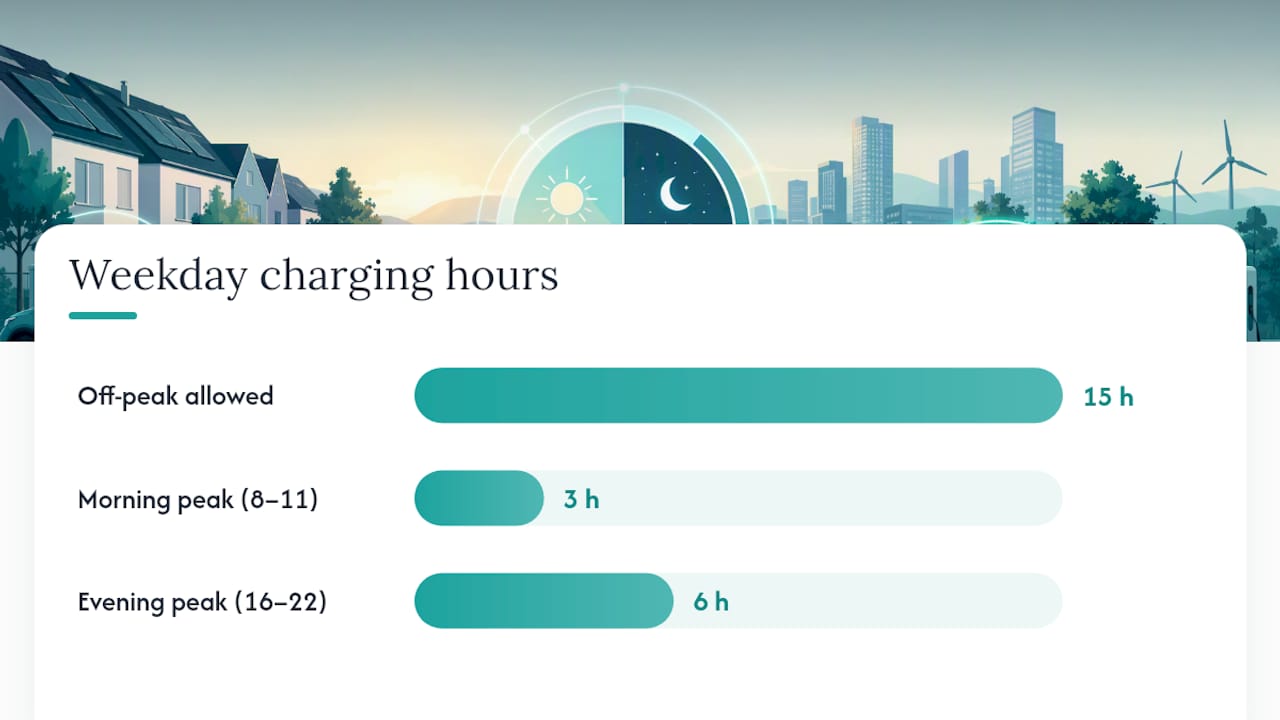
There is one recognised alternative pathway. If a charge point is sold together with an active demand‑side response service already running, the device can follow that DSR arrangement instead of the standard off‑peak default. This matters because a DSR service typically hands charging‑time decisions to an aggregator or supplier algorithm responding to grid conditions in real time, rather than sticking to a fixed clock‑based window. For a fleet depot on a managed charging contract, that can mean genuinely dynamic charging patterns rather than a blunt 10pm cut‑in.
For most site operators, the practical interaction that matters is with your electricity tariff. A handful of things worth checking before commissioning:
Confirm whether your site is on a time‑of‑use tariff, and align the default off‑peak hours with the cheapest rate windows rather than leaving factory defaults unchanged.
Check whether a smart meter is fitted or planned, since accurate half‑hourly data makes both DSR participation and tariff optimisation considerably more effective.
Ask whether the charger’s default schedule can be adjusted remotely across a whole fleet, rather than unit by unit, if you are managing multiple sites.
Verify that any DSR service quoted at point of sale is actually live and contracted, not just theoretically available, because a charger sold “DSR‑ready” without an active service still needs to meet the standard off‑peak default.
Workplace operators setting internal charging rules alongside these regulatory defaults may find it useful to formalise expectations in a written workplace EV charging policy that spells out who can override defaults and under what circumstances.
Randomised delay and measuring systems: the detail that protects the grid
Two of the more technical requirements in the Regulations exist specifically to stop thousands of chargers switching on at exactly the same moment and hammering the local grid.
Randomised delay on start‑up. When a relevant charge point begins a charging event, Regulation 11 requires a random delay of up to 600 seconds (10 minutes) by default before charging actually starts, and the device must be capable of extending that delay to as much as 1,800 seconds (30 minutes) if configured to do so.
A genuinely different delay each time. The randomisation cannot be the same fixed pause repeated every session; each charging event should generate its own random value within the permitted range, which is what actually spreads load across a street or car park rather than shifting a synchronised spike by a fixed ten minutes.
Exceptions for safety and urgency. The randomised delay does not apply where it would compromise safety, or where the owner has indicated they need an urgent charge, since the whole point of the feature is grid protection rather than making someone late for a hospital appointment.
The logic behind this rule is worth understanding rather than just complying with blindly. According to Gov, randomised delays exist alongside the off‑peak defaults as the primary mechanism protecting the National Grid from simultaneous demand spikes, because thousands of chargers all starting at 10:01pm the moment peak pricing ends would simply recreate the same problem the off‑peak window was designed to solve.
Every relevant charge point must be capable of a randomised delay of up to 1,800 seconds, even though the default setting is only 600 seconds. That gap between default and capability matters at procurement stage: a device that only offers a fixed 10‑minute delay with no ability to extend it further does not meet the full requirement, even if its default behaviour looks compliant on day one.
On the measuring side, obligations are equally specific:
The device must measure or calculate the electricity imported (and exported, for bidirectional units) during each charging event.
It must record how long the charging event lasted, tying usage to a specific time window.
It must capture the rate of power delivered throughout the session, not just a start‑and‑end total.
All of this data must be visible to the owner either through the device’s own interface or via a connected app or network dashboard.
That visibility requirement is not optional decoration. A charger that logs usage data on a manufacturer’s server but gives the owner no practical way to see it fails the measuring system test just as surely as one that does not measure at all.
Security baseline and assurance duties every seller must meet
Security requirements sit in Schedule 1 of the Regulations, and they are mostly built around principles from ETSI EN 303 645, the internationally recognised cybersecurity standard for consumer connected devices. That means a compliant charger needs to protect sensitive security parameters, keep meaningful logs, and demonstrate resilience against common attack vectors rather than shipping with default passwords and an open port.
Beyond the technical build, three paperwork duties apply to every seller of a relevant charge point:
A statement of compliance must be supplied to the buyer at the point of sale, confirming the device meets the Regulations’ requirements.
A technical file must exist and be made available to the buyer, or to an enforcement authority, on request.
A register of sales must be kept for 10 years, giving enforcement bodies a clear audit trail if a device is later found to be non‑compliant.
That ten‑year retention window is longer than most businesses keep routine sales paperwork, so it is worth building a deliberate filing system rather than trusting it to whatever inbox the original order confirmation landed in. Facilities managers procuring across multiple sites should also request evidence of Schedule 1 compliance directly rather than assuming a big‑name supplier automatically means the paperwork exists. If cybersecurity evidence feels thin, our guide to securing commercial EV chargers against theft and cyberattack covers the practical side of hardening an installation beyond the regulatory minimum.
Pro Tip: Request the technical file before you sign the purchase order, not after installation. Chasing a supplier for security documentation once the charger is bolted to a wall gives you far less leverage.
Practical compliance checklist for purchasers, installers and facilities managers
Turning the legal text into a working procurement and installation process comes down to three stages, each with its own documentation trail.
Procurement stage. Write compliance clauses directly into your purchase contract or tender specification. Request the statement of compliance, the technical file, evidence of ETSI EN 303 645 alignment, and confirmation of the default off‑peak hour configuration before you commit to an order.
Installation and commissioning. Physically test that the unit retains smart functionality when simulated against a different supplier’s network profile. Disconnect the internet connection briefly and confirm the charger still delivers power, since loss of communications must never stop a vehicle charging. Check the owner interface displays live usage data. Trigger two separate charging events and confirm the randomised delay differs between them.
Handover and records. Give the site operator a complete pack: statement of compliance, technical file reference, commissioning test results and default settings applied. Store a duplicate copy centrally, version‑controlled, and retain it for the full 10‑year sales register period even if the physical device is later replaced.
Compliance stage | What to check or request | Who is responsible |
Procurement | Statement of compliance, technical file, ETSI EN 303 645 evidence | Purchaser / buyer |
Commissioning | Offline charging test, randomised delay test, interoperability check | Installer |
Handover | Full documentation pack, default hour settings confirmed | Installer to site operator |
Ongoing record keeping | Duplicate filing, 10‑year retention, version control | Facilities manager |
If your organisation is running this across several sites, a written workplace EV charging policy is the natural place to fix responsibility for each of these steps, so commissioning checks do not depend on whichever engineer happens to be on site that day. It is also worth checking whether any planned installation qualifies for support under current workplace EV charging grant schemes, since grant applications often ask for the same technical documentation your compliance file already needs.
Enforcement, civil penalties and where compliance disputes go
Enforcement sits with the Secretary of State, supported operationally by the Office for Product Safety and Standards (OPSS), which has investigatory powers to examine devices, request documentation and pursue non‑compliant sellers.
Enforcement officers can issue compliance notices requiring a seller to fix a specific breach within a set timeframe.
Civil penalties (financial sanctions) can follow where a compliance notice is ignored or where a breach is serious enough to warrant a direct fine.
Obstructing an enforcement officer, or supplying false information during an investigation, carries its own separate consequences beyond the underlying charge point breach.
Sellers should treat a request for the sales register or technical file as a formal enforcement step, not a casual query, and respond with the same rigour they would give an HMRC or trading standards request.
Authoritative clarification always sits with GOV.UK’s official guidance page rather than third‑party summaries, however well‑intentioned. If you are unsure whether a specific product or sale scenario falls inside scope, that page is the starting point before you take a supplier’s word for it.
Where to find the official templates and referenced standards
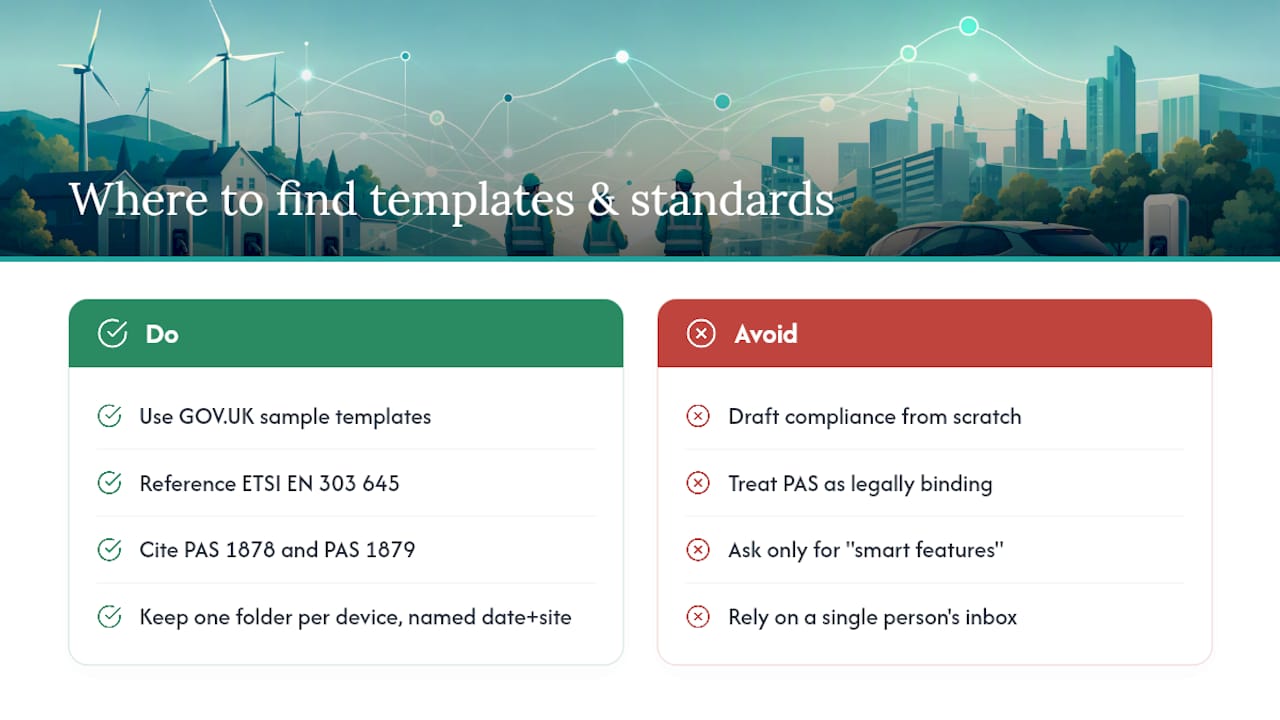
GOV.UK publishes downloadable sample templates covering the statement of compliance, the technical file structure and the register of sales format, all produced by OPSS and BEIS specifically to give sellers a starting point rather than forcing them to draft from scratch.
Beyond ETSI EN 303 645, guidance also points procurement and commissioning teams towards PAS 1878 and PAS 1879, the Publicly Available Specifications covering energy smart appliance functionality and demand‑side response communications respectively. Neither carries the direct legal weight of the Regulations themselves, but referencing them in a tender specification gives suppliers a concrete, checkable standard to build against rather than a vague request for “smart features.”
For your own internal record keeping, a simple rule works well: one folder per device, named by installation date and site, containing the compliance statement, technical file reference and commissioning test log, backed up somewhere that survives a staff change. Ten years is a long time to rely on one person’s inbox.
Installer perspective: what actually goes wrong on site
The gap between paper compliance and real compliance shows up at handover, not at the design stage. The most common omission is a missing technical file reference, not because the device lacks one, but because nobody asked the manufacturer for it before installation day. Capture that evidence at commissioning, not afterwards, because chasing a supplier for documentation months later rarely goes well.
Firmware and security patching responsibility often falls into a gap between installer and manufacturer. Establish upfront who escalates a vulnerability report to the vendor, and get it in writing.
The businesses that sail through a compliance check are the ones with a boring, consistent filing habit: one folder, one naming convention, updated the day a charger goes live, not the week before an inspection.
— Swift Charging
How Swift Charging handles compliance so you don’t have to
Some commercial EV charging providers manage the full compliance chain for commercial buyers, so the paperwork burden sits with them rather than landing back on your facilities team six months after installation. This can include site surveys, preparation of statements of compliance, technical file support from manufacturers, and managed installation with commissioning tests documented and handed over in full.

Where a DIY approach leaves you chasing suppliers for missing evidence years into a 10‑year retention period, a managed installer keeps that filing centralised from day one. If you are based around the south coast, our teams cover commercial EV charging installation in Chichester and commercial EV charging installation in Eastbourne, or you can start with a broader look at Swift Charging’s commercial services across the UK. Get in touch for a site survey and we will tell you exactly what documentation your existing or planned installation needs.
Sources
Recommended