Public charge point regulations UK: what operators must do


If you own, operate, or host public EV chargers in the UK, you’re already bound by the Public Charge Point Regulations 2023, which came into force on 24 November 2023 and apply across England, Scotland and Wales. Operators must deliver on six fronts: contactless payment at the right power thresholds, one third-party roaming connection, 99% reliability across rapid networks, a free 24/7 staffed helpline, transparent pence-per-kWh pricing, and open data through the Open Charge Point Interface (OCPI). The Office for Product Safety and Standards (OPSS) enforces all of it on behalf of the Secretary of State, with the Office for Zero Emission Vehicles (OZEV) as a named recipient of the open data you’re required to publish.
Your first move should be a scoped audit, not a scramble to fix individual gaps. Before anything else, confirm:
Which of your charge points meet the “public” definition and fall in scope
Which power bands each asset sits in (below 8kW, 8 to 50kW, above 50kW)
What data you can currently export, and in what format
Whether payment, roaming, and helpline arrangements already exist, and where the gaps sit
That audit becomes the foundation for every task that follows, from contactless procurement to your first reliability report.
Key Takeaways
Meeting public charge point regulations UK requirements demands contactless payment, roaming access, 99% rapid reliability, a 24/7 helpline, transparent pricing, and OCPI open data, all enforced by OPSS.
Point | Details |
Scope test comes first | Any charger accessible to the public at any time counts, even if it’s free or shared with private users. |
Roaming deadline has passed | The third-party roaming payment obligation deadline has already passed, so gaps here are current non-compliance, not future risk. |
Reliability is fleet-wide | The 99% average applies across your whole rapid (50kW+) network, not per individual charger. |
Evidence beats explanation | Commissioning logs, OCPI histories, and helpline records matter more to OPSS than assurances that issues are “being addressed.” |
Managed services simplify delivery | Swiftcharging runs payments, roaming, OCPI feeds, helpline provision, and reliability monitoring as one contracted service. |
Table of Contents
Public charge point regulations UK: scope and who counts as operator
Public charge point regulations 2026: key deadlines you cannot miss
How do you build a compliance checklist for public charge points?
What happens if you fail to meet public charge point compliance UK requirements?
Technical standards and certifications for public charge points
How Swiftcharging helps you meet public charge point regulations UK requirements
Frequently asked questions about public charge point regulations UK
Public charge point regulations UK: scope and who counts as operator
A charge point counts as “public” under the Regulations if it’s accessible to any member of the public, at any time, even if it also serves a restricted group the rest of the day. That includes chargers you offer for free. There’s no size exemption and no goodwill exemption: a hotel car park charger available to non-guests after hours, a retail park charger anyone can pull up to, or a leisure centre charger open during public opening hours all meet the functional test, regardless of who paid for the hardware.
Some categories sit outside scope more reliably:
Chargers genuinely restricted to a defined group with no public access window, such as staff-only workplace charging behind a barrier
Domestic chargers at private residences
Chargers on fleet-only depot sites with no public throughput at any time
The line that trips up commercial landlords most often is the “at any time” wording. A shopping centre car park that’s gated to customers during trading hours but left open overnight for deliveries or events can still count as public, because accessibility is assessed across the full operating pattern, not just the busiest hours.
Responsibility sits with the charge point operator, which the Regulations define functionally rather than by ownership title. That can be the landowner running the asset directly, a managed service provider running it under contract, or a hybrid where the landlord owns the hardware but a third party handles payments, roaming, and reporting. Whoever performs the operator function carries the statutory duties, which is precisely why the wording in your installation or management contract matters as much as the kit itself.
Pro Tip: Don’t assume a “staff and visitors only” sign settles the question. If a member of the public could physically walk up and use the charger without prior arrangement, treat it as public until you’ve had that assessed against your specific access controls.
Key requirements for public charge point compliance UK
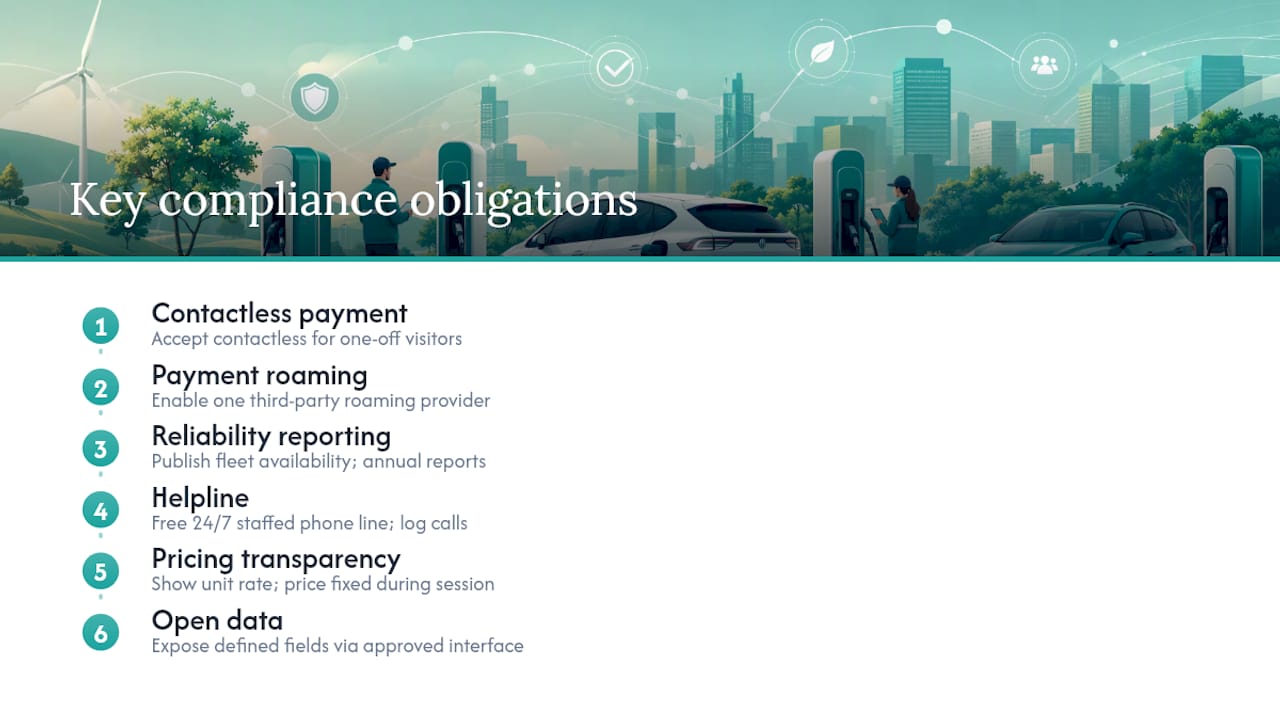
Six obligations sit at the centre of the Regulations, and each one carries a distinct operational task. None of them are theoretical: OPSS can request evidence of compliance against every item below.
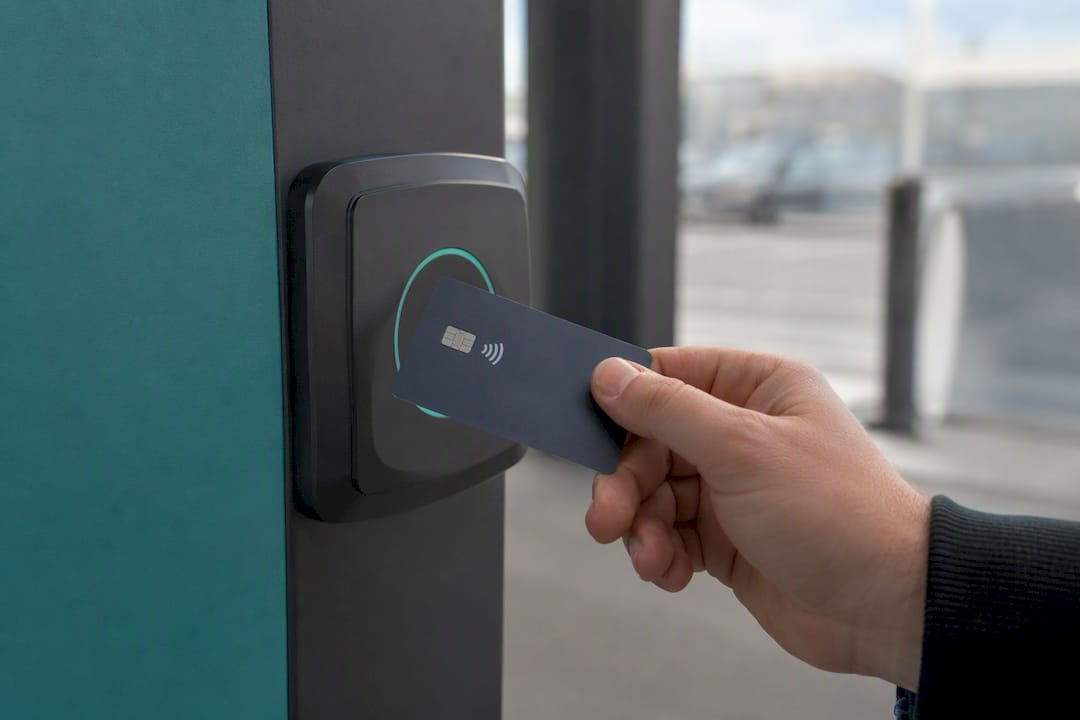
Contactless payment. New public charge points rated at or above a specified power threshold, installed after a specified date, must accept contactless payment without requiring the driver to hold a pre-existing account or app. Existing higher-powered charge points are also in scope. The payment method can sit on the charge point itself or on a separate device covering the whole site, but it has to work for a one-off visitor with no prior relationship to your network.
Payment roaming. Regulation 6 requires operators to enable payment through at least one third-party roaming provider within two years of the Regulations coming into force. In practice, this means integrating with an e-mobility service provider (eMSP) or a roaming hub so drivers on other networks’ apps or RFID cards can charge and pay at your site without opening a new account.
Reliability. Rapid networks, meaning charge points above a defined power threshold, must hit high average availability across the operator’s rapid fleet. That’s measured as a fleet-wide average, not a per-charger guarantee, and operators must publish reliability figures and submit annual reports.
Rapid networks operating below the required average threshold face reputational exposure well before any regulatory penalty lands. A single unreliable site drags down a fleet-wide figure that’s published for anyone to check.
Helpline. A free, staffed telephone helpline available 24 hours a day, every day of the year, is mandatory, with every call logged for reporting purposes as required by the regulations.
Pricing transparency. The price must be displayed clearly as a rate per unit of electricity consumed, and once a session starts, the maximum price cannot increase mid-charge, whatever happens to your tariff afterwards.
Open data. Operators must hold and expose defined data fields using an approved open data interface, with datasets flowing to statutory recipients including the relevant authorities.
Public charge point regulations 2026: key deadlines you cannot miss
Most of the deadlines that matter have already passed, which means late movers are managing legacy risk rather than future planning. The table below sets out the dates that shaped the rollout and the ones still live for anyone completing new installations.
Deadline | What was required |
24 November 2023 | Public Charge Point Regulations 2023 came into force UK-wide |
A year after 24 November 2023 | Contactless payment mandatory for specified new and existing public charge points |
A year after 24 November 2023 | OCPI data holding and opening obligations took effect |
Two years after 24 November 2023 | Deadline for enabling payment via a third-party roaming provider |
Ongoing (annual) | Reliability reports due for rapid networks |
Ongoing (quarterly) | Helpline call records due for reporting |
If you’re installing new rapid infrastructure now, in 2026, contactless and OCPI obligations apply from day one of go-live, not from some future compliance window. There’s no grace period for new builds: a rapid charger commissioned this year has to meet every threshold on day one. The roaming deadline has already passed for existing operators, so any site still lacking a third-party roaming connection is currently non-compliant, not approaching a deadline.
How do you build a compliance checklist for public charge points?
Turning six regulatory strands into a working project plan is where most operators stall, usually because they tackle tasks in the wrong order. Work through this sequence instead.
Audit every asset first. Map each charge point by power rating, install date, and current capability against contactless, roaming, and OCPI data fields. This single exercise tells you exactly which sites are compliant, which need hardware changes, and which only need software or contractual fixes.
Fix payments before anything else. If a site lacks contactless, that’s the most visible compliance gap and the easiest for OPSS or a frustrated driver to spot. Decide between on-charger terminals and a shared site-level payment device, then get procurement moving, because hardware lead times can run longer than software integrations.
Sort roaming integration. Connecting to an eMSP or a roaming clearing house is largely a technical integration project between your back-office platform and the roaming provider’s network. Budget time for testing transaction flows end-to-end, not just confirming the connection exists.
Address reliability at the root cause. Most rapid charger downtime traces back to poor commissioning, connector wear, or payment terminal faults rather than dramatic hardware failure, as analysed in detail by the EV Risk Index. Put remote monitoring in place so faults get flagged before a driver reports them, and build service level agreements with your maintenance provider around uptime, not just response time.
Stand up the helpline properly. A compliant 0800 number needs staffing around the clock, a call-logging process that captures the data you’ll need for quarterly reporting, and signage on-site that makes the number genuinely easy to find, not buried in small print.
Automate your OCPI feed and reporting. Set up the OCPI feed once, then treat it as ongoing data hygiene rather than a one-off task, since maintaining accurate feeds is what generates the evidence base for your annual reliability report and any OPSS enquiry.
Keep an evidence pack running. Commissioning logs, uptime histories exported from your OCPI feed, helpline call records, and dated photographs of pricing signage should sit in one place, updated continuously rather than assembled retrospectively when a compliance notice lands.
Pro Tip: Treat your OCPI feed as a live compliance instrument, not a technical afterthought. The same data that satisfies your open data duty is what proves your reliability figures when OPSS asks for evidence.
What happens if you fail to meet public charge point compliance UK requirements?
OPSS enforces the Regulations on behalf of the Secretary of State and holds real investigatory powers, including the ability to demand records and site access. Where it finds a breach, the typical response is a compliance notice giving the operator a defined window to fix the issue, followed by escalation to civil penalties if the notice is ignored or the breach continues. In more serious or repeated cases, enforcement can extend to a prohibition on further installations by that operator.
The reports you owe fall into a predictable rhythm: annual reliability figures for any rapid network, quarterly helpline call summaries, and a one-off roaming notification once your third-party connection is live. Each of these has to reach OPSS through the reporting channels set out in the statutory guidance, and missing a submission window is itself treated as a compliance gap, separate from the underlying performance issue.
If a notice does arrive, the practical response is the same evidence pack you should already be building: commissioning records, exported OCPI status histories, helpline logs, and dated site photographs showing pricing and signage in place. A remediation plan that names specific fixes and dates tends to land far better with OPSS than a general assurance that “it’s being looked at.”
Penalties and consequences beyond civil fines
Civil penalties are the headline enforcement tool, but they’re not the only cost of falling behind on public charge point regulations UK operators are expected to meet. A prohibition on further installations effectively freezes an operator’s growth plans until compliance is demonstrated, which matters enormously for anyone with a multi-site rollout in progress.
There’s also a commercial cost that doesn’t show up in the Regulations themselves. Published reliability figures and open data feeds mean drivers, roaming platforms, and even competing operators can see your network’s performance. A site with a poor reliability record or a payment terminal that rejects contactless cards generates complaints that reach your helpline, your app store reviews, and eventually your landlord relationship if you’re operating on someone else’s site under contract.
For commercial property owners hosting a third-party operator, non-compliance by that operator can also complicate lease and licence arrangements, particularly where the property owner is named or implicated in enforcement correspondence. That’s a strong argument for building compliance obligations directly into any hosting agreement, rather than assuming the operator’s paperwork will stay in order without contractual pressure.
Technical standards and certifications for public charge points
The Regulations sit alongside, not instead of, existing electrical and product safety standards. Charge point hardware still needs to meet relevant British and international electrical safety standards for installation and equipment, and installers should be certified to work on the electrical infrastructure involved, typically through recognised electrotechnical certification schemes.
OCPI is the specific technical standard the Regulations name for open data compliance, and it’s worth treating as a certification-adjacent requirement in its own right. Your back-office platform or charge point management system needs genuine OCPI capability, not a workaround that exports data in a similar but non-compliant format. When evaluating a charging management platform, ask directly whether it supports OCPI natively and whether that capability has been used to supply data to a statutory recipient before, rather than taking a vendor’s word that it’s “compatible.”
Payment terminal hardware for contactless compliance also needs to meet the same card payment industry standards that apply to any unattended retail payment device, since a driver tapping a contactless card at a charger has the same security expectations as tapping at a fuel pump or a shop terminal.
Accessibility requirements for disabled EV drivers
Accessibility isn’t a standalone chapter in the Public Charge Point Regulations, but it interacts directly with several of the obligations above, and site owners get this wrong more often than any other requirement. Payment terminals need to be usable without requiring a driver to bend down further than a wheelchair user reasonably can, and contactless readers positioned at standard height on badly designed installations create a real accessibility gap that a compliance audit focused purely on “is contactless present” will miss entirely.
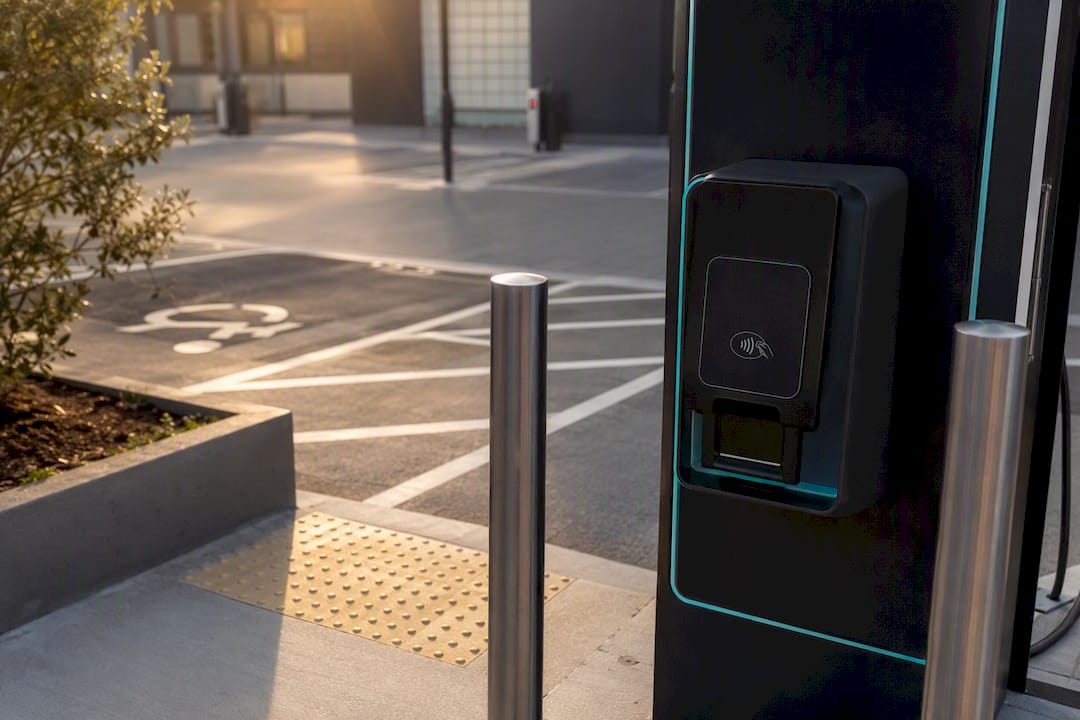
The PAS 1899 accessible EV charging standard, developed separately from the Public Charge Point Regulations but referenced heavily in wider government EV infrastructure guidance, sets out physical accessibility criteria including cable weight, reach distances, and space around the charger for wheelchair manoeuvring. It isn’t a direct legal requirement under the 2023 Regulations, but property owners installing or refreshing public charging infrastructure should treat it as the practical benchmark, since local planning authorities and funding bodies increasingly expect to see it addressed.
Helpline accessibility matters too. A helpline that only takes voice calls, with no text relay or alternative contact route, falls short of good practice even where it technically meets the 24/7 staffed requirement, and it’s a straightforward fix to build in from the outset rather than retrofit later.
Installation responsibilities and ownership implications
Who installs a charge point and who owns it are separate questions from who carries the statutory operator duties, and conflating them is one of the most common structural mistakes commercial property owners make. You can own the hardware outright and still contract the operator function to a managed service provider, with the contract explicitly assigning payment, roaming, reliability, helpline, and reporting duties to that provider.
Get this allocation into writing before installation begins, not afterwards. A lease or licence agreement that’s silent on who holds Public Charge Point Regulations obligations leaves both parties exposed if OPSS comes asking, because the Regulations attach to whoever performs the operator function in practice, regardless of what the ownership paperwork says. Ambiguous contracts tend to surface their gaps only when an enforcement notice arrives, which is the worst possible time to discover them.
For fleet and workplace operators expanding into public-facing charging, ownership also determines who benefits from available UK EV charging grant support and who carries ongoing maintenance liability once the manufacturer’s warranty period ends. Building those cost and responsibility lines into the original contract, rather than assuming goodwill will sort it out later, saves considerable friction if the relationship between property owner and operator changes down the line.
Working with local planning and permitting authorities
Public Charge Point Regulations compliance sits on top of, not instead of, your normal planning and permitting obligations, and the two processes run on entirely separate tracks. Installing new public charging infrastructure, particularly rapid chargers with associated substation or grid connection upgrades, can trigger planning permission requirements depending on the scale of civil works, changes to parking layout, or signage additions on the site.
Local authorities are also increasingly proactive stakeholders in EV charging rollout rather than passive permit-granters, since many have their own EV infrastructure strategies tied to local air quality targets. Engaging early, before submitting a formal planning application, often surfaces useful information about grid capacity constraints in the area, local design guidance for charge point signage and bollards, and any locally-specific accessibility expectations that go beyond the statutory minimum.
Grid connection timelines from your DNO frequently run longer than the planning process itself, particularly for rapid charging capacity in areas with constrained local networks. Sequencing matters: starting the DNO conversation and the planning conversation in parallel, rather than waiting for one to conclude before starting the other, is usually the difference between a six-month project and an eighteen-month one.
Getting the priorities right on public charge point regulations UK compliance
The operators who get caught out aren’t usually the ones who ignored the Regulations. They’re the ones who tackled the visible task, fitting a contactless reader, and assumed the less visible obligations, particularly OCPI data feeds and roaming integration, could wait. Both carry the same enforcement exposure as a missing card reader, they’re just harder to spot on a site visit.
The most consistent mistake is misjudging scope: treating a site as private because it feels private, rather than testing it against the actual “accessible to the public at any time” wording. The second is leaving reliability monitoring reactive, waiting for driver complaints instead of catching faults through remote monitoring before they affect the fleet-wide average.
For smaller operators without a dedicated compliance team, a managed service arrangement usually delivers better value than building in-house capability from scratch, purely because the fixed costs of running a compliant helpline and OCPI feed don’t scale down well for a handful of sites.
How Swiftcharging helps you meet public charge point regulations UK requirements
There are several ways to tackle this yourself: build an in-house compliance team, patch together separate vendors for payments, roaming, and reporting, or hire a specialist for each individual obligation. All of that works, but it’s slow, and it leaves you personally accountable for stitching six different regulatory strands into one coherent system.

Swiftcharging runs the whole compliance stack under one contract instead. Our service covers the site survey and audit, contactless payment integration, roaming onboarding with a third-party provider, OCPI feed setup and maintenance, helpline provision, and the ongoing maintenance work that keeps your reliability figures where they need to sit. When you engage us, the process runs audit first, then a recommended scope tailored to what your sites actually need, then delivery, then ongoing management so compliance doesn’t quietly lapse six months after installation.
For commercial property owners across the region, including those planning new infrastructure or replacing outdated chargers, our commercial EV charging installation service in Chichester is a direct route to getting a compliant public charging setup in place without carrying the regulatory burden internally. Get in touch to arrange a site assessment and find out exactly where your current setup stands.
Frequently asked questions about public charge point regulations UK
Does a free EV charger at my business still count as a public charge point? Yes. The Regulations cover any charger accessible to members of the public, and pricing has no bearing on whether it falls in scope. A free charger open to visitors carries exactly the same obligations as a paid one.
What counts as a “rapid” charger for the 99% reliability requirement? Charge points rated 50kW and above fall into the rapid category, and the 99% figure is measured as an average across an operator’s entire rapid network, not guaranteed per unit.
Do workplace chargers fall under the Public Charge Point Regulations? Only if they’re accessible to the public at some point. A workplace charger restricted entirely to staff and never open to visitors or the public typically sits outside scope, but access patterns get tested functionally, not by signage alone.
How quickly does OPSS act on a compliance issue? Enforcement typically starts with a compliance notice giving the operator a window to remedy the breach, escalating to civil penalties if the issue continues, and in serious cases to a prohibition on new installations.
Can a managed service provider take on our Public Charge Point Regulations obligations? Yes, provided the contract clearly assigns operator responsibilities to that provider. Ownership of the hardware and responsibility for statutory compliance are legally separate, so get the allocation written into the agreement before installation.
Recommended