Cut Capex and Boost Footfall with Retail EV Charging for Operators


Retail EV charging is worth the investment for most shopping centre and retail park operators, provided you anchor chargers to high-dwell tenants and mix AC with DC power. Prioritise a commercial model that keeps upfront capex low, such as revenue-share or a fully funded install, and lock in data rights and uptime guarantees before signing anything. Start with a site feasibility survey to confirm what your electrical supply can support.
TL;DR:
More than half of fast-charging EV users at retail sites visit adjacent stores, creating a captive audience that boosts in-store spending and brand loyalty.
Dwell times are the key factor in charger selection, with AC charging ideal for stays over 40 minutes and DC rapid units suited for visits under 20 minutes.
Placement and site layout should prioritize visibility, safety, and proximity to high-dwell tenants, with early civils planning to enable future expansion.
Grid capacity often dictates project costs and timelines, so load management software and careful planning are essential before installation.
Controlling data ownership and ensuring uptime guarantees are critical to avoid losing marketing insights and to maximize commercial benefits.
Table of Contents
Which charger types and speeds actually suit retail dwell times?
What funding and commercial models are available for retail sites?
What technical constraints affect a retail EV charging project?
Real installs, real lessons: what Swift Charging has learned on site
How do you get from feasibility to first revenue in 90 days?
What regulatory and safety standards apply to retail EV charging?
How should retail operators handle data privacy and cybersecurity?
What environmental benefits do retail chargers actually deliver?
What is the commercial case for retail EV charging?
The numbers here are more compelling than most operators assume. Around 50% of EV drivers who use fast chargers at retail sites go on to visit the adjacent shop or food outlet while their car charges. That is not incidental footfall, it is a captive audience with 20 to 40 minutes and nothing to do but browse.
The revenue works on several levels at once. Direct charging fees are only the starting point.
Charging revenue from per kWh or per session pricing
Incremental in-store spend from drivers who would otherwise never have stopped
Loyalty integration, where charging sessions link to app-based offers and rewards
Advertising and sponsorship, since charge points are prime, dwell-heavy screen real estate
There is a tenant angle too. Retailers increasingly ask landlords about EV provision before signing or renewing a lease, and sustainability credentials now factor into how anchor tenants judge a site’s long-term viability. A retail park without chargers risks looking behind the curve to exactly the tenants you want to keep.
Retail charging conversion: Roughly half of fast-charging users at retail locations become paying customers of the adjacent business while they wait, according to industry analysis of destination charging.
Which charger types and speeds actually suit retail dwell times?
Match the power output to how long people actually stay, not to what looks impressive on a spec sheet. AC charging, typically 3.7 to 22 kW, suits customers parked for an hour or more, since it tops up gradually without needing heavy grid capacity. DC rapid and ultra-rapid charging, from 50 kW upwards, suits shorter visits where drivers need meaningful range in a limited window.
Dwell time is the real design variable:
Under 20 minutes (convenience stores, pick-up points): only ultra-rapid DC delivers useful range in this window; AC is largely wasted here.
20 to 40 minutes (supermarket shop, quick lunch): 50 to 100 kW DC works well, typically adding 60 to 150 miles depending on the vehicle.
Over 40 minutes (cinema, large shopping centre visit, gym): AC charging is perfectly adequate and considerably cheaper to install per bay.
For starter mixes, grocery-anchored sites benefit from a higher share of DC rapid units alongside AC bays for longer-stay parking. Convenience-led retail parks do well with entry-level AC plus a handful of 50 kW DC units. Leisure and mall sites, where visits run longest, should weight heavily towards AC with only a small number of rapid bays for shorter-stay visitors.
Where should chargers go and how should the layout work?
Placement decisions made early save expensive rework later. Get these three things right before a single cable goes into the ground.
Position for visibility and safety. Chargers near the main entrance or a well-lit walkway get used far more than units tucked behind a car park. Pedestrian routes from bay to store should never cross an unmarked vehicle path.
Anchor near high-dwell tenants. Supermarkets, department stores and cinemas generate the dwell time that actually justifies rapid DC investment. Chargers hidden near low-turnover units get ignored.
Build for expansion from day one. Sizing conservatively is sensible, but reserving extra conduit, ducting and switchgear space costs relatively little now compared with digging up a finished car park later.
Beyond placement, a proper civils checklist covers accessible bay dimensions, adequate lighting, clear directional signage, CCTV coverage, and a published enforcement policy for EV-only bays. Without enforcement, chargers get blocked by non-EVs within weeks, and usage data becomes meaningless.
What funding and commercial models are available for retail sites?
This is where most projects either become financially sensible or stall in committee. Four broad models dominate the UK retail market:
Fully funded installs, where a specialist covers the capex and hardware costs in exchange for a longer-term revenue or service agreement.
Host agreements with revenue share, where you provide the land and grid connection and receive a percentage of charging income.
Charging as a Service (CaaS), a flat operational fee model that removes capital outlay entirely while you retain more control over the customer offer.
Outright purchase, giving full ownership and full upside, but requiring the largest upfront commitment.
Grant support can materially change the maths on any of these. UK funding schemes have supported hardware and installation costs for eligible businesses, and manufacturers specifically have accessed up to £34,000 in grant funding through current schemes. Swift Charging helps clients identify which grants apply to their site and manages the application process alongside the technical design.
Before signing anything, run through a simple checklist: who funds the capex, who is responsible for maintenance, who owns the usage data, what uptime SLA is guaranteed, and how the commercial upside is split if usage exceeds forecasts.
Pro Tip: Never accept a “free” fully funded install without reading the data-ownership clause. If the operator owns all customer charging data, you lose the ability to link sessions to your own loyalty programme later.
What technical constraints affect a retail EV charging project?
Grid capacity is almost always the deciding factor in cost and timeline, more than the chargers themselves. If your existing electrical supply cannot support the load you want, the Distribution Network Operator (DNO) has to carry out reinforcement work, and that can take many months to schedule and complete.
Dynamic load management (DLM) software is the practical workaround most retail sites use before committing to a costly grid upgrade. It shares available capacity dynamically across multiple chargers, letting you install more charge points than your raw supply would otherwise allow.
Budget for these alongside the chargers themselves:
Trenching and cabling routes across the car park
New or upgraded metering and sub-metering for billing accuracy
Switchgear and any distribution board upgrades
Ducting sized for future expansion, not just the current install
How should the day-to-day operating model work?
The software decision shapes everything downstream. A white-label platform keeps the customer experience branded to your retail park and gives you direct access to usage data for loyalty and marketing purposes. Third-party network software is often quicker to deploy but hands the customer relationship, and the data behind it, to someone else. Retailers are increasingly choosing to own the charging experience precisely because that data has real marketing value.
Payment structures need fair-use rules built in from the start.
Per kWh pricing is the fairest and most transparent for customers
Per minute pricing works better for slower AC bays where turnover matters
Idle fees discourage drivers from occupying a bay long after charging finishes
On maintenance, insist on a defined SLA with remote diagnostics as standard, so faults get flagged before a customer ever finds a broken charger.
Real installs, real lessons: what Swift Charging has learned on site
Swift Charging has delivered commercial EV charging projects across UK sites including Retford, Reading and Rayleigh, each teaching a slightly different lesson. Retford underlined how much early tenant consultation smooths later disruption. Reading showed the value of oversizing ducting during the initial civils phase. Rayleigh highlighted why a phased rollout, starting small and expanding once usage data comes in, beats guessing at day-one capacity.
Recurring project risks worth planning for:
Permitting delays, mitigated by starting local authority conversations early
Civils surprises, such as unmapped services underground, mitigated by a proper pre-install survey
Tenant coordination gaps, mitigated by involving anchor tenants in the site plan before construction starts
A wider case study, including practical detail on delivery, sits in the Tower Court project.
How do you get from feasibility to first revenue in 90 days?
Most delays come from skipping steps rather than the steps themselves taking long. Work through these in order:
Confirm feasibility. Get stakeholder sign-off, consult key tenants, map customer footfall patterns, and commission a preliminary electrical assessment.
Nail the procurement spec. Define your technical requirements, agree KPIs for uptime and fault response times, and settle data rights and the payment model before tendering.
Plan the launch. Install clear signage, brief on-site staff on how the chargers work, agree any tenant-linked offers, and run local marketing to drive early usage.
Pro Tip: Book your feasibility survey before finalising any lease renewal negotiations with anchor tenants. Charging provision is increasingly part of what larger retailers expect, and having a plan in hand strengthens your position at the table.
What regulatory and safety standards apply to retail EV charging?
Retail chargers sit under the same core electrical safety framework as any other fixed electrical installation, governed primarily by BS 7671 wiring regulations, alongside specific product standards covering charge point safety and interoperability. Any competent installer working on a commercial site should be certified to install and commission equipment against these standards, and you should ask for that certification in writing before work begins, not after.
Public-facing chargers on retail land also fall under accessibility expectations. Bay dimensions, cable weight, screen height and reach distances all need to accommodate drivers with mobility limitations, and getting this wrong risks both reputational damage and legal exposure under existing accessibility legislation.
Metering accuracy is another area regulators pay increasing attention to, since customers pay directly for energy delivered. Chargers used for public billing need metering that meets recognised accuracy standards, and operators should keep records demonstrating compliance, particularly if a third-party network operates the payment layer on your behalf.
Fire safety and emergency access planning matter more with EV infrastructure than with standard parking bays. Charge point positioning needs to account for emergency vehicle access routes, and any enclosed or covered parking areas with charging infrastructure should factor EV-specific fire risk guidance into their design, not just generic parking regulations.
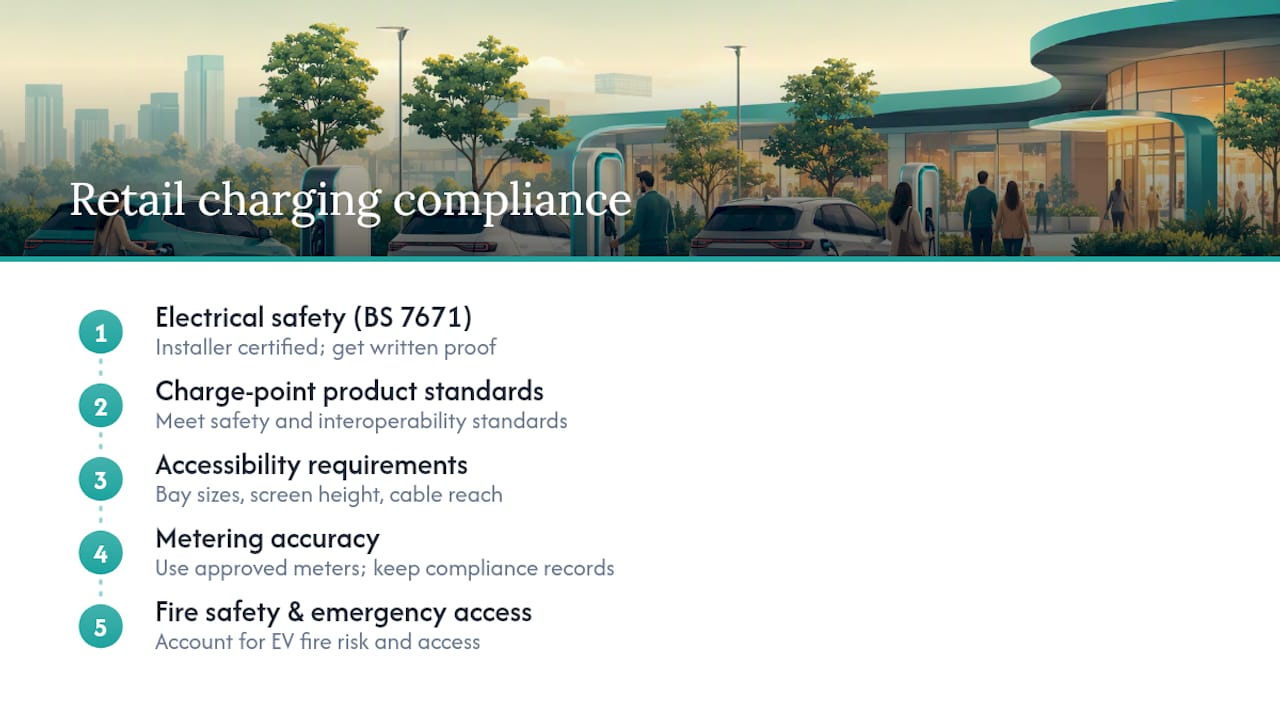
None of this needs to be intimidating if you work with an installer who handles compliance as standard practice rather than an afterthought bolted onto the design at the end.
How should retail operators handle data privacy and cybersecurity?
Every charging session generates data, including vehicle identifiers, payment details, timestamps and, where loyalty schemes are linked, customer identity. That makes your charging network subject to UK GDPR obligations in exactly the same way as your till systems or customer Wi-Fi.
Payment security follows the same PCI DSS standards that apply to any card transaction, whether payment runs through a dedicated app, contactless terminal, or RFID card. If a third-party network handles payments on your behalf, confirm in writing that they carry current PCI DSS compliance, since liability for a breach does not automatically transfer away from the site host.
Cybersecurity extends beyond payment data. Networked chargers are connected devices, and like any connected device on your site, they represent a potential entry point for attackers if firmware is not kept current. Ask any prospective installer or software provider how they handle firmware updates, how quickly they patch known vulnerabilities, and whether the charging network sits on a segregated part of your site’s IT infrastructure rather than the same network as tills or CCTV.
Data ownership deserves particular scrutiny in any contract. If a white-label platform captures usage data on your behalf, that data has genuine marketing value for loyalty and personalisation, but only if your contract actually grants you access to it and not just summary reports. Read the data clauses in any charging agreement as carefully as the commercial terms, because the two are increasingly linked.
What environmental benefits do retail chargers actually deliver?
Retail EV charging supports a straightforward emissions reduction case: every session on-site is a session that did not require a detour to a dedicated forecourt, cutting unnecessary miles driven purely to find a charger. For sites already investing in sustainability, that reduction adds a concrete, measurable element to wider environmental reporting.
The connection to on-site renewables adds a further layer. Retail parks with solar PV installations, whether on car park canopies or roof space, can use that generation to offset a meaningful share of charging demand, particularly during daytime hours when both solar output and shopper footfall peak together. Pairing chargers with battery storage smooths out demand spikes and reduces reliance on grid reinforcement, tackling two problems with one investment.
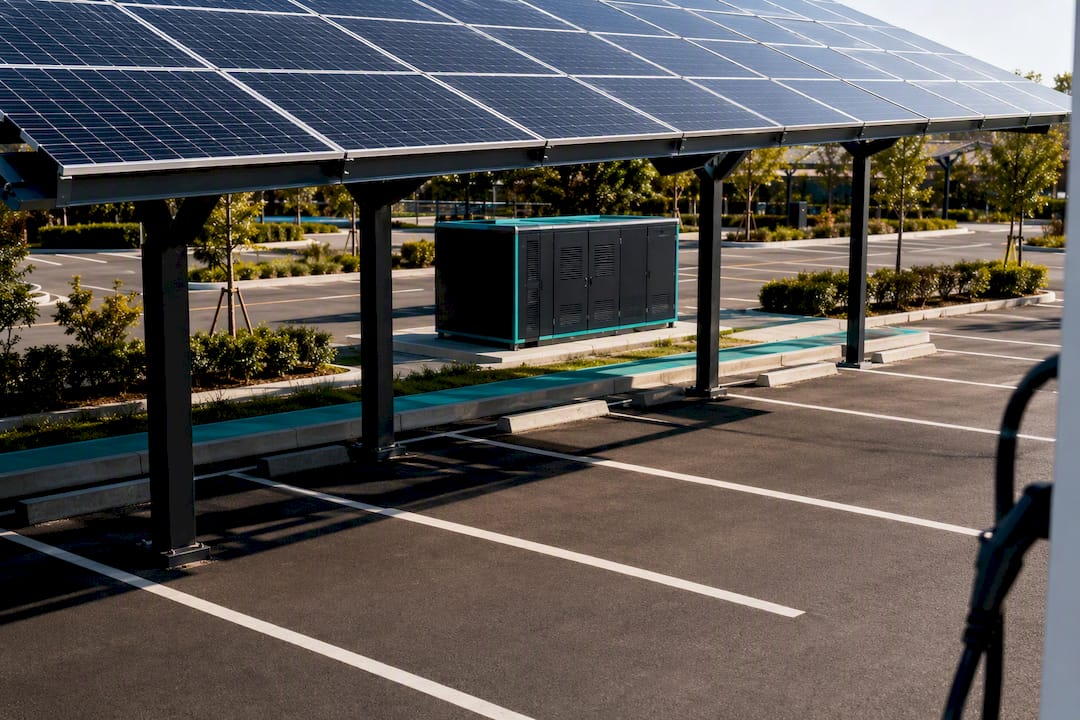
Sustainability credentials increasingly influence commercial decisions beyond goodwill. Anchor tenants assess a landlord’s environmental provision as part of lease negotiations, and local planning authorities increasingly expect EV infrastructure as a condition of new retail development consent. Chargers installed now position a site ahead of requirements that are likely to tighten rather than loosen over time.
None of this replaces the commercial case built earlier in this piece, but it reinforces it. A retail park that can point to both strong charging revenue and a credible sustainability story has a stronger position with tenants, planners and increasingly with customers who actively choose where they shop based on environmental provision.
An operator’s honest take on procurement
The biggest surprise operators report is how much grid capacity, not charger hardware, dictates timeline and cost. The real procurement trap is signing away data ownership for a “free” install. Prioritise uptime guarantees, data rights and a fair commercial split over the lowest headline price.
— Swift Charging
How Swift Charging can help you get started
Swift Charging is the practical route to retail charging that avoids the two biggest procurement traps: losing control of your customer data and overpaying for capacity you don’t need yet. We handle site surveys, technical design, installation, grant applications and ongoing software and maintenance as one connected service, rather than leaving you to coordinate separate suppliers for each stage.

If you host land or want to explore a no-capex commercial model, our host site programme explains how revenue share works in practice. For sites planning a full public charging rollout, our public charging services cover everything from dwell-time analysis to ongoing network management. We also support businesses through available UK grant schemes to reduce upfront installation costs where sites qualify.
The first step is a free feasibility survey. Book one through Swift Charging and get a clear picture of what your site can support before you commit to any commercial model.
Sources
FAQ
Are supermarket EV chargers still free to use?
Free charging at major UK supermarkets has largely disappeared as networks moved to paid tariffs reflecting energy costs. Some retailers still offer discounted rates or loyalty-linked pricing, but blanket free charging is no longer the norm across UK grocery retail.
What is the 80/20 rule for EV charging?
For retail sites, this matters because charging to 80% typically takes far less time than the final 20%, which is one reason shorter dwell-time bays work well with rapid DC units.
How much does it cost to charge an electric car for 200 miles?
The cost depends entirely on the electricity tariff and charger speed used, varying between home, workplace and public rapid charging rates. Retail operators setting their own pricing should benchmark against local public charging rates rather than fixed national figures, since prices vary significantly by network and location.
Is EV charging free at Sainsbury’s?
Sainsbury’s charging pricing has shifted to paid tariffs in most locations, in line with the wider move away from free retail charging across UK supermarkets. Specific pricing varies by store and charging network, so operators should check current terms directly rather than assume free charging remains standard.
What does it cost to install EV chargers at a retail park?
Installation costs vary widely depending on grid capacity, number of bays, and charger speed chosen, with DC rapid units costing considerably more than AC bays per connection. Swift Charging provides site-specific quotes following a feasibility survey, and current commercial packages are detailed on the Swift Charging site.
Recommended