Avoid Costly Grid Upgrades: Smart Charging for Fleets


Smart charging for fleets means using software to schedule, prioritise and share power across chargers automatically, rather than letting every vehicle plug in and pull maximum current at once. Swift Charging works from a simple principle backed by peer-reviewed research on coordinated EV charging: managed charging cuts energy costs and guarantees every vehicle is ready when it needs to be on the road.
TL;DR:
Managed charging can significantly reduce energy costs by shifting usage to off-peak hours and optimizing tariffs, especially with peak shaving to avoid grid upgrades.
Prioritizing vehicles by departure time and sharing power across chargers helps stay within electrical capacity and ensures vehicles are always ready on time.
Implementing smart charging involves site assessment, installing OCPP-compliant chargers, integrating telematics, running pilot tests, and scaling gradually for reliable operation.
Compliance with UK wiring regulations, data protection laws, and planning permissions is essential, making expert support valuable for smooth deployment.
Future developments include energy market participation and vehicle-to-grid capabilities, but choosing standards-based hardware remains crucial for adaptability.
Table of Contents
What smart charging for fleets actually involves
Unmanaged charging treats every vehicle the same: plug in, draw full power, hope the site’s electrical supply can cope. Smart charging replaces that guesswork with three coordinated functions. Schedule-aware charging looks at each vehicle’s planned departure time and works backwards to decide when it needs to start drawing power. Dynamic load balancing shares available capacity across every connected charger in real time, so a depot with ten chargers and a limited grid connection never trips the system. Tariff optimisation shifts consumption into cheaper electricity windows wherever the vehicle’s schedule allows it.
The technical backbone is usually the Open Charge Point Protocol (OCPP), which lets chargers from different manufacturers talk to one management platform, plus a telematics link that feeds real-world route and mileage data back into the charging plan. Fleet charging platforms such as IAV’s Swarm IQ Charge and Load illustrate how this works in practice, redistributing power across chargers by departure priority rather than charging order.
Core features to expect from a genuinely smart system include:
Prioritisation by departure time, so the last vehicle out isn’t stuck behind one that left three hours ago
Power-sharing across chargers to stay within your site’s electrical capacity
Charge-rate modulation that slows or speeds charging as tariffs and demand change
Vehicle-to-grid (V2G) readiness, even if you don’t use it on day one
Benefits for fleets: costs, operations and sustainability
The financial case starts with when you charge, not just how. Shifting charging into off-peak windows and letting the software chase the cheapest available tariff routinely cuts energy spend compared with charging on demand. Peak shaving, capping how much power the whole depot draws at any one moment, matters just as much: it can avoid or delay a costly grid capacity upgrade, which is often the single biggest line item in an electrification budget.
Fewer vehicles caught short. Coordinated charging strategies, including vehicle-to-grid participation, have been shown in academic modelling to reduce grid stress and fleet operating costs compared with unmanaged charging across the fleet.
Operational wins follow naturally. Vehicles that charge on a managed schedule are consistently ready at shift start, which reduces the downtime that comes from a driver arriving to find a flat battery or a charger stuck mid-cycle behind another vehicle.
Sustainability benefits stack on top:
Higher renewable self-consumption when charging is timed around on-site solar generation
Lower peak grid draw, easing pressure on the local network as fleet electrification accelerates
Better alignment with the wider adoption trend tracked by the IEA in its Global EV Outlook, which flags smarter depot management as essential as fleet numbers grow
How to implement smart charging at depot scale
Getting from diesel yard to smart-charged depot follows a fairly predictable sequence, whatever the fleet size.
Site survey. Assess your grid import capacity, existing switchgear, available parking layout and any civil works needed for cabling or trenching. This is the step that determines almost everything downstream.
Hardware selection. Choose OCPP-compliant chargers so you’re not locked to one software vendor, plan power distribution across the site, and get cable management right from the start rather than retrofitting it later.
Software selection. Pick a charge management platform that integrates with your telematics system, exposes APIs for reporting, and gives you visibility into every charger’s status without needing a site visit.
Pilot phase. Run a small subset of vehicles and chargers first, checking readiness rates and reliability before committing capital to the full fleet.
Validation. Confirm charge times, energy costs and vehicle readiness meet your targets during the pilot.
Scale-up. Roll out to the rest of the fleet in planned milestones, not all at once.
Pro Tip: Treat the pilot as a genuine test, not a formality. A phased rollout that checks vehicle readiness, charger reliability and measured energy savings before scaling catches problems while they’re cheap to fix, not after fifty vehicles depend on the system.
Acceptance criteria before going live should include: every charger reporting status correctly to the management platform, a tested fallback for grid or charger faults, and confirmed vehicle readiness across at least two full operating cycles. For guidance on the civils and cabling side specifically, our piece on EV charger cable management for fleet operators covers the practical detail.
Keeping charging aligned with daily fleet operations
Smart charging only works if it talks to the systems that already run your fleet. Telematics data, routes, mileage, return times, should feed directly into the charge plan so the software knows which vehicle needs priority tonight, not last week. Platforms like FreightSuite show how transport management systems increasingly expect this kind of two-way data flow as standard.
Override and fallback rules matter more than most fleets expect. If a vehicle returns early, unscheduled, or a charger faults overnight, the system needs a clear rule for what happens next, not a phone call to whoever’s on shift.
Track a small set of numbers consistently:
Energy consumed per vehicle, to spot outliers early
Readiness rate, the percentage of vehicles fully charged at shift start
Peak demand, to confirm you’re staying inside your grid capacity
Our guide to fleet depot charging as an operational discipline goes deeper into building these rules into daily practice.
Costs, funding and the business case
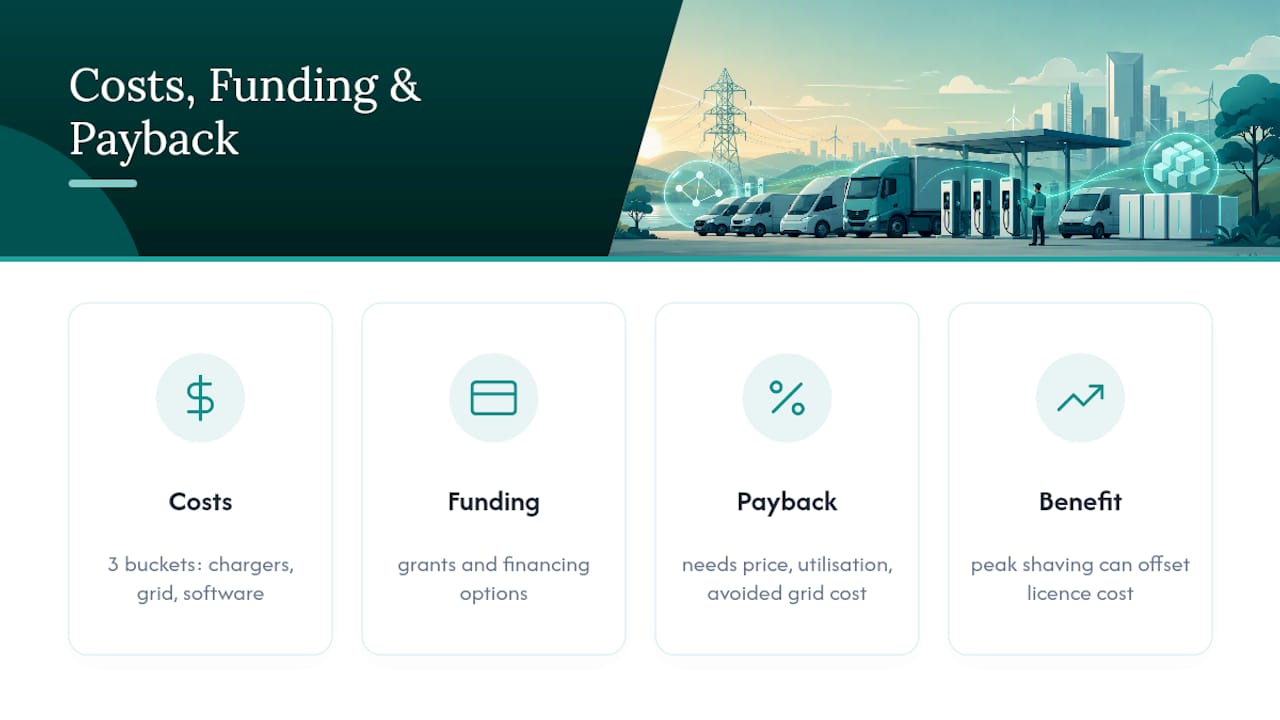
Capital costs sit in three buckets: chargers and installation, electrical infrastructure (switchgear, cabling, sometimes a grid upgrade), and the software platform itself. Smart charging shifts some of the burden from capital to operating expenditure, since avoiding a grid upgrade through peak shaving can be worth more than the software licence costs over several years.
Funding routes worth exploring include government EV charging grants, where eligible, and financing models that spread installation costs rather than requiring full upfront capital.
A rough payback model needs just three inputs: your current energy price per kWh, expected fleet utilisation, and the avoided cost of a grid upgrade if peak shaving removes the need for one. These numbers vary enormously by site, which is exactly why a proper feasibility survey, not a generic estimate, is the sensible starting point. Our article on unlocking savings through EV charging grants walks through how a feasibility study changes the numbers in practice.
A practical route from feasibility to managed operation
A recommended approach follows the sequence: feasibility assessment, system design, installation, commissioning, then long-term management, rather than a chargers-only sale that leaves the software and maintenance to figure out later.
Where a site has, or is considering, solar PV and battery storage, the charging plan is built to work with them rather than around them, timing vehicle charging to draw from on-site generation when it’s available and from the grid only when it isn’t.
Typical elements of that end-to-end service include:
Site feasibility and grid capacity assessment before any hardware is chosen
Support identifying and applying for available EV charging grants
Ongoing management through charger software with load management built in
Integration guidance for solar PV, battery storage and wider energy solutions
Regulatory and compliance aspects affecting smart charging implementation
Commercial charging infrastructure in the UK sits under several overlapping compliance requirements, and getting them wrong tends to surface at the worst possible moment, usually during a grid connection application or an insurance review.
Electrical installations must meet the relevant UK wiring regulations, and any charger connected to the grid needs to satisfy your Distribution Network Operator’s connection requirements, particularly where total site demand is significant enough to need a formal application rather than a simple notification. Fleet depots drawing serious power almost always fall into the formal application category, which is one reason the site survey stage matters so much: it flags capacity issues before they become a stalled project.
Data handling deserves equal attention. A charging management platform holds vehicle usage patterns, driver behaviour data in some telematics integrations, and payment information if you’re running RFID access or public-facing charging alongside fleet use. That data needs handling in line with UK data protection requirements, and any third-party software vendor should be able to explain clearly where that data lives and who can access it.
Building and planning permissions can also apply, particularly for civil works, new switchgear housing, or any structural changes to accommodate charger placement. Grant-funded installations typically come with their own compliance conditions attached, covering everything from installer accreditation to reporting obligations after the system goes live. None of this is a reason to delay a project, but it is a reason to bring in expertise that has navigated it before rather than treating compliance as an afterthought bolted onto a hardware order.
Where smart charging is heading and what to watch for
Fleet charging is moving from simple scheduling towards genuine energy market participation. V2G pilots may eventually offer revenue for spare battery capacity, but real value depends heavily on vehicle capability and the commercial terms on offer, not on the technology alone. The safest long-term move is choosing hardware-agnostic, standards-based charge software, so today’s decision doesn’t lock you out of tomorrow’s options.
— Swift Charging
Get your depot assessed for smart charging
There are DIY routes into fleet charging, buying chargers directly and stitching together your own software and telematics integration, but most fleet managers don’t have the spare time to become charging infrastructure specialists on top of running a fleet. An end-to-end alternative offers one point of contact from feasibility survey through installation, commissioning and ongoing management, often supported by grant application assistance where eligible.

First contact starts with a feasibility review of your depot, checking grid capacity, site layout and current vehicle schedules against what smart charging could realistically deliver. From there, you get a proposal covering hardware, software and, where relevant, solar PV and battery storage integration. If your fleet already operates from a shared workplace site, our workplace EV charging solutions may cover both needs under one installation.
Visit the fleet EV charging solutions page to request a site survey and see how the numbers stack up for your depot.
Sources
FAQ
How does smart charging work?
Smart charging uses software to schedule when each vehicle charges, share available power across chargers, and shift consumption into cheaper tariff windows. It relies on standards like OCPP to connect chargers from different manufacturers to one management platform, and often pulls in telematics data to prioritise vehicles by departure time.
What is fleet charging?
Fleet charging refers to the infrastructure and management systems that charge a company’s commercial vehicles at a depot or workplace site, rather than relying on public charge points. It typically combines chargers, power distribution, and management software to keep every vehicle ready for its next shift.
Does Swift Charging offer EV charging for fleets?
Yes. Swift Charging provides fleet EV charging solutions covering feasibility assessment, design, installation, commissioning and ongoing management, alongside support applying for available EV charging grants where eligible.
Which vehicles will be V2G ready?
Vehicle-to-grid readiness depends on the manufacturer building bidirectional charging capability into both the vehicle and its onboard charger, and this varies by model and manufacturer rather than being universal across new EVs. Fleet managers considering V2G should confirm bidirectional compatibility directly with the vehicle manufacturer before assuming a model supports it, and treat early pilots as revenue potential rather than guaranteed income.
Recommended