Solar EV charging: can you power your car for free?

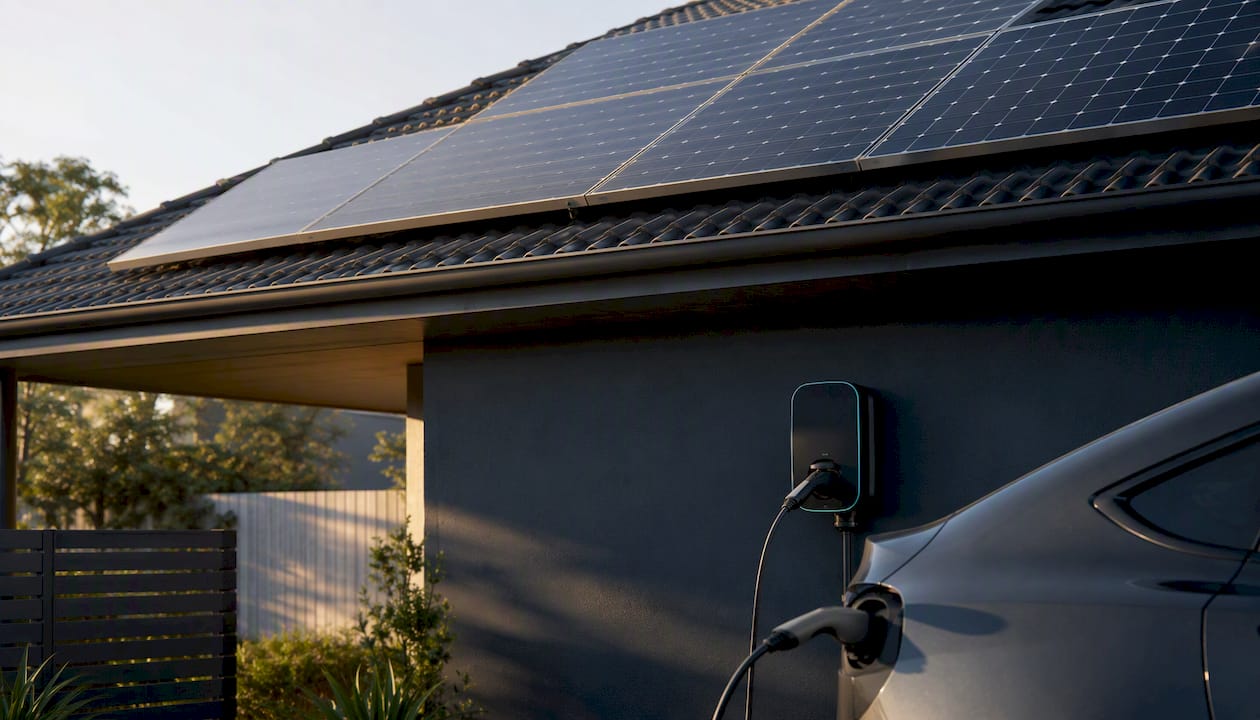
Yes. Most UK homeowners with a suitably oriented roof can use solar panels to meaningfully offset home EV charging, often covering a large share of typical daily driving during spring and summer. The limits are real, though, and depend on your roof, your car and when you plug in. Your immediate next step is a professional site survey, or at minimum a rough household energy check, to see how your roof yield and driving pattern line up. Standards from bodies like IEA‑PVPS and grant guidance from the Office for Zero Emission Vehicles shape what a good setup looks like, and Swiftcharging can talk you through both.
Key Takeaways
Solar EV charging works best when panel output, charger intelligence and (where needed) battery storage are sized together against your actual roof and driving pattern, not chosen separately.
Point | Details |
Direct daytime charging is cheapest | Best if your car sits at home during sunny hours; needs no extra hardware beyond a solar‑aware charger. |
Sizing depends on mileage, not guesswork | A commuter driving 20 miles a day needs roughly 5 to 6 dedicated panels; higher mileage needs 12 or more. |
Batteries solve evening charging | A 10 to 20 kWh battery can meaningfully top up most daily commutes after dark. |
Charger features matter more than brand | Look for PV‑diversion, load balancing, CT clamp integration and automatic grid fallback. |
Grants can offset costs | Check current OZEV workplace and business schemes before budgeting, especially for home‑to‑work charging splits. |
A site survey changes the plan | Swiftcharging models roof yield, household load and DNO position before recommending a solar EV charging setup. |
Table of Contents
How does solar EV charging actually work at home?
A domestic solar EV charging system links a handful of components, and understanding how they talk to each other explains why some setups waste solar and others use nearly all of it. Your roof generates direct current electricity, which an inverter converts to the alternating current your home and charger actually use. From there, power either serves your household loads first, tops up the car, or spills to the grid if nothing at home needs it.
PV array: the panels themselves, sized in kWp (kilowatt peak)
Inverter: converts DC to AC and reports generation data
Home meter/CT clamp: measures what your house is drawing versus exporting
Solar‑aware charger or PV diverter: reads that surplus and steers it to the car
Optional battery: stores excess for use after the sun drops
Grid connection: fills any gap when solar and battery can’t cover demand
Two modes dominate real installations: direct daytime offset, where the charger only draws what the panels are producing right then, and grid‑supported charging, where the car draws a steady rate topped up by the grid whenever solar output dips. Smart charging and load balancing sit underneath both, constantly reading that CT clamp so the charger never pulls more than your house can spare, as explained in detail at net zero and sameday deliveries.
Which home setup suits your driving pattern?
The right configuration for solar EV charging depends far more on when your car sits on the drive than on how many panels you can fit on the roof. Four setups cover most UK homes.
Direct daytime charging: the simplest and cheapest option, works well if your car is parked at home during sunny hours, such as retirees or hybrid workers.
Solar‑divert charger: a PV‑aware charge point that automatically steers midday surplus into the car; suits anyone home during the day but not glued to a charging app.
Solar plus home battery: stores daytime generation for an evening or overnight charge; the right call if you commute and only plug in after dark.
Grid‑tied with smart scheduling: little or no new hardware beyond a smart charger, using off‑peak tariffs to fill gaps solar can’t reach.
Most homeowners start with direct daytime charging or a solar‑divert charger, then add a battery later once they’ve seen their actual generation pattern through a full year.
How many solar panels do you need to charge an EV?
Sizing depends on daily mileage, your car’s efficiency and how much roof you can dedicate to panels, so a worked example beats a generic rule of thumb. Assume a typical EV uses around 0.3 kWh per mile, a standard 400W panel produces roughly 350 to 450 kWh a year in the UK depending on orientation and shading, and a 60 kWh battery is a realistic mid‑size EV.
Low user (20 miles/day, roughly 6 kWh): around 5 to 6 panels dedicated to EV charging on top of household needs.
Average user (30 to 40 miles most days): around 8 to 10 panels, assuming decent south‑facing roof space.
High user (40 to 50 miles/day or regular longer trips): 12 or more panels, and a strong candidate for battery storage to catch what daytime driving misses.
Charger type | Power | Time to charge 60 kWh battery |
Standard AC home charger | 7 kW | Around 7 hours |
Fast AC home charger | 22 kW | Around 3 hours |
These figures for charge time by charger type show why most homes stick with 7 kW: it matches an overnight or all‑day solar window without needing a costly three‑phase supply upgrade.
What features make a charger solar-compatible?
A solar‑aware charger, not brand loyalty, is what determines whether your panels actually reach the car. Look past marketing names and focus on what the unit does.
Must‑haves:
PV‑diversion or PV‑aware mode that reads surplus generation in real time
Load balancing to avoid tripping your main fuse when the car and other appliances draw together
CT clamp or meter integration so the charger knows what’s actually available
OCPP support for future compatibility with management software
Automatic fallback to grid power when solar drops, so charging never simply stops
Nice‑to‑haves:
Scheduled charging windows tied to tariff periods
Adjustable maximum charging rate
App‑based telemetry and notifications, similar to the solar‑steering app features some vendors already build in
Export‑limiting controls
Remote firmware updates from the manufacturer
A charger missing the must‑haves will still charge your car. It just won’t know when your roof is doing the work for free.
Do you need a home battery for solar EV charging?
Not always, but a battery solves a specific problem: it lets you charge after dark using power your roof generated at midday. Batteries earn their keep in three ways: shifting solar into evening charging windows, boosting overall self‑consumption of what you generate, and adding resilience during outages.
Shift midday surplus to an evening top‑up
Increase self‑consumption instead of exporting to the grid for a fraction of retail price
Provide backup capacity during a power cut
A rough sizing rule: a 10 to 20 kWh usable battery can meaningfully top up most daily commuters, covering 30 to 60 miles of driving depending on efficiency. Battery capital cost and round‑trip efficiency losses mean it pays off fastest when paired with smart scheduling rather than left to run on default settings.
Pro Tip: Don’t size a battery around your worst winter day. Size it around your typical week, then let the grid cover the outliers. Oversized batteries rarely pay back their extra cost.
What does solar EV charging cost, and where’s the payback?
Installed costs vary by roof complexity and system size, but ballpark figures help with early budgeting. A typical 4 kWp domestic solar array runs roughly £5,000 to £7,000 installed, and adding a solar‑aware EV charger typically adds £800 to £1,500 on top of a standard charger install.
Solar array (4 kWp): £5,000 to £7,000
Solar‑aware EV charger upgrade: £800 to £1,500 extra
Battery storage (10 kWh): £3,000 to £5,000 additional
Homeowners driving 10,000 miles a year at 0.3 kWh per mile use around 3,000 kWh annually for the car alone. At a typical grid rate well above the cost of self‑generated solar, offsetting even half that mileage with free daytime generation can save several hundred pounds a year, though your actual figure depends on tariff, roof yield and driving pattern.
Grant support changes this maths for some households, particularly where charging straddles home and work use. The Office for Zero Emission Vehicles’ workplace scheme and similar business‑facing grants can materially reduce charger capex if you run a small business from home or negotiate with an employer. Always check current local schemes before finalising a budget. They shift year to year.
What installation and safety checks should you expect?
A competent installer follows a set sequence: site survey, electrical capacity check, panel and inverter procurement, charger installation, then commissioning and handover with test certificates. Skipping steps here is where problems start.
MCS accreditation for the solar PV installation itself
NICEIC or equivalent certification for the electrical work
Correct earthing and bonding, checked against current wiring regulations
Meter and CT clamp correctly installed and calibrated
Test certificates issued and explained, not just handed over
Typical timelines run two to six weeks from survey to commissioning, depending on Distribution Network Operator (DNO) approval where needed. Red flags include installers who can’t produce accreditation numbers, quotes with no itemised breakdown, or promised turnarounds that sound too fast for a proper structural and electrical check.
Why does a professional site survey matter so much?
A site survey is where theory meets your actual roof, and it routinely changes the plan homeowners walked in with. A good installer models roof yield using your specific pitch, orientation and shading, profiles your household’s existing electricity use hour by hour, and checks whether a DNO conversation is needed before your export capacity is confirmed.
Roof yield modelling against your specific orientation and any shading from trees or neighbouring buildings
Household load profiling to see when you actually use power, not just how much
DNO discussion where export limits or supply capacity need checking
A proposed layout with two or three cost and performance options, not a single take‑it‑or‑leave‑it quote
What separates an accredited installer from a DIY approach is grant support, workmanship guarantees and back‑office software that keeps your charger talking to your solar system correctly. One recent domestic survey found a homeowner’s assumed south‑facing roof was in fact ten degrees off true south with a chimney shading the array for two hours each afternoon, a detail that changed panel placement and pushed a battery from optional to worthwhile.
What do installers see that homeowners don’t expect?
Every survey turns up something the homeowner hadn’t accounted for. Roof orientation looks fine from the street and turns out to be twenty degrees off what the compass app suggested. Or a chimney nobody thought about casts a two‑hour shadow across the exact panels doing the heaviest lifting.
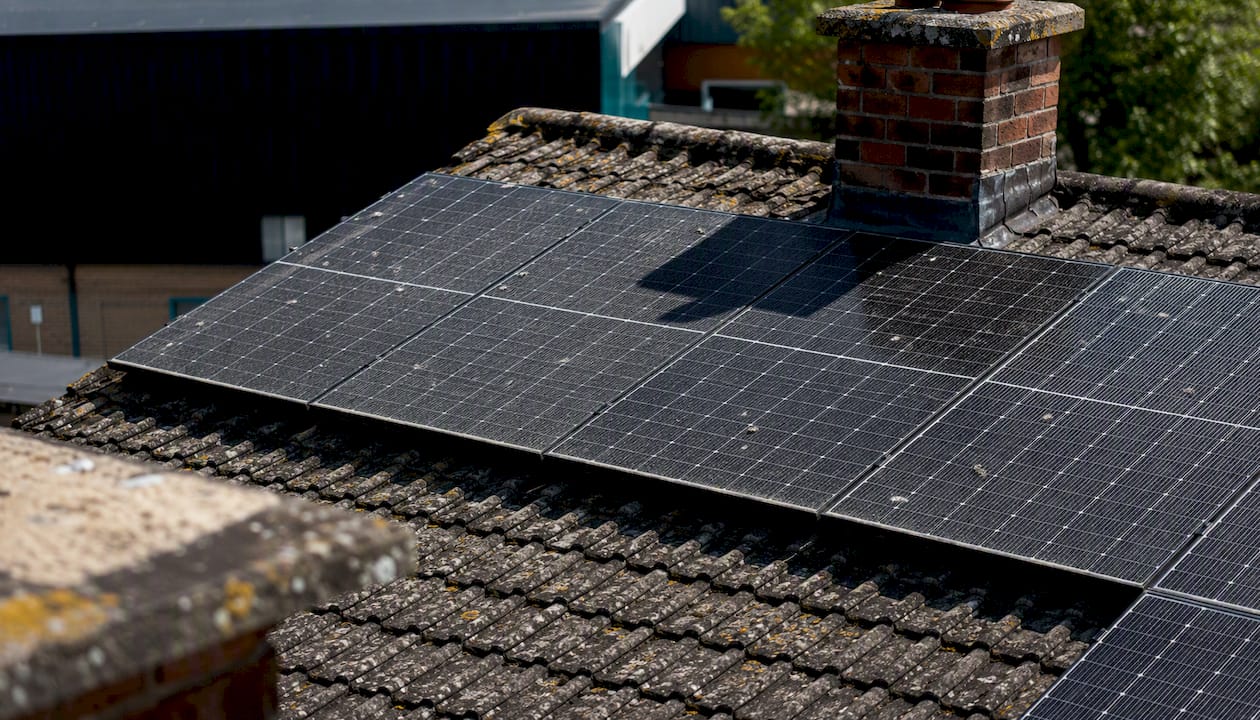
The most common surprise isn’t the roof at all. It’s household demand: people consistently underestimate how much power they already use before the car enters the picture, which changes how much solar is actually left over for charging. None of this makes solar EV charging a bad idea. It just means the number you imagined before the survey rarely matches the number the survey delivers, and that’s exactly why the survey happens before the quote, not after.
Get a solar-ready EV charging setup without the guesswork
Swiftcharging designs and installs EV charging infrastructure with solar PV and battery storage built into the plan from day one, not bolted on afterwards. Where a DIY solar kit or a generic charger installer leaves you guessing whether your setup actually offsets your driving, Swiftcharging runs a proper site survey first: roof yield, household load, DNO position and realistic cost options, all before you commit to a spec.

That approach suits homeowners who’ve read this far and want the sizing questions answered against their actual roof rather than a generic worked example. It also suits anyone weighing a home‑to‑work charging split, since Swiftcharging can advise on available grant support alongside the technical design. If you’re near Chichester, Eastbourne or Farnborough, get in touch to book a site survey and get a proper quote before you buy anything.
Frequently asked questions
Can I charge my EV directly from solar panels without a battery? Yes, using a solar‑divert charger that steers surplus daytime generation to the car. You’ll lose the option to charge after dark from stored solar, so it suits homes where the car is parked during sunny hours.
Do I need planning permission for a home solar EV charging setup? Most domestic rooftop solar installations fall under permitted development in the UK, but listed buildings, conservation areas and unusual roof configurations can require checks. Your installer should confirm this during the site survey.
How long does a solar EV charging installation take? Typically two to six weeks from initial site survey to commissioning, depending on whether DNO approval is needed for grid export or supply capacity.
Will solar EV charging work in winter? Generation drops significantly in winter months, so most UK homes rely more on grid‑supported charging or off‑peak tariffs during that period, with solar making up a larger share in spring and summer.
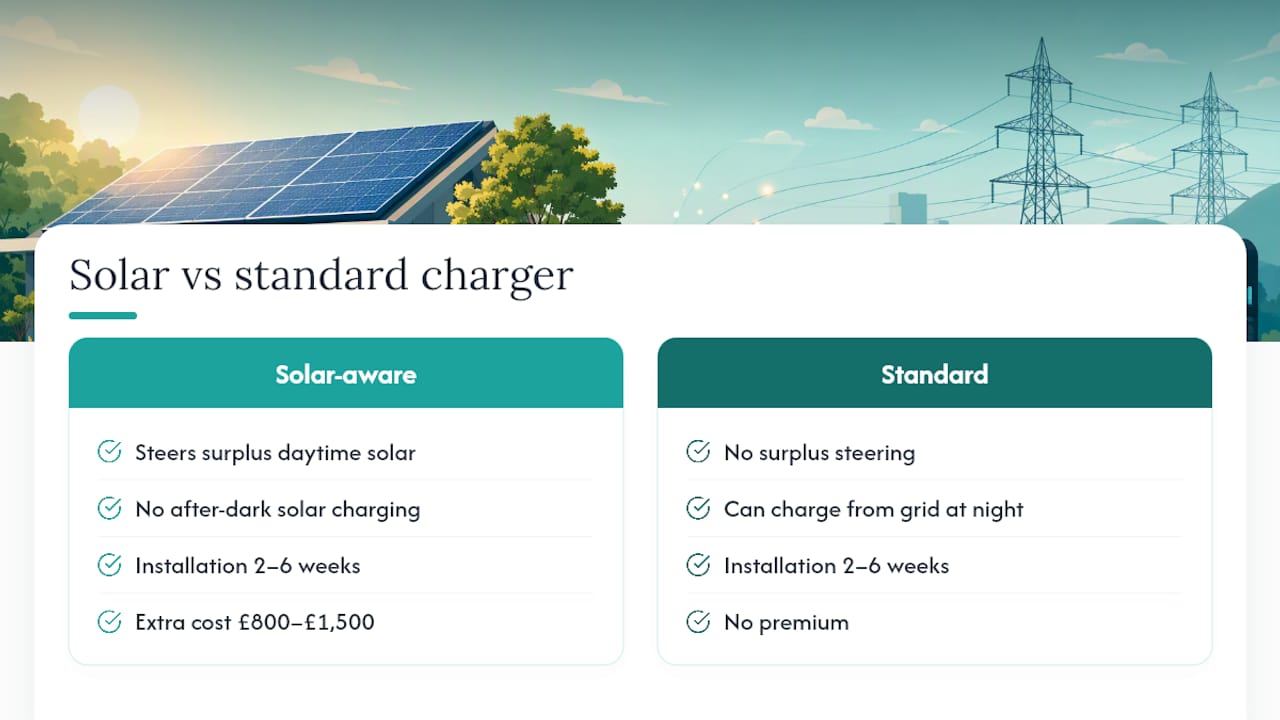
Is a solar‑aware charger worth it over a standard charger? For homeowners with rooftop solar, yes. The price difference, typically £800 to £1,500, is usually recovered through better use of free daytime generation rather than exporting it at a lower grid rate.
Sources
Recommended