5 Charging Management Software Features Procurement Teams Must Verify

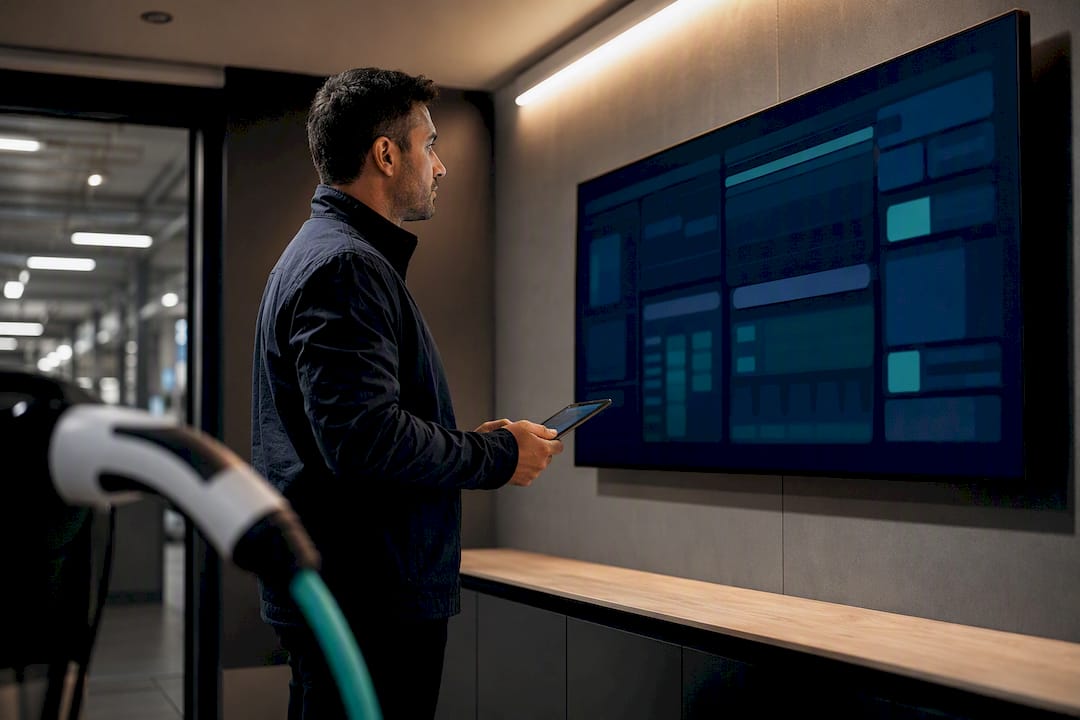
A charging management platform must let you operate, control and monetise chargers at scale while keeping energy use inside your site limits. That means five capability groups matter most: operations and monitoring, energy management, billing, integrations and security. Look for OCPP and OCPI compliance, dynamic load balancing, and clear reporting on uptime, and you’re evaluating the right things.
TL;DR:
Dynamic load balancing can significantly reduce the need for costly grid upgrades by adjusting charger output in real time based on demand fluctuations.
Smart charging prioritizes shifting sessions to off-peak periods, lowering peak demand charges through accurate site metering and communication protocols.
Vendors should support offline charging, remote diagnostics, role-based user authorization, and data exports, especially for scaled multi-site deployments.
Compliance with OCPP 1.6 or 2.0.1 and OCPI standards is essential to prevent vendor lock-in and ensure interoperability across hardware and payment systems.
A comprehensive demo should test fault handling, load response, tariff changes, and offline operation to verify features meet real-world operational needs.
Table of Contents
Charging management software features: the core checklist
Before comparing vendors, decide what “good” looks like. The checklist below is what we’d expect any credible platform to answer without hedging.
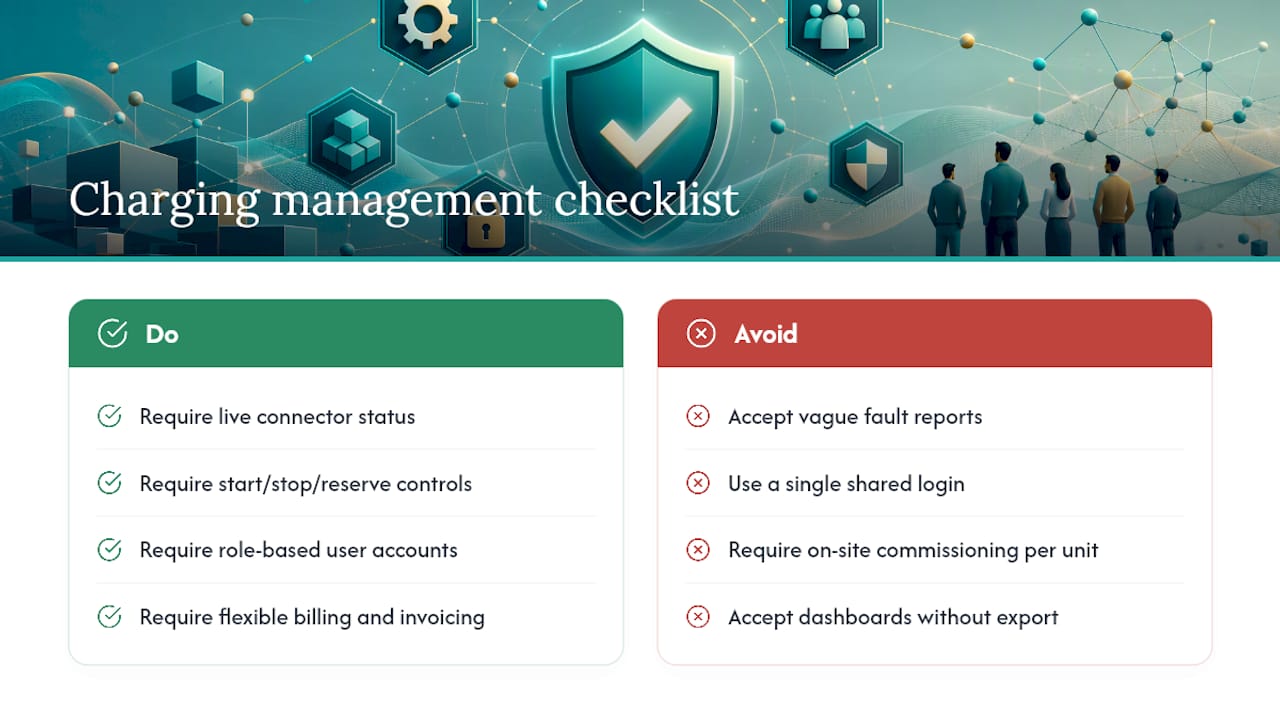
Monitoring and diagnostics. You need live status per connector, fault codes in plain language, and remote restart capability. Ask vendors how quickly a fault surfaces and whether diagnostics distinguish a hardware fault from a network dropout.
Session control and reservations. Drivers or fleet controllers should be able to start, stop, and reserve a bay ahead of arrival. This matters more for depots and workplaces than public sites, where walk-up usage dominates.
User authorisation. Expect RFID card support, individual driver accounts, and the ability to group users by cost centre or department. Corporate groups need role-based permissions, not a single shared login.
Billing and payment options. The platform should handle per-kWh, per-minute, subscription and hybrid tariffs, plus invoicing that reconciles against actual consumption.
Commissioning and firmware management. Look for staged firmware rollouts, remote configuration, and zero-touch commissioning so new chargers join the fleet without an engineer visit for every unit.
Evaluation criteria for each item should be the same: does it work offline, does it scale past ten sites, and can you export the underlying data rather than just a dashboard screenshot? Vendor examples show how these features translate into practice, including zero-touch commissioning and staged firmware updates across a charger fleet.
Energy management: dynamic load balancing and smart charging
Dynamic load balancing adjusts charger output in real time so your total site draw stays within the grid connection you’ve actually paid for. It works by grouping chargers into “power groups” that share a capped allocation, throttling individual sessions automatically as demand shifts across the group. Done properly, dynamic load balancing can reduce or delay the need for a costly grid connection upgrade, which is often the single biggest cost variable in a multi-charger installation.
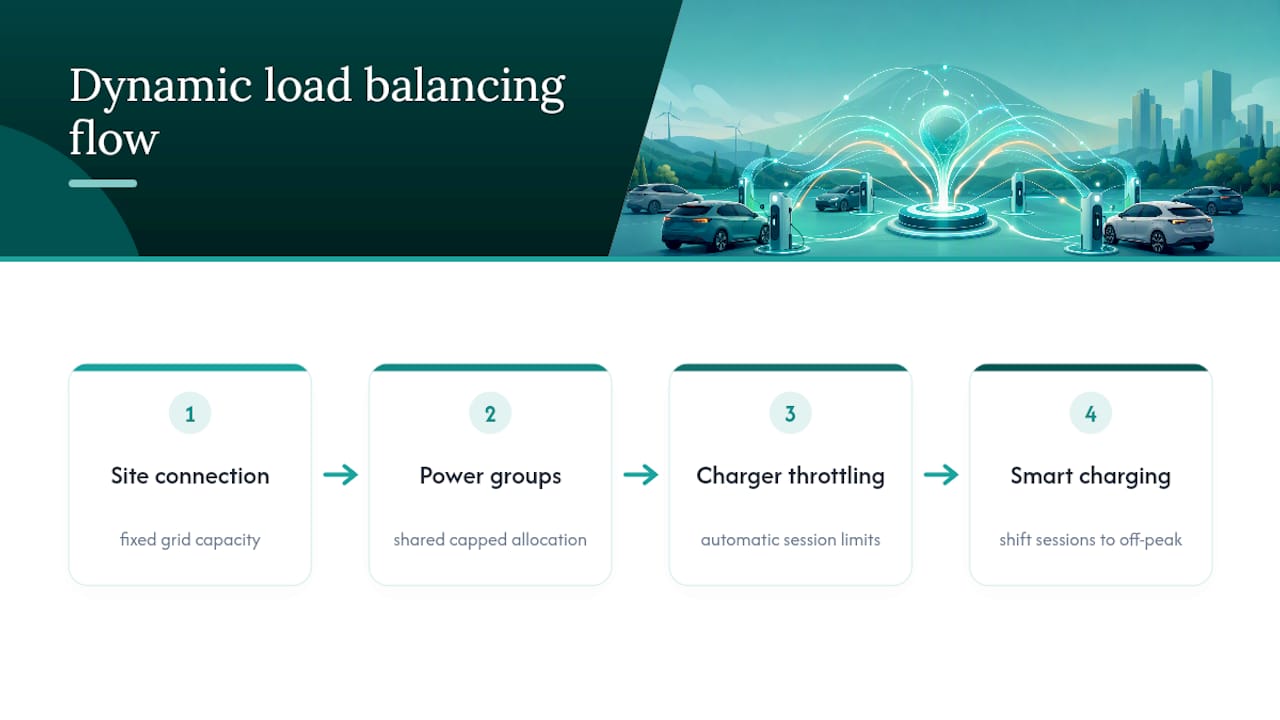
Smart charging goes further, shifting sessions towards cheaper time-of-use periods and away from peak import charges. It depends on accurate site metering, a communications gateway, and chargers that support the right OCPP messaging to accept remote power adjustments. The IEA’s Global EV Outlook flags smart charging controls as central to limiting grid strain as EV numbers grow, and the operational upside is concrete: lower peak demand charges and infrastructure that scales without repeated capital spend. For the mechanics behind power groups, our guide to dynamic load balancing covers the technical detail site managers usually ask about first.
Pro Tip: Ask any vendor for their control cadence, meaning how often the platform recalculates and sends new power limits. A system that updates every 30 seconds behaves very differently under load than one that updates every 10 minutes.
Fleet and depot features that keep vehicles moving
Depot managers care about one thing above all: vehicles leaving on schedule, charged and ready. The features that deliver that are specific.
Scheduling and reservations tied to route departure times, not just charger availability.
Vehicle-level profiles that match charge rate and target state-of-charge to each vehicle type, rather than treating every van the same.
Charger assignment logic that allocates bays automatically based on arrival order and battery state.
Remote diagnostics with guided fault workflows, so a driver or site supervisor can resolve a stuck connector without waiting for a callout.
Zero-touch commissioning for scaling a depot from five chargers to fifty without proportional engineering time.
Running a short pilot at one depot, checking each item against real shift patterns, tells you more in two weeks than any spec sheet. Our fleet depot charging guide sets out a fuller operational checklist for exactly this stage.
Billing, payments and revenue operations
Finance teams should test three things before signing: metering accuracy, tariff flexibility and how cleanly the platform reconciles against your accounting system.
Pricing models: confirm the platform supports per-kWh, per-minute, flat subscription and hybrid tariffs, and that you can change tariffs without a vendor ticket.
Wallets and invoicing: check corporate accounts can prepay via wallet or be invoiced monthly, with multi-site settlement rolled into one statement.
Finance integration: near real-time metering and ERP or accounting integration matter, since billing platforms that lack multi-model pricing and finance system integration create reconciliation errors and vendor lock-in.
Audit trail: every session should generate a record you can retrieve, not just a monthly total.
Demo checks should include a live session, then a reconciliation report pulled the same day, to confirm the numbers actually match.
Integrations, APIs and standards: avoiding lock-in
Interoperability protects you when a vendor relationship ends or a charger model changes. Two standards do most of the work: OCPP (Open Charge Point Protocol) governs how chargers talk to the management platform, and OCPI (Open Charge Point Interface) governs how platforms exchange roaming and payment data with each other.
Verify which OCPP version is supported (1.6 versus 2.0.1 matters for smart charging features) and ask for a compliance test certificate, not a marketing claim.
Check for REST APIs and webhooks with published developer documentation, not a promise to “build it on request.”
Confirm integrations with telematics, building management systems, meters and payment gateways, and ask to see a working example of freight management software, not a roadmap slide.
Security, compliance and maintenance you should require
Ask for role-based access control and single sign-on support before you ask about anything else. Data protection matters just as much: session and payment data need clear GDPR handling and a logging trail you can produce for an audit.
Firmware policy should specify how updates roll out and how incidents get escalated, backed by an uptime SLA in writing. Request evidence rather than assurances, since platforms often publish security claims that procurement should verify against pen-test summaries and ISO 27001 certificates rather than take at face value.
How to evaluate vendors: the demo and pilot checklist
A feature list on a data sheet tells you what a platform claims. A structured demo tells you what it actually does under pressure.
Simulate a charger fault mid-session and time the alert.
Push the site to maximum simultaneous load and watch how load balancing responds.
Change a tariff live and confirm it applies to the next session, not the next billing cycle.
Disconnect the network and check offline charging still authorises known RFID cards.
Pull a reconciliation report and match it against the metered kWh.
Ask who owns the session and driver data, and what export format you get on exit.
Request the exit and migration terms in writing before you sign anything.
Confirm engineering effort required on your side for initial setup and ongoing changes.
On cost, look beyond the licence fee to migration risk and the engineering hours integration will actually consume. Testing real scenarios like offline fallback and tariff changes reveals more about vendor risk than any feature checklist, so treat the pilot as the real evaluation, not a formality before signing.
Pro Tip: Set a minimum acceptance threshold before the pilot starts, such as zero missed reconciliations over 30 days, so the decision isn’t made on gut feel afterwards.
Which features actually deliver commercial value
Priorities shift by use case. Workplace sites live or die on driver authorisation and simple billing; fleet depots live or die on scheduling and vehicle-level profiles; public hosts live or die on payment reliability and uptime reporting. The most common implementation pitfall we see is buying analytics tiers that report basic uptime while the business actually needs vehicle-level telemetry for route assurance, a gap Kempower’s ChargEye tiers illustrate well. Match the tier to the decision you need to make, not the one that looks impressive in a sales deck.
— Swift Charging
How Swift Charging supports your implementation
Choosing the right software is only half the job. Swift Charging designs, installs and manages commercial EV charging infrastructure across workplace, fleet, depot and public sites, and we integrate charging software with load management from day one rather than bolting it on afterwards.

If you’re weighing up features on a spreadsheet, a feasibility survey usually settles more questions than another vendor call. Our workplace EV charging solutions cover installation through to ongoing management, while fleet EV charging solutions are built around depot scheduling and vehicle readiness. Landowners considering hosting EV chargers on their site get the same software and billing backbone. We also support businesses through applicable UK EV charging grants, which can reduce the upfront cost of installing infrastructure. Request a site survey or a software demo through Swift Charging and get a specific answer for your site, not a generic feature list.
Sources
FAQ
What Are the Must-Have Charging Software Features?
Monitoring and diagnostics, dynamic load balancing, flexible billing, OCPP/OCPI compliance and role-based security controls form the essential core; anything missing one of these needs a strong justification.
Does Charging Software Need OCPP and OCPI Support?
OCPP governs charger-to-platform communication and OCPI governs roaming and cross-platform data exchange, so both matter if you want to avoid being locked into a single vendor’s hardware.
How Much Does EV Charging Management Software Cost?
Pricing varies by deployment size and feature tier, and Swift Charging doesn’t publish a fixed rate; current costs are available directly through Swift Charging after a short feasibility conversation.
Can Charging Software Reduce Peak Electricity Costs?
Yes, dynamic load balancing and time-of-use smart charging both cut peak demand charges by shifting or capping charger output automatically, which can also delay the need for a grid connection upgrade.
What Should a Software Demo Actually Test?
Push the demo beyond the feature list: simulate a fault, force high simultaneous load, change a tariff live, and disconnect the network to confirm offline authorisation still works.
Recommended