Landlords: Get EV Chargers Live in 8–10 Weeks With a Legal Checklist


Landlords usually choose one of three routes: landlord-funded installation, a fully-funded operator partnership, or a tenant-led project with your consent. Whichever route fits your site, the first move is always the same: check your lease for restrictive covenants, then commission an electrical feasibility survey before you agree anything with a tenant or installer.
TL;DR:
Responsibility for EV charger installation depends on lease provisions, especially regarding alterations, parking rights, and ownership of equipment after tenancy ends.
Site surveys must assess existing electrical capacity, potential grid upgrades, and appropriate charger types to avoid costly delays and overruns.
Most installations fall under permitted development unless in conservation areas or listed buildings, requiring careful planning consent and freeholder approval.
Costs are mainly unpredictable civil and grid reinforcement expenses, which can extend timelines from weeks to several months, especially if upgrades are needed.
Using an end-to-end provider for survey, design, installation, and management reduces risks of budgeting errors and helps access grants or additional electrical capacity options.
Table of Contents
Who is responsible for commercial landlord EV charging: landlord or tenant?
Which funding model suits your site: self-funded, operator partnership, or hybrid?
What does EV charger installation cost, and what’s the realistic timeline?
Which contract structure protects you: licence, lease, or deed of variation?
How do you keep chargers running smoothly once they’re live?
How Swift Charging gets you from survey to live chargepoints
Who is responsible for commercial landlord EV charging: landlord or tenant?
Responsibility hinges on what your lease actually says, not on who asks first. Most commercial leases were drafted before EV charging was a live issue, so alteration clauses, parking rights and service charge provisions often say nothing explicit about chargepoints.
Start by checking for restrictive covenants that touch parking allocation, structural alterations, or exclusivity over specific bays. A tenant converting three shared spaces into dedicated EV bays without checking these clauses can breach the lease even with good intentions on both sides.
If your building sits under a head lease, freeholder consent is very likely required before anyone runs cabling through communal risers or car park areas. Document that permission in writing every time, because verbal agreements dissolve the moment a dispute arises over cost or access.
A short landlord checklist for tenant requests:
Confirm whether the request falls under an existing alterations clause or needs a formal licence.
Check parking allocation rights before agreeing to repurpose any bays.
Establish who owns the installed hardware once the tenancy ends.
Get freeholder or head-lease consent in writing, not verbally, where multi-occupancy applies.
Set a response timeline. Many landlord guides recommend replying to formal improvement requests within a set statutory period, and the 2026 landlord guide sets out the practical steps for doing this without losing control of the asset.
Cost recovery through service charges is another trap. Legal guidance from Myerson warns that recovering EV installation or running costs through service charges is risky unless the lease expressly permits it. A separate licence or deed often protects you better than trying to stretch existing service charge wording to cover something it was never written for.
Which funding model suits your site: self-funded, operator partnership, or hybrid?
Three models dominate the market, and each suits a different risk appetite.
Self-funded. You pay for hardware, installation and grid upgrades, then keep control and any revenue generated. This works well if you have capital available and want the asset on your balance sheet, but you carry full exposure to civils and grid costs.
Fully-funded operator partnership. An operator installs and runs the chargers at no upfront cost to you, usually in exchange for a long access or licence agreement. It removes your CapEx risk, but you need to scrutinise exit terms carefully before signing anything multi-year.
Revenue-share or hybrid. You contribute some capital, the operator contributes expertise and ongoing management, and income is split. This balances upfront cost against recurring return, though the split terms need clear performance benchmarks.
Pro Tip: Read the grant guidance before you assume it covers your project. The Gov subsidises eligible hardware and installation costs when you use an OZEV-registered installer, but it typically excludes grid reinforcement and civil works, which is exactly where budgets tend to blow out.
What does a site survey need to check before installation?
An electrical feasibility survey is the gating activity for every project. It tells you whether your existing supply can handle new load, what the meter and MPAN setup allows, and whether a grid upgrade is likely before you commit to a design.
Charger type matters just as much as capacity. AC Level 2 units suit workplace and destination sites where vehicles park for hours, while DC fast chargers suit higher-turnover sites where drivers need a rapid top-up. Choosing DC for a site with all-day parking wastes money on hardware nobody needs at that speed.
A thorough survey and installation process should cover:
Existing supply capacity against total proposed charger load.
Whether a grid connection upgrade is triggered, and the likely cost and timescale if so.
Charger type and quantity matched to actual dwell time on site, not assumed demand.
Confirmation that the installer is OZEV-registered and that work complies with BS 7671 wiring regulations.
Signage and layout planning to reduce misuse, an issue Weightmans flags as a recurring long-term usability problem.
Grid upgrades are the single biggest variable in both cost and schedule. A site with spare capacity can go live in weeks; one needing a transformer upgrade can add months and a five-figure sum to the project.
Do you need planning permission for EV chargers?
Most standalone chargepoint installations fall under permitted development, but that is not universal. Listed buildings, conservation areas, and sites with existing planning restrictions on external alterations often need a specific check with your local planning officer before work starts.
Multi-tenant buildings raise a separate set of consents. Where a leaseholder wants chargers installed but the freehold sits elsewhere, the 2026 landlord guide notes that written freeholder consent is usually required before any cabling runs through communal areas, and skipping that step risks enforcement action later.
Before work begins, confirm:
Whether your site sits in a conservation area or has listed status that triggers planning consent.
Written freeholder or head-lease consent, with cable routes through shared areas specifically documented.
Updated insurance cover. Notify your insurer about new electrical infrastructure and outdoor equipment, and get written confirmation that cover extends to the installation.
Skipping the insurer conversation is a common oversight. A chargepoint fire or fault claim can be contested if the insurer was never told the equipment existed.
What does EV charger installation cost, and what’s the realistic timeline?
Hardware and standard installation are the predictable part of the budget. The unpredictable part is almost always grid reinforcement and civil works, which Property Week’s analysis warns frequently dominate the final bill even when a grant covers the chargepoint hardware itself.
Worked examples: A workplace site installing six Level 2 AC chargers with adequate existing capacity might go live within eight to ten weeks of survey completion. A destination site adding two DC fast chargers, where a grid upgrade is triggered, can take four to six months once reinforcement work is scheduled with the district network operator.
Revenue potential depends heavily on charger type, tariff and footfall. Beyond direct charging income, Property Week’s survey of UK commercial landlords found that most now see EV charging as important for attracting and retaining tenants, which supports lower void rates and stronger dwell time even before a single charging session is billed.
Which contract structure protects you: licence, lease, or deed of variation?
Contract choice depends on who installs, who owns the hardware, and how long the arrangement runs.
Licence agreement. Suits short to medium-term arrangements where you want flexibility to end the relationship without touching the underlying lease.
Deed of variation. Suits situations where the existing lease needs formal amendment, for example granting a tenant explicit rights to install and recover costs.
Standalone commercial agreement. Suits operator partnerships where the charging arrangement sits entirely separate from the tenancy itself.
Whichever route you choose, insist on clear terms covering maintenance responsibility, hardware ownership, reinstatement obligations at exit, and access to usage data. Practical Law’s model clauses for commercial premises offer a useful drafting reference for exactly these protections. Negotiate hard on exit rights before signing, since long-term operator licences are the clause most likely to trap you later.
How do you keep chargers running smoothly once they’re live?
Running costs and enforcement matter as much as installation quality. Decide your tariff model early, whether pay-as-you-go, subscription, or included in service charge, and make sure dedicated EV bays are actually enforceable through signage and clear terms of use.
Set maintenance response SLAs with your installer or operator before go-live, not after a fault occurs.
Agree who pays for repairs versus routine servicing in the contract, not informally.
Address “ICEing,” where non-EVs block dedicated bays, through clear signage and parking enforcement terms.
Insist on data and payment transparency so you can reconcile usage against revenue claims from any operator partner.
Remote monitoring reduces downtime significantly. A charger that faults silently for weeks loses both revenue and tenant goodwill before anyone notices.
What do real commercial EV charging projects look like?
Some companies’ project histories demonstrate how these models play out on the ground.
Tower Court: a multi-tenant commercial site where landlord-funded installation solved a recurring tenant demand issue, with the main challenge being coordinating access through shared parking areas. See the Tower Court case study for detail.
Carl Zeiss: a corporate site installation where phased rollout managed load capacity constraints without a full grid upgrade. Full detail in the Carl Zeiss case study.
Livingston and Lincoln sites: regional destination and workplace projects demonstrating that multi-site delivery timelines stay consistent when feasibility work happens early, covered on the Livingston and Lincoln project pages.
Match your site type to the closest precedent above and you’ll get a realistic read on timeline and likely friction points before you commit.
Why acting now protects your asset value
Landlords who treat EV charging as optional are already behind the curve. The market has shifted, and sites without chargers risk losing tenants to buildings that offer them as standard, not as a bonus. Waiting rarely reduces cost or complexity; grid capacity gets tighter, not looser, as more sites electrify nearby.
The one action worth taking this week is simple: check your lease for restrictive covenants, then book an electrical feasibility survey. Everything else in this playbook follows from that first step.
— Swift Charging
How Swift Charging gets you from survey to live chargepoints
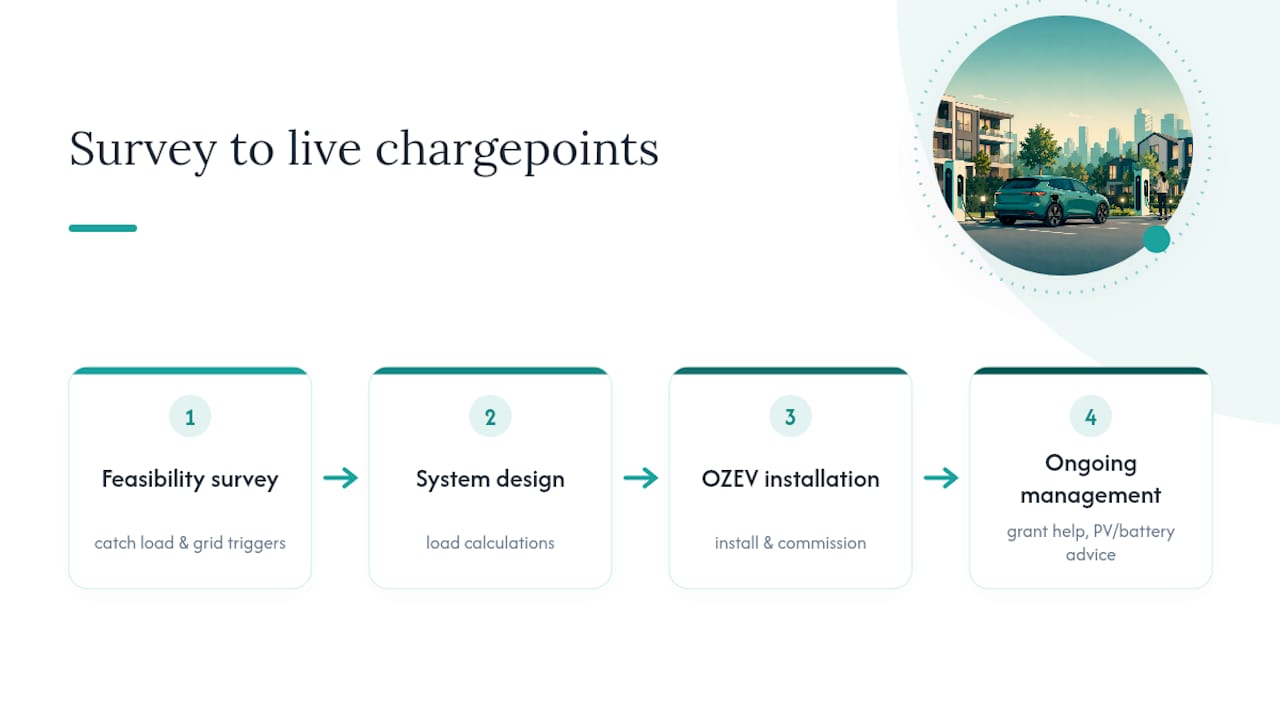
A comprehensive EV charging provider can handle the entire process end to end: feasibility survey, system design, OZEV-registered installation, and ongoing management, so you are not stitching together separate contractors for each stage.

That matters most at the survey stage, where getting load calculations and grid triggers wrong is what turns a straightforward eight-week project into a six-month one. Site assessments by experienced providers are designed to catch those triggers early, before they become unbudgeted costs. Where sites qualify, some providers also help identify and apply for available grant support, and can advise on complementary options like solar PV or battery storage to offset additional electrical load.
If your site is near Chichester, Eastbourne, Farnborough, Farnham or Portsmouth, get a feasibility survey booked for your Chichester site or request a quote for your nearest location to see what your building can realistically support.
Where to check the detail before you sign anything
The gov.uk EV chargepoint grant for landlords confirms eligibility and installer requirements. Practical Law’s clause library offers drafting reference for licences and deeds. BS 7671 remains the technical wiring standard every installer must meet.
Sources
FAQ
Should the landlord pay for an EV charger?
There’s no fixed rule. It depends on your lease, the operating model you choose, and whether a tenant’s improvement request triggers a formal response obligation, but self-funding, operator partnerships and hybrid revenue-share deals are all common routes.
What is the 80/20 rule for charging electric vehicles?
It refers to charging an EV battery to roughly 80% rather than 100% for daily use, which preserves battery longevity, and to only using the final 20% before a long journey. It’s a driver-side habit rather than a landlord installation requirement.
Can I get a grant for an EV charger in a rental property?
Yes, where you meet the eligibility criteria set out in the gov.uk chargepoint grant guidance for landlords, provided you use an OZEV-registered installer. The grant typically covers hardware and installation but excludes grid reinforcement or civil works.
How much profit does a commercial EV charging station make?
Profit varies widely by charger type, tariff and footfall, so there’s no single reliable figure to quote. Beyond direct income, most UK commercial landlords surveyed by Property Week now see charging as important for tenant attraction, which supports value through lower void rates rather than charging revenue alone.
Recommended