UK Fleets: DNO Application EV Charging, 15–65 Working Days, One Team Support

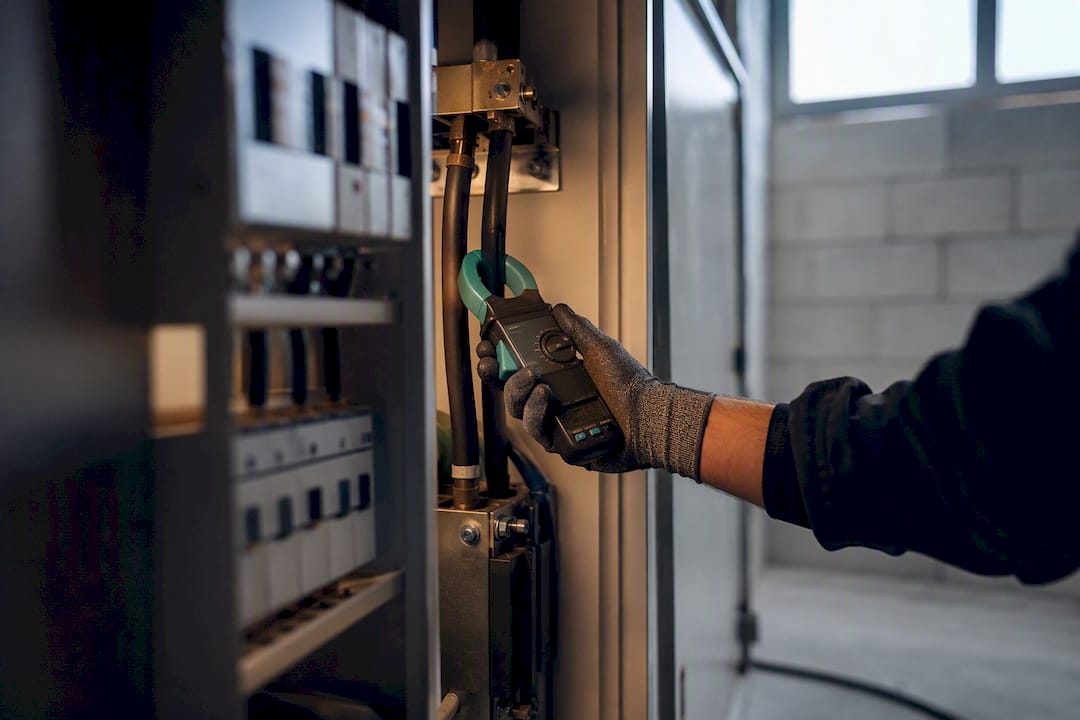
If your planned EV charging load will push your site past its Authorised Capacity, you need to apply to your local Distribution Network Operator for a capacity increase before any chargers go live. If your demand stays comfortably within that capacity, you may only need to notify the DNO rather than submit a full application, but you should always check rather than assume. Either way, the first practical step is the same: book a pre-application meeting, sometimes called a connection surgery, with your regional DNO.
TL;DR:
A DNO application becomes mandatory if your planned EV load exceeds your site’s Authorised Capacity, typically when load exceeds 30% of current maximum demand.
The application process involves detailed documentation, including site plans, load calculations, charger specs, and proof of entitlement if not the landowner, with timing ranging from 15 to 65 working days.
Since April 2023, DNOs no longer charge for network reinforcement needed for new EV connections, reducing costs for large depot or fleet projects.
Contestable works, such as cabling and excavation, can be tendered separately from DNO-owned assets, but require accreditation and clear scope agreements to prevent delays.
Early engagement, including grant considerations and comprehensive load data, is crucial to avoid project delays and cost overruns in deploying EV charging infrastructure.
Table of Contents
What is a DNO application for EV charging and when do you need one?
How do you start the DNO application process for EV chargers?
How long does a DNO connection application take, and what does it cost?
What is the difference between contestable and non-contestable works?
Where can you find funding, and how can Swift Charging help?
What fleet operators consistently get wrong on DNO applications
Swift Charging: one team for your DNO application and delivery
What is a DNO application for EV charging and when do you need one?
A DNO application for EV charging is a formal request to your regional Distribution Network Operator for extra capacity or a new connection to support charge points at a commercial site. It differs from the domestic process homeowners follow for a single driveway charger. If you run a depot, warehouse, retail park or office car park with multiple charge points, or high-power chargers above 22kW, the load calculations and paperwork are considerably more involved.
The trigger point is Authorised Capacity, the maximum electrical demand your site is licensed to draw. Add up the kVA your chargers will need at full simultaneous use, then compare that figure against your existing supply. If the total tips you over your Authorised Capacity, a DNO application for EV charging infrastructure becomes mandatory, not optional. Get this checklist right early and you avoid the most common cause of project delay: discovering a capacity shortfall after chargers are already ordered.
How do you start the DNO application process for EV chargers?
Getting the paperwork moving early saves weeks later. Follow these steps in order:
Pull together your site plan, meter location, current peak demand, and your Authorised Capacity figure from your energy supplier or existing DNO records.
Total your planned EV load in kVA, then build a simple charger schedule showing model, power rating, and expected usage times.
Contact your local DNO to request a pre-application meeting and a budget estimate. Most DNOs run connection surgeries specifically for this.
Decide whether contestable works (the parts you can competitively tender) will go to an Independent Connection Provider, or stay with the DNO.
That fourth step catches people out. Many facilities managers assume the DNO handles everything, when in fact some of the physical works can be opened to competitive quotes, often at a lower cost and faster timeline.
Who do you contact: DNO, IDNO, ICP or National Grid?
Your Distribution Network Operator owns and operates the regional electricity network your site connects to, and it is always your first point of contact regardless of who eventually delivers the work. The UK has several regional DNOs, including National Grid Electricity Distribution, UK Power Networks, SP Energy Networks, and Scottish and Southern Electricity Networks (SSEN). The Energy Networks Association publishes tools to identify which operator covers your postcode.
Beyond the DNO itself, you have options for who actually delivers parts of the work:
Independent Connection Providers (ICPs) carry out accredited contestable works competitively, provided they hold NERS or LRQA accreditation.
Independent Distribution Network Operators (IDNOs) are licensed by Ofgem to own and adopt parts of the network, an alternative delivery route for some sites.
Transmission-level connections through National Grid’s electricity transmission network apply only to very large, multi-megawatt sites, and should be discussed with the DNO at the earliest opportunity if your load approaches that scale.
For most fleet depots and workplace schemes, the DNO remains the primary contact throughout, even when an Independent Connection Provider eventually delivers the trenching and cabling.
What documents and data does a DNO application need?
A complete application pack moves faster through assessment. DNOs consistently ask for the same core information, and missing any of it is the single most common cause of delay.
Your pack should include:
Site address, applicant details, and a plan showing the meter, supply point and site boundary.
Total proposed load in kVA, broken down per charger, with expected charging times and profile (peak, off-peak, or scheduled overnight).
Technical datasheets for each charger model, plus details of any existing on-site generation or storage such as solar PV or battery systems.
A letter of authority if you are not the landowner, since DNOs will not progress an application without proof you are entitled to request the connection.
Site data such as charger location, power band (22kW, 50kW, 100kW or above) and existing generation is exactly what SSEN’s fleet connection guidance flags as standard requirements.
Pro Tip: Include your proposed phasing and any future-proofing options in the initial submission. DNOs regularly ask about growth plans anyway, so answering it upfront avoids a second round of correspondence.
How do you calculate whether you need a capacity upgrade?
Authorised Capacity is the ceiling your supply agreement permits; Maximum Demand is what you actually draw at your busiest moment. The gap between the two determines whether a formal application is unavoidable.
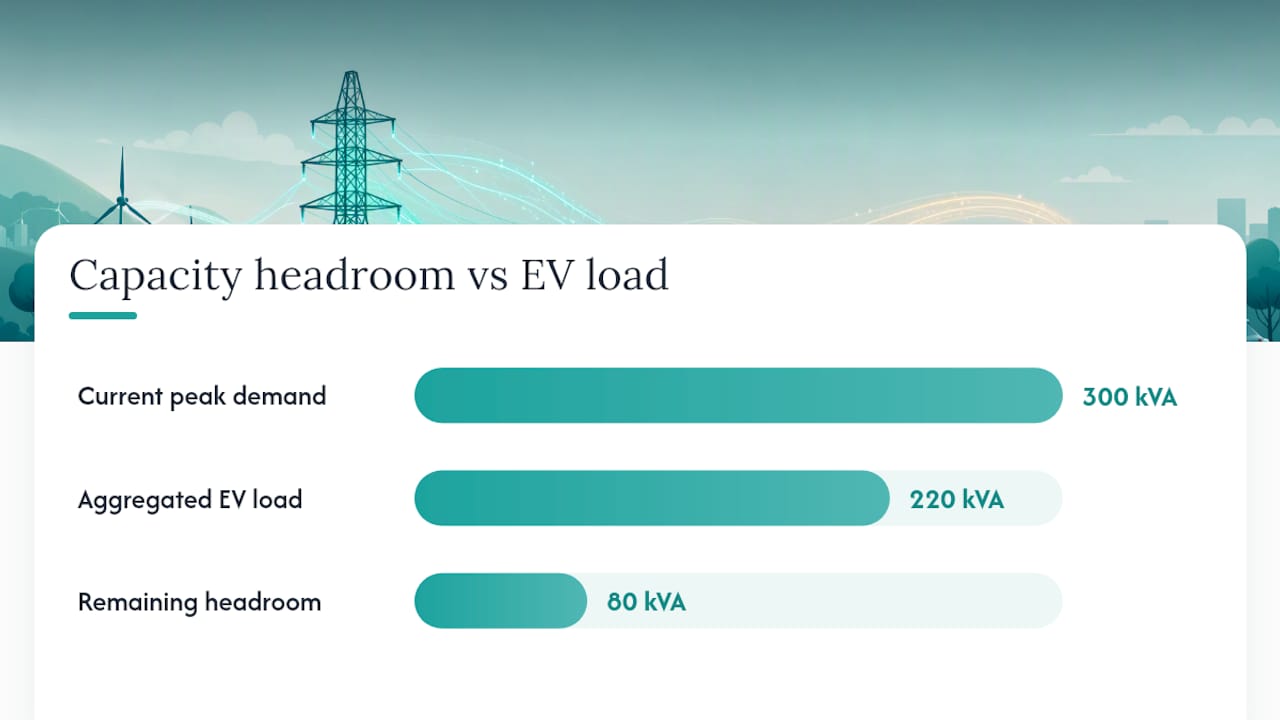
A widely used screening test treats your DNO application for EV charging as likely required once your aggregated planned EV load exceeds roughly 30% of your site’s current maximum demand, according to SSEN’s fleet guidance. Below that threshold, and within your Authorised Capacity, a simple notification may be sufficient.
A worked example makes this concrete:
A depot with 300kVA current peak demand plans 10 x 22kW AC chargers.
Aggregated demand at full simultaneous use is roughly 220kVA, which is over 70% of current peak, comfortably clearing the 30% screening threshold.
That result signals a formal capacity application is the safer route, not a courtesy notification.
Charger power bands map to real supply implications: a 22kW AC unit typically needs a three-phase 32-amp supply now, while clusters of 100kW+ rapid chargers routinely require significant network reinforcement, as the Fleet Decarbonisation Toolkit sets out.
How long does a DNO connection application take, and what does it cost?
DNOs move through three distinct stages, and each one delivers something different.
Budget estimate: a free or low-cost, high-level figure, usually returned within around 20 working days, giving you a rough cost before committing to anything chargeable.
Feasibility study: a chargeable, detailed assessment that models your specific site and load, often deductible from the eventual formal offer cost.
Formal offer: a firm quotation with a defined validity period; typical delivery runs from around 15 working days for straightforward low-voltage work up to 65 working days for more complex high-voltage projects, per Energy Networks Association guidance.
Since April 2023, demand connection customers are no longer charged by DNOs for the distribution network reinforcement needed to accommodate new EV charging connections, a policy shift confirmed by Gov. That change alone has materially improved the economics of larger depot and fleet projects, since reinforcement costs were previously one of the biggest unpredictable line items on a connection budget.
What is the difference between contestable and non-contestable works?
Contestable works are the parts of a connection you can put out to competitive tender; non-contestable works must stay with the DNO because they touch the shared network directly.
Contestable: on-site cabling, excavation, and civil works between the point of connection and your chargers.
Non-contestable: work on the DNO’s own network assets, such as substation modifications or upstream cable reinforcement.
Any ICP delivering contestable work must hold NERS or LRQA accreditation, and IDNOs operate under an Ofgem licence. Before accepting a DNO’s formal offer, confirm the scope split and any network adoption terms in writing. Ambiguity here is a frequent source of late-stage disputes and programme slippage.
Where can you find funding, and how can Swift Charging help?
GOV.UK’s chargepoint connection guidance is the starting point for current workplace and fleet grant eligibility, since scheme rules and funding pots change periodically. Timing matters: some grant windows close before a DNO’s formal offer arrives, so it pays to check eligibility before you commit to a connection programme rather than after.
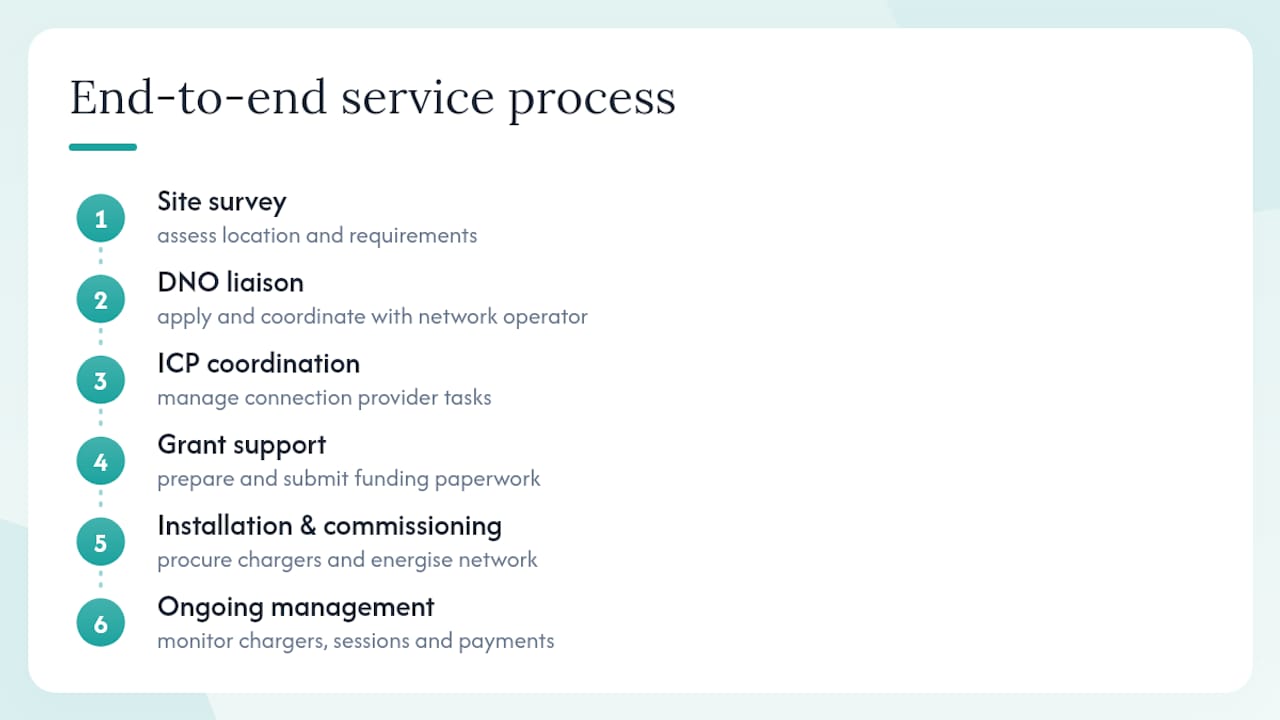
Some EV charging providers support businesses through site survey, grant identification, DNO liaison, installation and ongoing management, acting as a single point of contact across a process that otherwise involves several separate organisations.
Pro Tip: Ask about grant eligibility at the same time you book your DNO pre-application meeting. Running both tracks in parallel, rather than sequentially, shortens your overall project timeline considerably.
What fleet operators consistently get wrong on DNO applications
The most damaging mistake is contacting the DNO too late, usually after chargers have already been specified. Incomplete load data runs a close second: omitting future phasing or existing solar and battery storage from your application almost guarantees a second, slower round of assessment.
The fix is straightforward. Book your pre-application meeting early, include storage and generation data from the outset, and ask explicitly for optioneering during the feasibility stage. Connection surgeries are genuinely collaborative. Use them to pressure-test alternative approaches before committing to a design, because redesigning after a formal offer has landed costs far more than getting the brief right at the start.
— Swift Charging
Swift Charging: one team for your DNO application and delivery
Coordinating a DNO application alongside grant paperwork, charger procurement and installation scheduling is a lot to run in-house on top of your day job. Some EV charging providers handle the whole sequence as one service: site survey, DNO liaison and ICP coordination, grant support, installation, commissioning and ongoing management, providing a single point of accountability rather than requiring multiple separate contracts.

We’ve worked through this process on live commercial sites, including installations in Dover, and our back-office platform gives fleet and facilities teams live visibility over charger status, sessions and payments once the network is energised. For businesses further along in specification, our EV infrastructure resources cover charger selection and site design decisions that feed directly into your DNO application data.
If you’re planning a multipoint or high-capacity installation, get in touch for a site assessment. Facilities in the Chichester area can start with our commercial EV charging installation page to see how the survey and DNO liaison process runs from first contact through to energisation.
Sources
Save these alongside your DNO’s budget estimate, feasibility study and formal offer:
FAQ
Do I always need a formal DNO application for workplace charging?
Not always.
How long does a DNO formal offer take?
Formal offers typically take between 15 and 65 working days depending on whether the work is low-voltage or high-voltage, according to Energy Networks Association guidance.
Will I be charged for network reinforcement?
No, since April 2023 demand connection customers have not been charged by DNOs for the reinforcement needed to accommodate new EV charging connections, per GOV.UK.
Can I choose who does the physical installation work?
Yes, contestable works such as on-site cabling and excavation can go to an accredited Independent Connection Provider, while non-contestable works on the DNO’s own network assets stay with the DNO.
Can Swiftcharging manage the DNO application for me?
Some EV charging companies handle site survey, DNO liaison, grant identification and installation as one coordinated service, allowing clients to deal with a single supplier rather than managing separate contracts for each stage.
Recommended