Avoid 30–50% Demand Charge Shock: EV Charging Tariffs for Businesses


If your fleet runs predictable routes and shifts, a fixed or Charging-as-a-Service tariff gives you certainty. If usage varies or your fleet is still growing, a tiered or usage-based structure with a time-of-use pass-through and a management fee protects you better. Either way, ask prospective suppliers for scenario-based cost modelling and a written SLA before you sign anything, and note that providers such as Swift Charging build both into their commercial proposals as standard.
TL;DR:
Fixed or Charging-as-a-Service tariffs work best for fleets with predictable routes and schedules, but fluctuate costs for growing or variable fleets.
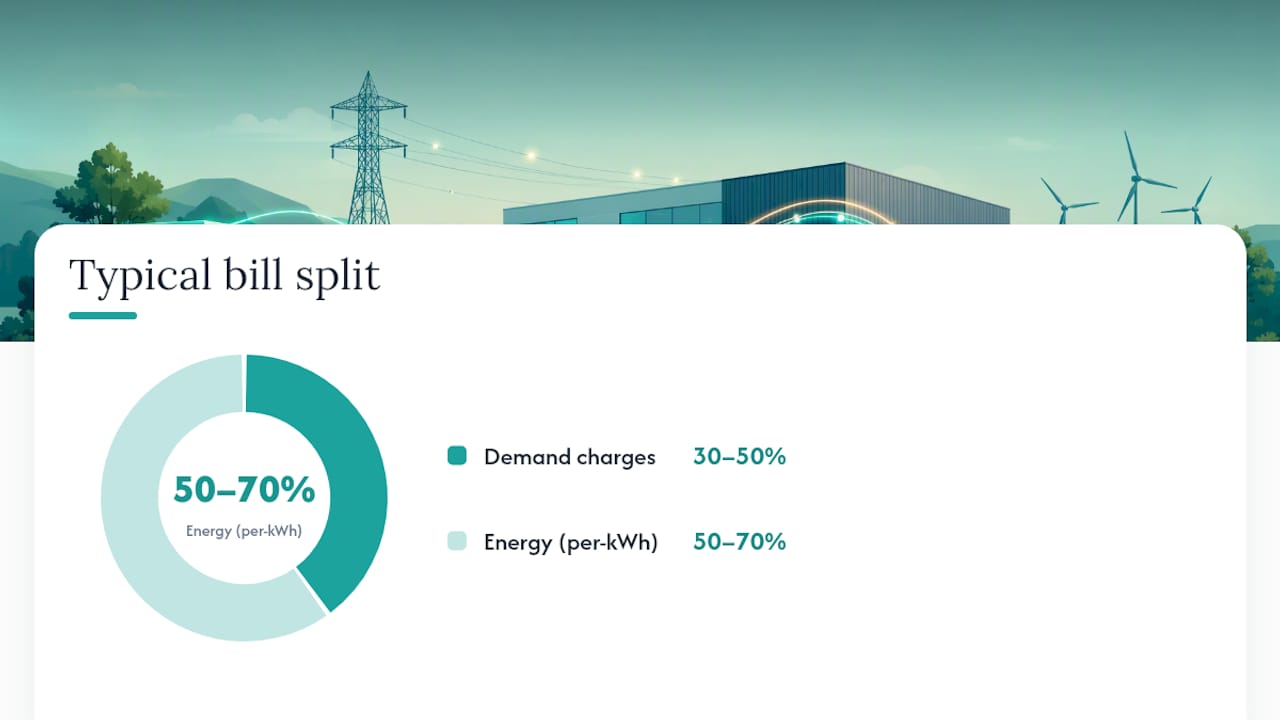
Demand charges can account for up to half of a charging bill during low utilization, making load management essential to control costs.
Time-of-use and dynamic pricing reward shifting charging to off-peak hours, significantly reducing peak demand and overall expenses.
Insist on scenario-based cost modeling, SLA with remedy caps, and discount triggers tied to actual consumption when comparing tariffs.
Local network conditions greatly influence regional tariffs, so site-specific load profiles are necessary for accurate cost comparisons.
Table of Contents
How do demand charges and time-of-use pricing change your costs?
Commercial tariff structures and contract terms fleets should expect
What should procurement ask for when comparing charging tariffs?
Regulatory and compliance considerations for commercial charging tariffs
How do EV charging tariffs fit into business energy management?
What are the common EV charging tariff models for business?
EV charging pricing models fall into five broad categories, and picking the wrong one is the single most common budgeting mistake we see among facilities and fleet teams.
Energy-based pricing charges per kWh consumed, which most sources agree is the fairest and most transparent structure because you pay for exactly what you use. Time-based pricing charges per minute connected, which discourages vehicles overstaying but can penalise slower-charging models unfairly. Flat or subscription pricing (often sold as Charging-as-a-Service) fixes a monthly fee regardless of consumption, shifting utilisation risk onto the provider. Tiered or volume-banded pricing sets a rate that steps down once you cross defined kWh thresholds. Hybrid models blend time and energy charging, which Virta’s pricing overview notes helps balance fairness with the operational need to keep bays turning over.
Matching the model to your usage pattern matters more than the headline rate:
Fixed schedules with known vehicle counts suit flat-fee or CaaS deals, where the provider absorbs demand spikes.
Mixed or seasonal usage suits tiered pricing, where costs scale down as volume grows.
Unpredictable or expanding fleets suit usage-based pricing with a time-of-use pass-through and a management fee, until your consumption data is solid enough to negotiate something firmer.
Whichever model you choose, insist on separate sub-metering for EV loads. Without it, you cannot verify a bill, claim grants, or spot roaming charges hidden inside a combined site energy invoice.
How do demand charges and time-of-use pricing change your costs?
Demand charges, not the per-kWh rate, are usually what wreck an EV charging budget. A demand charge bills you for the single highest peak of kilowatts drawn during a billing period, even if that peak lasted only fifteen minutes. According to YoCharge’s B2B pricing guide, demand charges commonly account for 30–50% of a commercial EV charging bill when utilisation is low, because a handful of vehicles charging simultaneously can set a peak that the rest of the month never approaches again.
Time-of-use and dynamic pricing work the opposite way: they reward you for shifting load away from expensive peak windows into cheaper overnight or off-peak periods. Research on dynamic pricing shows that a well-designed price menu, offering different rates for different charging speeds, can improve outcomes for both the operator and the business paying the bill.
A simple illustration shows the scale of the risk:
Ten vans charging at 7kW between 10pm and 6am, staggered across the night: no demand spike, energy billed at off-peak rate.
The same ten vans plugged in simultaneously at 5pm because drivers forgot to stagger: one 70kW peak that resets your demand charge for the entire billing cycle, regardless of how little energy that peak actually delivered.
The second scenario can cost several times more for identical total energy consumed.
Commercial tariff structures and contract terms fleets should expect
Three structures dominate corporate charging deals, and each moves risk in a different direction. Fixed/CaaS pricing suits fleets with predictable schedules, because the provider prices in worst-case peaks and you pay the same fee regardless of what actually happens. Tiered/volume-banded pricing suits fleets with steady but growing demand, rewarding higher consumption with lower per-unit rates. Usage-based with a time-of-use pass-through suits fleets still building a consumption history, since it keeps you exposed to real costs but avoids overpaying for capacity you don’t yet use. YoCharge’s B2B guide frames this as the standard menu most commercial providers now quote against.
Whichever structure you pick, the contract mechanics matter as much as the headline rate. Before signing, get clarity on:
SLA and uptime definitions — how uptime is measured (per charger, per site, monthly average) and what triggers a remedy.
Escalation clauses — how disputes over billing or performance get resolved, and within what timeframe.
Minimum-commitment or take-or-pay terms — whether you’re locked into a volume even if usage falls short.
Volume-discount triggers — whether discounts kick in automatically or need renegotiation.
Review cadence — how often pricing can be revisited as your fleet or usage changes.
Pro Tip: Tie any discount to realised kWh or completed sessions, not to a fixed vehicle count. Fleets change size, and a discount pegged to headcount stops working the moment you add or lose a vehicle.
Common commercial SLAs sit between 98% and 99.9% uptime, measured monthly per charger, according to YoCharge. Anything below that range for a business-critical depot should raise questions.
How can businesses reduce EV charging tariff exposure?
Cutting your effective tariff cost rarely means switching supplier. It usually means changing when and how power gets drawn.
Stagger start times. Spreading charging sessions across the night avoids the simultaneous peak that triggers demand charges.
Enforce unplugging policies. Vehicles left connected after charging completes waste bay capacity and can distort time-based billing.
Use smart charging profiles. Software that ramps charging speed up or down based on site load keeps you under demand thresholds automatically.
Add battery storage for peak shaving. A battery discharges during the peak window instead of drawing from the grid, flattening the spike that sets your demand charge.
Pair with solar PV where the site allows it. Daytime generation offsets grid draw directly, particularly useful for depots that charge across shift changeovers.
Scale charger power to the site, not the vehicle. Oversized chargers on underused bays inflate both capital cost and demand exposure.
Pro Tip: Ask any bidder to run their proposed tariff against your worst three months of usage, not your average month. A tariff that looks cheap on average can be brutal in the month your delivery schedule doubles.
Short trial periods and quarterly review windows also let you rebalance a contract before a bad billing assumption compounds across a full year.
What should procurement ask for when comparing charging tariffs?
A tariff quote is only useful if it’s built the same way every other quote in your comparison is built. Ask every supplier for a line-by-line cost model that separates energy, demand, fixed fees, and any management or platform fee, run against at least three utilisation scenarios: low, expected, and peak.
Insist that SLA definitions come with remedy caps attached, not vague promises of “high availability.” And make sure discount triggers are tied to realised consumption, not to the number of named vehicles on your account, since fleets rarely stay a fixed size for the length of a contract.
Three red flags should stop a deal in its tracks:
A flat fee offered with no SLA attached, meaning you have no contractual remedy if uptime collapses.
Discounts keyed only to specific named vehicles rather than total consumption.
No right to a periodic pricing review, which locks you into today’s assumptions for the life of the contract.
Ask for | Why it matters |
Line-by-line cost model (energy, demand, fixed, management fee) | Lets you compare quotes on identical terms, not headline rates alone |
At least three utilisation scenarios | Reveals how the tariff behaves outside the average month |
SLA with remedy caps | Converts an uptime promise into an enforceable contract term |
Discount triggers tied to realised kWh/sessions | Keeps savings aligned with actual fleet size and usage |
Periodic pricing review clause | Protects you if consumption patterns shift mid-contract |
Regulatory and compliance considerations for commercial charging tariffs
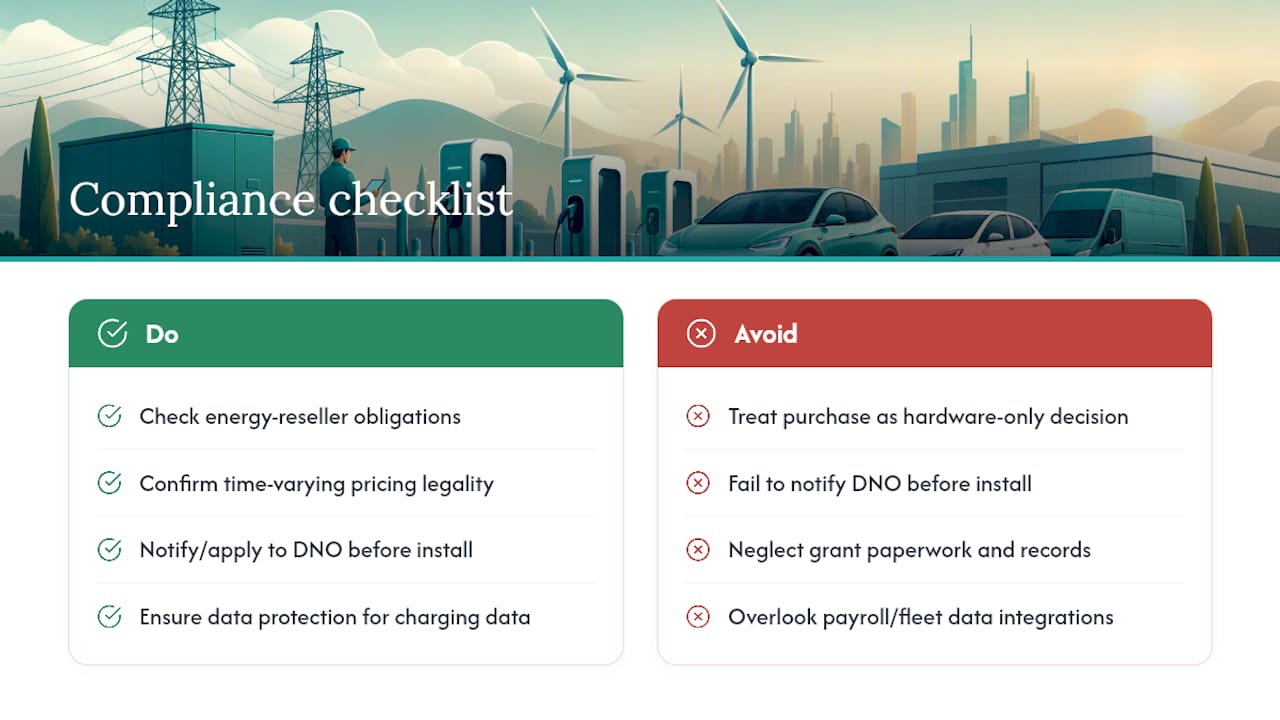
Commercial EV charging sits inside a patchwork of energy market rules, and the constraints differ depending on how you’re structured. If you’re billing tenants, staff, or the public for charging, you may be treated as an energy reseller, which brings metering accuracy and consumer protection obligations into play. Research on dynamic pricing regulation notes that legal constraints on certain billing methods, particularly time-varying rates, vary significantly between markets and utility jurisdictions.
Grid connection agreements also carry compliance weight. Adding charging load above certain thresholds typically requires notifying or applying to your distribution network operator, and failing to do so before installation can delay commissioning by months. Any business claiming government EV charging grants needs to keep procurement, installation, and metering records that satisfy the scheme’s audit requirements, since grant clawback is a real risk when documentation falls short.
Data protection rules apply too, particularly where charging software captures driver identity, vehicle registration, or payment details for RFID access control. If your charging platform integrates with payroll or fleet management systems, that data flow needs the same scrutiny you’d apply to any other employee data processing.
None of this is exotic, but it’s easy to overlook when the buying decision gets treated as a pure hardware and tariff choice. Building compliance checks into your procurement checklist from the start, alongside the cost modelling and SLA terms already covered, avoids a costly retrofit later.
How do EV charging tariffs affect business ROI?
The tariff you choose changes your payback period as much as the hardware you install. A flat CaaS fee gives you a predictable line in the budget, which finance teams tend to prefer, but it can mean paying for capacity you rarely use if your fleet’s charging pattern is lighter than the supplier priced for.
A usage-based tariff with a time-of-use pass-through exposes your true cost more accurately, which rewards businesses willing to invest in operational discipline, staggered charging, smart profiles, off-peak scheduling, with a lower blended rate over time. The trade-off is volatility: a bad month of unmanaged peaks can spike your bill in ways a flat fee never would.
For ROI modelling, run the comparison over at least twelve months rather than a single quarter, since seasonal variation in fleet activity (holiday periods, school terms, delivery peaks) can swing utilisation enough to change which tariff wins. Installation costs, grant contributions, and ongoing maintenance fees all belong in that same model. A resource like Swift Charging’s breakdown of installation costs is a useful starting point for building the capital side of that calculation before layering the tariff assumptions on top.
The businesses that get the best return are rarely the ones chasing the lowest headline rate. They’re the ones that modelled their actual usage pattern against each tariff structure before committing.
Comparing EV charging tariffs across utilities and regions
Tariffs vary more between distribution regions than most procurement teams expect, largely because network charges, standing charges, and demand-charge thresholds are set locally rather than nationally. Two businesses running identical fleets in different parts of the country can see meaningfully different total costs purely because of where their site sits on the grid.
Urban sites often carry higher standing charges but benefit from more competitive supplier markets, since multiple energy retailers compete for commercial contracts in dense areas. Rural or edge-of-network sites can face higher demand charges because the local grid infrastructure has less headroom, meaning your peak draw pushes closer to the network’s actual capacity limit.
This is where scenario-based tariff comparison earns its keep. Rather than comparing headline pence-per-kWh rates across regions, ask each prospective supplier to price your specific site’s expected load profile, including your realistic peak scenario. A tariff that looks expensive on paper in one region might be the cheaper option once you factor in a lower demand-charge threshold or a more favourable time-of-use window specific to that network operator.
If you operate across multiple sites, resist the temptation to force identical tariffs onto every location for administrative simplicity. The commercial installations Swift Charging has delivered across different UK regions, including sites in Portsmouth, show how much local network conditions can shift the right tariff choice from one postcode to the next.
How do EV charging tariffs fit into business energy management?
Treating EV charging as a bolt-on utility bill, separate from your building’s wider energy management, is one of the most common ways businesses overpay. Charging load should sit inside the same energy management system that governs your site’s other major loads: heating, lighting, refrigeration, or industrial processes.
Integrating charging into a site energy management system lets you see EV demand in the context of everything else drawing power at the same time, which is exactly what triggers demand charges in the first place. If your charging load spikes at the same hour your HVAC system also peaks, you’re stacking two demand contributors into a single, more expensive peak, something a standalone charging tariff review would never catch.
Smart charging platforms that talk to a broader building management system can automatically throttle EV charging when other site loads rise, keeping your combined peak lower without any manual intervention. This is also where onsite generation and storage earn their keep twice over: solar PV and battery storage installed for general site resilience can be coordinated with charging schedules rather than sized and managed separately.
For businesses already assessing complementary technologies like solar PV, battery storage, or heat pumps, folding EV tariff strategy into that same conversation avoids a fragmented energy strategy where each system is optimised in isolation but the overall site bill still climbs.
Swift Charging’s perspective on managing tariff risk
We build tariff modelling into every commercial proposal because a quote without scenario testing is a guess dressed up as a number. Our process starts with feasibility and site assessment, then moves through tariff structure selection based on your actual usage pattern, load management to control peaks, and support applying for available UK EV charging grants where you qualify.
Projects across sites including Eastbourne and Portsmouth have shown us that the right structure depends less on fleet size than on how predictable that fleet’s schedule actually is. We typically recommend fixed pricing only once we’ve stress-tested it against your worst realistic month, and we push for contractual protections, SLA terms and review clauses, on every deal we structure.
— Swift Charging
How Swift Charging can help you choose the right tariff
Comparing tariff structures on paper only gets you so far. What actually protects your budget is scenario modelling built around your real fleet schedule, and a contract that holds your supplier to it. Swift Charging works through that process from initial feasibility and site assessment right through to installation and long-term management, including tariff structure recommendations, load management setup, and support applying for available EV charging grants where your business qualifies.

Whether you’re installing your first workplace chargers or restructuring an existing fleet contract that’s no longer fit for purpose, getting the tariff conversation right at the start avoids a costly renegotiation later. If you’re based in or around the capital, our commercial EV charging installation service in London is a practical next step, get in touch for a site assessment and a scenario-based cost model built around your actual usage, not a generic average.
Sources
The claims in this article draw on three main sources. The DOI-indexed 2024 paper on price menu design provides the academic basis for demand-response pricing and dynamic rate structures. YoCharge’s B2B pricing guide supplies the practical detail on fleet tariff structures, demand-charge proportions, and SLA norms. Virta’s overview of pricing models explains the fairness and behavioural trade-offs between energy, time, and hybrid billing. Together, they cover the academic, commercial, and operator perspectives a business needs before signing a tariff agreement.
FAQ
What is the best EV charging tariff for a business fleet?
There’s no single best option. Predictable, scheduled fleets do best on fixed or CaaS pricing, while variable or growing fleets do better on tiered or usage-based pricing with a time-of-use pass-through.
How much do demand charges add to a commercial charging bill?
Demand charges commonly make up 30 to 50% of a commercial EV charging bill when utilisation is low, driven by a single peak rather than total energy used.
What SLA uptime should businesses expect from a charging provider?
Commercial agreements typically specify 98% to 99.9% uptime measured monthly per charger, with defined remedies if the provider falls short.
Can time-of-use pricing actually lower charging costs?
Yes. Shifting charging into off-peak hours avoids the highest per-kWh rates and, combined with smart charging, reduces the chance of triggering a costly demand-charge peak.
Does Swift Charging help with tariff and contract negotiation?
Swift Charging builds tariff modelling, load management, and contractual SLA terms into its commercial proposals, helping businesses choose a structure suited to their actual usage pattern before signing.
Recommended