EV charger installation cost for UK workplaces and fleets

A small workplace installation with one or two fast chargers typically costs £2,000 to £6,000, a multi-charger fleet or workplace project runs £10,000 to £50,000 or more, and a rapid charging hub can reach £30,000 to £200,000+. Your next move should be booking a site survey and a DNO connection budget estimate. That single step turns a rough range into a real number for your site.
Statistic Callout: Industry figures put commercial project costs at £2,000–£6,000 for small workplace jobs, £10,000–£50,000+ for fleet or multi-charger sites, and £30,000–£200,000+ for rapid hubs, with electrician labour running £250–£450 a day.
Pro Tip: Get your DNO budget estimate moving before you finalise charger specification. Network capacity, not hardware choice, is what usually decides your final bill.
Key Takeaways
Commercial EV charger installation costs in the UK range from roughly £2,000 for a small workplace site to £200,000+ for a rapid hub, with DNO connection and civil works usually driving the total more than hardware.
Point | Details |
Cost bands vary by scale | Small workplace sites cost £2,000–£6,000; fleet and depot projects run £10,000–£50,000+; rapid hubs reach £30,000–£200,000+. |
DNO connection drives timelines | Connection quotes take 5 to 65 working days and often determine your critical path more than civils or hardware. |
Grants cut net cost meaningfully | The Workplace Charging Scheme caps at £500 per socket up to £20,000; the Depot Charging Scheme funds 70% of costs up to £1 million per window. |
Compliance protects grants and insurance | Installations must follow BS 7671, the IET Code of Practice and BS EN 61851 for equipment eligibility. |
Plan for running costs and scale | Electricity tariffs, load management and future capacity all affect total cost beyond the initial install. |
Swiftcharging manages the full process | Swiftcharging runs site surveys, DNO liaison, grant applications and commissioning as one coordinated project. |
Table of Contents
How much do commercial EV chargers cost by project size?
Cost bands only mean something once you can picture the project behind them. Here’s what four common UK commercial scenarios actually look like on the ground.
A small workplace installation (one or two 7 to 22 kW chargers for staff parking) typically lands at £2,000 to £6,000, and separate guidance puts per-socket installed costs at roughly £1,000 to £2,500 depending on charger power. This usually includes hardware, basic containment and a straightforward electrical connection, but excludes any DNO reinforcement work if your existing supply is short on capacity.
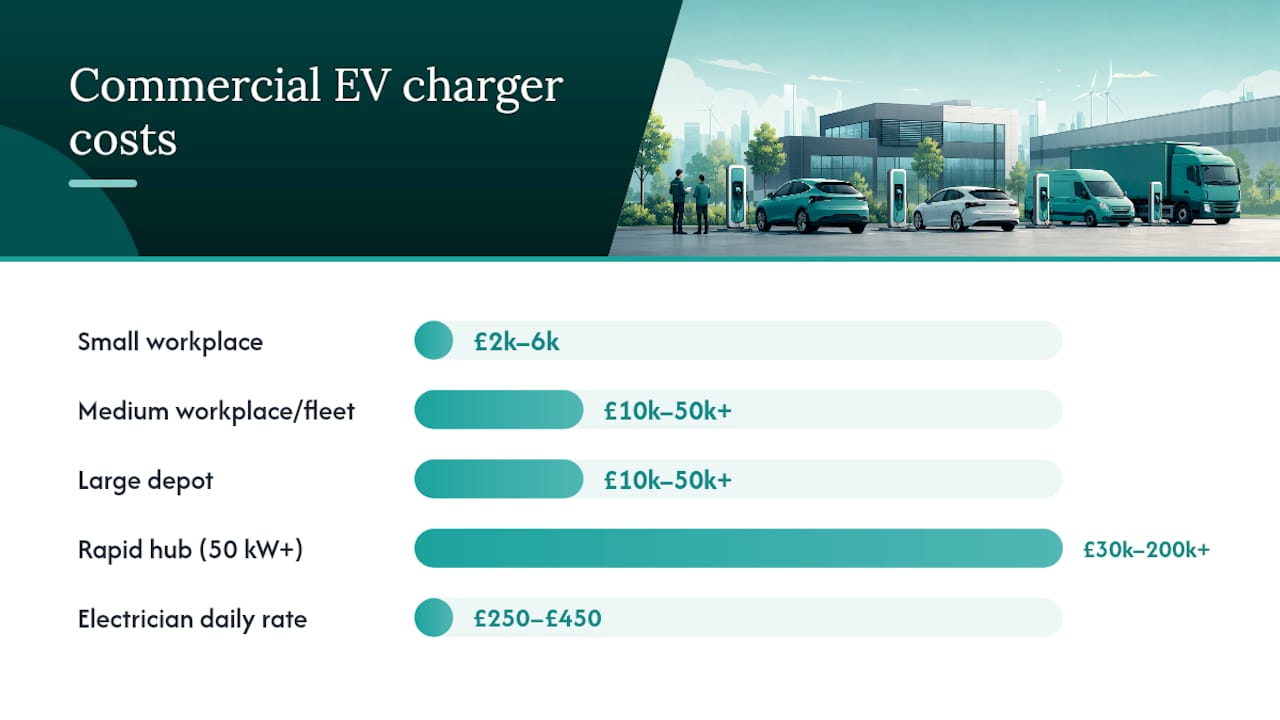
A medium multi-charger workplace or fleet site (six to twenty chargers) generally costs £10,000 to £50,000 or more. At this scale, civil works, load-management software and a formal DNO connection quote all become part of the quote, not optional extras.
A large depot installation for fleet operators sits in a similar £10,000 to £50,000+ band per the same guidance, though depot projects with dozens of vehicles and higher power requirements routinely push past that, largely on the back of substation and cabling work.
A rapid or ultra-rapid hub (50 kW and above, aimed at destination or public charging) runs £30,000 to £200,000+, reflecting the transformer upgrades and civils that high-power DC charging demands.
Small workplace: hardware and basic install included; DNO reinforcement usually excluded
Medium fleet/workplace: adds civils, load management and a formal DNO quote
Large depot: substation and cabling work often dominate the budget
Rapid hub: transformer capacity and civils are the majority of spend, not the charger itself
Pro Tip: A higher socket count nearly always improves your per-socket economics, since civils, DNO fees and project management get shared across more chargers rather than duplicated for each one.
What actually drives commercial installation costs?
Hardware is rarely the biggest line on a commercial quote. The connection to the grid and the civil works around it usually cost more than the chargers themselves, and that catches out a lot of first-time buyers.
The main cost drivers on any UK commercial project break down as follows:
DNO/network connection — cabling, transformer capacity and, where needed, substation upgrades
Civil works — trenching, ducting and reinstatement of car parks or hard standing
Charger hardware — AC or DC units, priced by power output and socket count
Cabling and containment — the physical wiring and protective runs between distribution board and chargers
Load-management software — dynamic power sharing across multiple chargers on a limited supply
Payment, RFID and back-office systems — for sites charging visitors, tenants or fleet drivers
Project management and commissioning — coordinating trades, testing and handover
Warranties and maintenance — ongoing service cover once the system is live
Two items catch buyers off guard most often: grid connection lead times and transformer or substation costs. DNO connection quotes take 5 to 65 working days depending on connection size, and if your site needs reinforcement beyond the existing supply, that’s where costs escalate fastest.
Statistic Callout: Connection offers from your DNO cover cables, transformers, labour, excavation and traffic management where applicable, and distribution network reinforcement isn’t charged to demand connection customers who applied after 1 April 2023, though the connection itself still carries a cost.
Ask any supplier how their installation complies with BS 7671, the IET Code of Practice, and BS EN 61851 for the chargepoint equipment itself. These three standards are your shorthand compliance check before you sign anything.
What UK grants can reduce your net installation cost?
Two schemes matter most for commercial buyers in 2026, and they work very differently.
The Workplace Charging Scheme (WCS) covers up to 75% of purchase and installation costs, capped at £500 per socket for up to 40 sockets per applicant, giving a maximum grant of £20,000. It runs until 31 March 2027. For a small workplace install at £1,000 to £2,500 per socket, that £500 contribution meaningfully cuts your effective per-socket spend.
The Depot Charging Scheme targets fleet operators at scale. It funded 70% of charge point and civil costs up to £1 million across sites for the 2026/27 window, with further windows expected though terms may taper over time.
Confirm eligibility against the current scheme rules before you budget the grant into your total
Check what’s excluded, VAT treatment and ongoing running costs generally sit outside grant funding
Use an OZEV-eligible installer, since grant compliance depends on it
Keep invoices, install dates and equipment specifications ready for claim submission
Apply within the stated windows, since depot funding rounds close on fixed dates
WCS covers hardware and installation, not ongoing electricity or maintenance
Grant terms differ between schemes, so read eligible spend rules carefully before committing budget
A partner guide on charger grants is a useful second reference for eligibility checks
How long does a commercial charger installation take?
The DNO connection quote is usually your longest lead-time item, so it needs to start early, not last.
Initial scoping and brief — defining sockets, power needs and site constraints (1 to 2 weeks)
Site survey — assessing existing supply, layout and civils requirements (1 to 2 weeks)
DNO budget estimate and connection quote — 5 to 65 working days depending on connection size and capacity
Detailed design — finalising layout, cabling routes and load management (2 to 4 weeks)
Civils and electrical works — typically 4 to 8 weeks on site
Commissioning and handover — testing, certification and staff training (1 to 2 weeks)
Where network capacity is genuinely constrained, DNO reinforcement can add several months rather than weeks to the timeline. Highway works also need a HERS-registered contractor, which is worth confirming with your installer at the design stage.
Pro Tip: Book your DNO budget estimate the same week you commission a site survey. It’s the one task on this list you cannot compress once it’s underway, so starting late anywhere else costs you far less than starting late here.
What should you check before accepting a supplier quote?
A comparable quote separates every cost line. A vague one bundles them together, and that’s usually where the surprises hide.
Require a line-by-line breakdown: hardware, civils, DNO costs, software and maintenance shown separately
Confirm warranty terms and what’s covered beyond the standard installation period
Clarify the payment model, whether it’s a flat fee, phased payments, or a hosted revenue-share arrangement
Get realistic lead-time estimates for each stage, not just an overall completion date
Check what civils and reinstatement assumptions the quote is built on
Ask suppliers directly: what DNO connection cost have they allowed for, who manages permits and traffic management, are they OZEV-approved, what do software licences cost annually, and can the system scale if you add chargers later?
Pro Tip: A suspiciously low hardware price paired with vague civils or no DNO allowance at all is the clearest red flag in commercial EV quoting. It usually means the real cost turns up later as a change order.
What will your charger cost to run after installation?
Installation is a one-off cost. Electricity is not, and it’s the line item most facilities managers underestimate when they first budget for charging infrastructure.
Your ongoing costs centre on electricity consumption, and the tariff you’re on changes that bill substantially. A fleet charging overnight on a standard commercial rate pays far more than one on a time-of-use tariff structured around off-peak hours. Load management and tariff timing matter here: shifting charging sessions to cheaper overnight periods can meaningfully cut your running costs without touching hardware.
Beyond electricity, budget for software subscriptions if you’re running load management or a back-office platform, plus any RFID or payment processing fees on sites where visitors or tenants pay to charge. Maintenance contracts add a further recurring cost, though they protect against the far larger expense of unplanned downtime on a charger that’s central to your operation.
If you’re hosting public or destination charging, revenue from usage can offset some of this, but don’t assume it covers your full operating cost in year one. Model electricity, software and maintenance as a genuine annual running cost, separate from your installation budget, and revisit your tariff arrangement annually. Energy markets move, and a tariff that suited your site two years ago may no longer be your cheapest option.
Can you integrate charging with existing energy systems or renewables?
Chargers don’t have to sit in isolation from the rest of your site’s energy setup, and increasingly, the smart approach is to make sure they don’t.
Load management software is the first integration point. It caps total site demand across multiple chargers so you avoid triggering a costly supply upgrade you don’t actually need, spreading available capacity dynamically instead of provisioning for worst-case simultaneous demand. That alone can be the difference between a straightforward connection and one that requires DNO reinforcement.
Solar PV and battery storage take this further. A site with rooftop solar can offset daytime charging directly, and battery storage lets you shift grid draw to cheaper off-peak periods while still charging vehicles when they’re on site during the day. For fleet depots with predictable daytime dwell times, this pairing often makes a genuine difference to running costs, not just a sustainability story for the annual report.
Heat pumps sit in a similar bracket. They’re not directly linked to EV charging, but where a site is reviewing its whole energy setup, assessing solar, battery and heating together tends to produce a more coherent investment than tackling each in isolation. Swiftcharging can help commercial customers assess these complementary technologies alongside charging infrastructure, since the electrical capacity and grid connection questions overlap significantly. If you’re planning a connection upgrade for charging anyway, it’s worth asking what else that capacity could support.
What does future capacity expansion cost?
The chargers you install this year are rarely the last you’ll need. Fleet electrification programmes tend to grow, and workplace demand from staff EVs climbs steadily as adoption increases across the UK vehicle parc.
The costly mistake is designing for today’s demand with no headroom for tomorrow’s. If your initial DNO connection and distribution board are sized exactly to your current charger count, adding sockets later often means a second, full DNO application and civils project, effectively paying the fixed costs of an installation twice over.
Specifying slightly larger cabling, ducting and distribution capacity at the outset, even if you don’t fill every socket immediately, is usually far cheaper than digging up the same car park again in three years. Load management software also helps here: a system designed to manage eight chargers today can often be reconfigured to manage twelve without new hardware, provided the underlying electrical capacity supports it.
Ask your installer directly what it would take to double your charger count in future, and get that answer in writing before you finalise your design. A quote that’s silent on scalability is a quote that’s optimised for the lowest number today, not the total cost across your site’s charging lifecycle. That’s a reasonable choice if budget is genuinely fixed, but it should be a deliberate one, not an oversight discovered when you next need more chargers.
What insurance and liability issues apply to commercial chargers?
Commercial EV charging infrastructure sits at the intersection of electrical installation, public liability and vehicle risk, and it’s worth treating it as its own line item in your insurance review rather than assuming existing cover extends automatically.
Public liability cover matters most for destination and workplace sites where visitors, tenants or staff use chargers you don’t directly supervise. Confirm with your insurer that charging infrastructure is explicitly covered, particularly for any site open to non-employees. Product liability and installation warranties from your supplier matter too: an installer following BS 7671 and the IET Code of Practice gives you a documented compliance trail that supports any future insurance claim, and OZEV-linked grant schemes already require equipment meeting BS EN 61851 with a three-year on-site warranty on parts and installation.
Landlords and property managers hosting chargers for tenants should clarify liability allocation in lease agreements. Who’s responsible if a fault damages a tenant’s vehicle, and who insures the charging hardware itself against damage or theft?
Fleet operators face an added layer: chargers used by multiple drivers across a depot need clear operational protocols, since liability questions get more complicated when the person charging isn’t the vehicle owner. Work with your insurer and installer together at the design stage, not after installation, so cover matches the actual risk profile of your site rather than a generic policy written for a business with no charging infrastructure at all.
Lessons from Swift Charging’s UK installation projects
Our Chichester project reflects a common pattern: initial scope covers the obvious chargers, then site surveys reveal supply constraints that reshape the civils budget. That’s normal, not a red flag.
Working with an OZEV-approved installer keeps grant claims straightforward and compliance documented from day one. If you want to talk through a similar project or see case-study detail, get in touch and we’ll walk through it.
Get a grant-aware quote you can actually budget against
Generic online calculators can’t tell you what your DNO will quote or whether your site qualifies for the Workplace Charging Scheme. Swiftcharging handles both from day one, running your site survey and DNO liaison in parallel with grant eligibility checks, so the number you get back is a real budget figure, not a placeholder.

We manage the full process end to end, from feasibility through design, installation and commissioning, and we help eligible businesses apply for available grants including the Workplace Charging Scheme and Depot Charging Scheme, reducing your net cost before work even starts. Whether you’re planning a single workplace site or a multi-location fleet rollout, our Eastbourne and Farnborough teams can scope your project properly rather than guessing at civils costs upfront.
Ready to move from estimate to actual quote? Book a site survey with Swift Charging through our Chichester project page and get your DNO budget estimate underway this month.
Sources
Recommended