Hotel EV charging: how to plan, fund and operate chargers

Updated: Aug 14

Hotels should install managed EV chargers now. Treat them as a guest amenity and a potential revenue stream, then commission a professional site feasibility survey as your immediate next step. Before that survey, check your eligibility for OZEV grant funding and consider whether an energy management system (EMS) can help you avoid costly grid upgrades.
Two practical starting points:
Overnight-focused hotels: begin with a small AC destination deployment (7–22 kW Level 2 units), sized to roughly 5–12% of room count, with pre-wiring for future expansion.
Hotels with transient daytime visitors: consider a mixed AC plus 50 kW+ DC approach to serve both overnight guests and passing fast-charge demand.
Three actions to take this week: commission a site survey, check OZEV grant eligibility, and ask your electrical contractor whether an EMS is worth specifying early.
Key takeaways
Hotel EV charging delivers measurable commercial value when planned correctly: the right charger mix, an EMS to manage grid load, grant funding to reduce capex, and management software to protect guest experience and track ROI.
Point | Details |
Start with AC, add DC selectively | Size AC units to 5–12% of room count; add 50 kW+ DC only where transient fast-charge demand exists. |
Commission a survey first | Grid capacity, civils and parking layout determine cost; you cannot price accurately without a professional feasibility report. |
Capture available grant funding | Check OZEV eligibility before committing budget; grants can materially reduce upfront installation costs. |
Specify an EMS early | An energy management system prevents peak-demand charges and integrates solar or battery storage without costly grid upgrades. |
Swiftcharging delivers end-to-end | Swiftcharging provides site surveys, DNO liaison, installation, software and SLA-backed maintenance for hotel projects across the UK. |
Table of Contents
Why hotel EV charging is a commercial decision, not just a green gesture
The business case for electric vehicle charging at hotels is now well-evidenced. A scenario-based study from UNLV found that offering on-site EV chargers, whether free or paid, increases guests’ perceived utilitarian value and booking intentions, and can raise willingness to pay a price premium. The effect is strongest where nearby public chargers are scarce, which describes a significant proportion of UK hotel locations outside major cities.
Stat to know: The UNLV research found that charger availability positively shifts booking intention and willingness to pay, particularly when public charging alternatives nearby are limited.
Charging availability also supports your ESG positioning. Guests travelling by EV are often high-value leisure or corporate travellers, and the ability to charge overnight is a genuine decision factor when choosing between comparable properties. Hotels that can demonstrate sustainable travel credentials are increasingly preferred by corporate booking managers operating under their own carbon-reduction commitments.
Location matters here. A city-centre hotel surrounded by public rapid chargers has a weaker differentiation argument than a rural country house where the nearest public charger is ten miles away. Calibrate your investment accordingly.
Which chargers should you install, and in what mix?
For most overnight hotels, Level 2 AC destination chargers of appropriate power level are the economic starting point. A guest arriving at 15:00 and departing at 11:00 has roughly 20 hours to charge, which is more than enough for a full battery top-up at 7 kW. Add higher-power DC rapid units only where you have genuine transient daytime demand, such as a motorway-adjacent hotel or a resort with a busy day-visitor car park.
Recommended configurations by hotel type:
Boutique country house (under 30 rooms): 2–4 tethered 7 kW AC units, pre-wired for 2 more. Solar plus battery storage is worth assessing here to offset electricity costs.
Mid-market hotel (50–100 rooms): 6–12 AC units (7–22 kW), one or two 50 kW DC units if the car park sees non-guest traffic. OCPP-compatible hardware throughout.
Large conference hotel (100+ rooms): 12–20+ AC units across multiple zones, 2–4 DC rapids, load management via EMS, and integration with the property management system (PMS).
Resort or day-visitor site: Prioritise DC rapids for shorter dwell times, supplement with AC for overnight guests.
On connectors: specify Type 2 sockets for AC units and CCS-capable DC units to cover the vast majority of EVs on UK roads. Tethered cables improve guest convenience but add replacement cost; untethered sockets are lower maintenance. All hardware must be OCPP-compliant to preserve your ability to switch software platforms or add chargers from different manufacturers later.
Pro Tip: Size your initial active deployment to 5–12% of room count, but future-wire at least 40% of parking spaces during civils. Trenching is the expensive part; adding chargers to pre-wired posts later costs a fraction of re-excavating.
What does a site feasibility survey actually check?
A professional site feasibility survey is not optional. Grid capacity, distribution board ratings, parking geometry, and civil works requirements can each materially change your cost and timescale, and you cannot price a project accurately without them.
Survey item | What the assessor checks | Why it matters |
Incoming supply capacity | DNO meter rating, available headroom | Determines whether grid reinforcement is needed |
Distribution boards and risers | Fuse ratings, cable routes to car park | Identifies upgrade costs before design |
Civil works requirements | Trenching routes, surface type, drainage | Often the largest variable in total project cost |
Parking layout and allocation | Bay dimensions, traffic flow, EV bay placement | Affects charger type, cable length and safety |
DNO connection options | New connection, upgrade or load management | Reinforcement can add months and significant cost |
Planning and listed building constraints | Permitted development rights, heritage restrictions | Can delay or limit installation options |
Fire and ventilation | Underground or enclosed car parks | Affects charger type and safety specification |
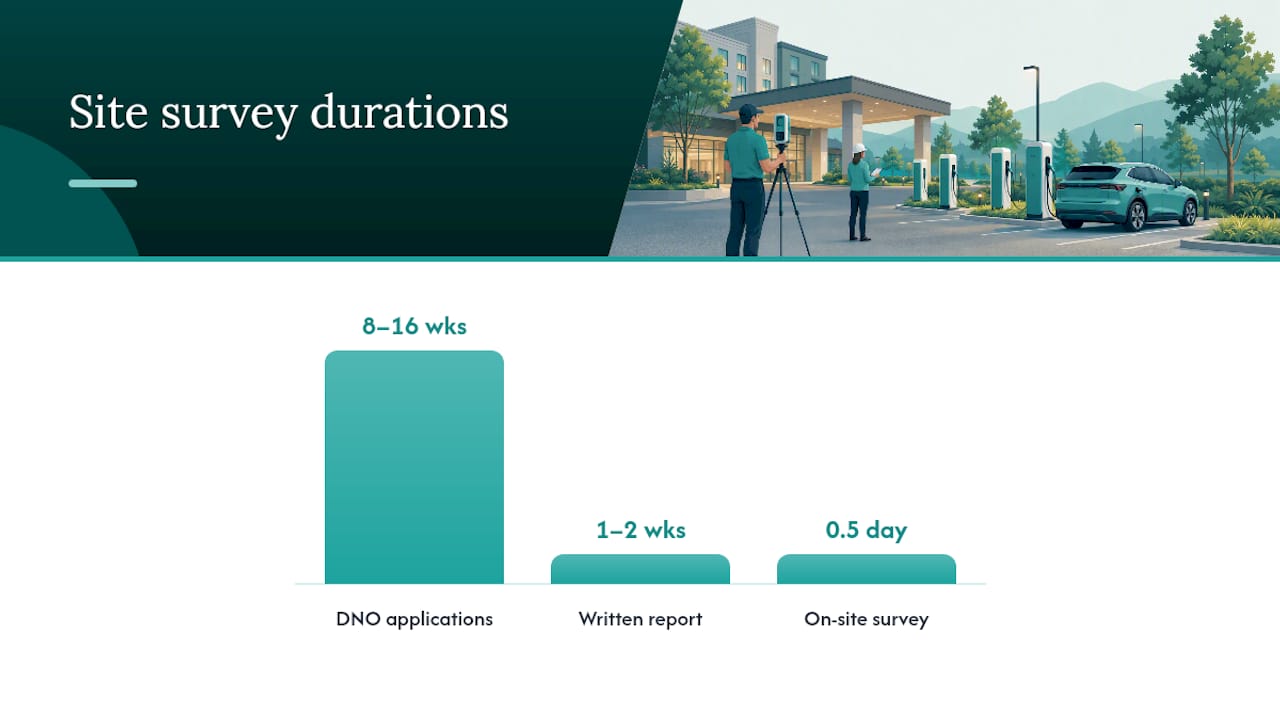
DNO applications, where reinforcement is needed, typically take 8–16 weeks to resolve. Factor this into your project timeline from the outset. A survey itself usually takes half a day on site, with a written report within one to two weeks.
What does hotel EV charging cost, and how do you fund it?
Installation costs vary considerably. As a guide, 7–22 kW AC destination chargers typically cost in the region of £1,200–£3,500 per unit installed, while 50 kW+ rapid DC chargers often cost tens of thousands of pounds installed before DNO connection work.
Cost components to budget for:
Hardware (charger units and mounting)
Civil works (trenching, ducting, surface reinstatement)
Electrical installation (cabling, distribution, metering)
DNO connection or reinforcement (if required)
Charge-point management software and back-office setup
Commissioning, testing and staff training
Funding models:
Model | How it works | Best for |
Capex purchase | You buy and own the hardware outright | Hotels wanting full control and no ongoing lease |
Capex plus maintenance contract | Purchase plus a fixed annual SLA fee | Predictable opex with ownership benefits |
Charging as a service (CaaS) | Monthly fee covers hardware, install and support | Hotels preferring zero upfront capital outlay |
OZEV grant schemes have historically supported eligible businesses with contributions toward installation costs. Eligibility and available amounts change, so confirm current terms directly with OZEV or ask your installer to check on your behalf during the survey stage.
On pricing strategy: free charging works well as a guest amenity for boutique and luxury properties where the ADR premium justifies the electricity cost. Paid sessions, billed per kWh or per session via QR code, suit mid-market and larger hotels where charger utilisation is higher and revenue recovery matters. Managed pay-as-you-go networks also increase discovery by non-resident EV drivers, generating incremental revenue from passing traffic.
How do you operate chargers effectively once they are live?
Robust charge-point management software and clear access policies are the operational foundation of a successful hotel deployment. Poor software or absent access control quickly becomes a reputational problem.
Hospitality-focused management platforms should provide QR-based guest access without requiring an app download, role-based multi-site dashboards, remote diagnostics, load balancing, and OCPP compliance. PMS integration, where the charger session is billed directly to the room, removes friction for guests and reduces front-desk queries.
Stat to know: Remote monitoring and diagnostics reduce on-site engineer call-outs by enabling remote triage and faster resolution, protecting both uptime and guest experience.
An EMS is worth specifying for any installation of four or more chargers. It distributes available power across active sessions, prevents peak-demand charges, and integrates with solar or battery storage to maximise renewable contribution, particularly important given that overnight hotel charging peaks between 18:00 and 22:00, after solar generation has ended.
KPIs to track from day one:
Utilisation per charger (sessions per day, kWh delivered)
Revenue per charger per month
Uptime percentage (target 98%+)
Guest complaints or front-desk queries related to charging
ADR comparison for EV-driving guests versus the property average
What is a realistic timeline from survey to live service?
A standard hotel EV charging project runs from initial survey to live service in 8–20 weeks, depending on DNO work and civil complexity.
Initial briefing and site survey (weeks 1–2): scope, power assessment, parking layout, grant eligibility check.
DNO application (weeks 2–10, if reinforcement needed): submit early; this is the most common delay.
Detailed design and specification (weeks 3–5): charger layout, cable routes, EMS specification, software selection.
Procurement (weeks 4–8): hardware lead times vary; OCPP-certified units from established manufacturers typically ship in 2–6 weeks.
Civil works (weeks 6–12): trenching, ducting, surface reinstatement.
Electrical installation (weeks 8–14): cabling, distribution upgrades, charger mounting.
Testing and commissioning (weeks 9–15): OCPP pairing, load management testing, payment system setup.
Software onboarding and staff training (weeks 10–16): back-office configuration, guest communication materials.
Common delay risks and how to mitigate them:
DNO turnaround: apply as early as possible, ideally before design is finalised.
Planning or listed building constraints: engage your local authority pre-application if the car park is within a conservation area.
Supply chain lead times: specify hardware early and confirm availability before signing off the design.
How do you choose the right EV charging supplier?
Choose a supplier that can evidence site survey capability, DNO liaison experience, OCPP-capable hardware supply, back-office software, grant application support, and a clear SLA. Require evidence for each item before signing a contract.
Questions to ask every supplier:
Can you show previous hotel project references and photos?
What is your standard SLA, and what are the uptime guarantees?
Which OCPP-certified hardware brands do you supply?
How do you handle DNO applications and reinforcement negotiations?
Do you assist with OZEV grant applications?
What does your remote monitoring dashboard look like? Can we see a live demo?
What is your spare-parts policy and typical response time for on-site faults?
Contract must-haves: delivery milestones with dates, a DNO contingency clause, performance SLA with financial remedy, remote support terms, and a change-control process for future expansion.
Red flags: vague or verbal SLA commitments, no remote monitoring capability, proprietary closed hardware without OCPP, and unclear warranty or spare-parts policy. A supplier who cannot show you a working back-office dashboard before you sign is a risk.
What do real hotel EV charging projects look like?
Country house hotel, 18 rooms: The property installed four tethered 7 kW AC units in a gravelled car park, paired with an existing rooftop solar array and a new battery storage unit. Solar generation during the day charges the battery; the battery then supplies the chargers during the evening peak. The result was a near-zero electricity cost for guest charging and a marketing story that supported a modest rate premium for EV-driving guests.
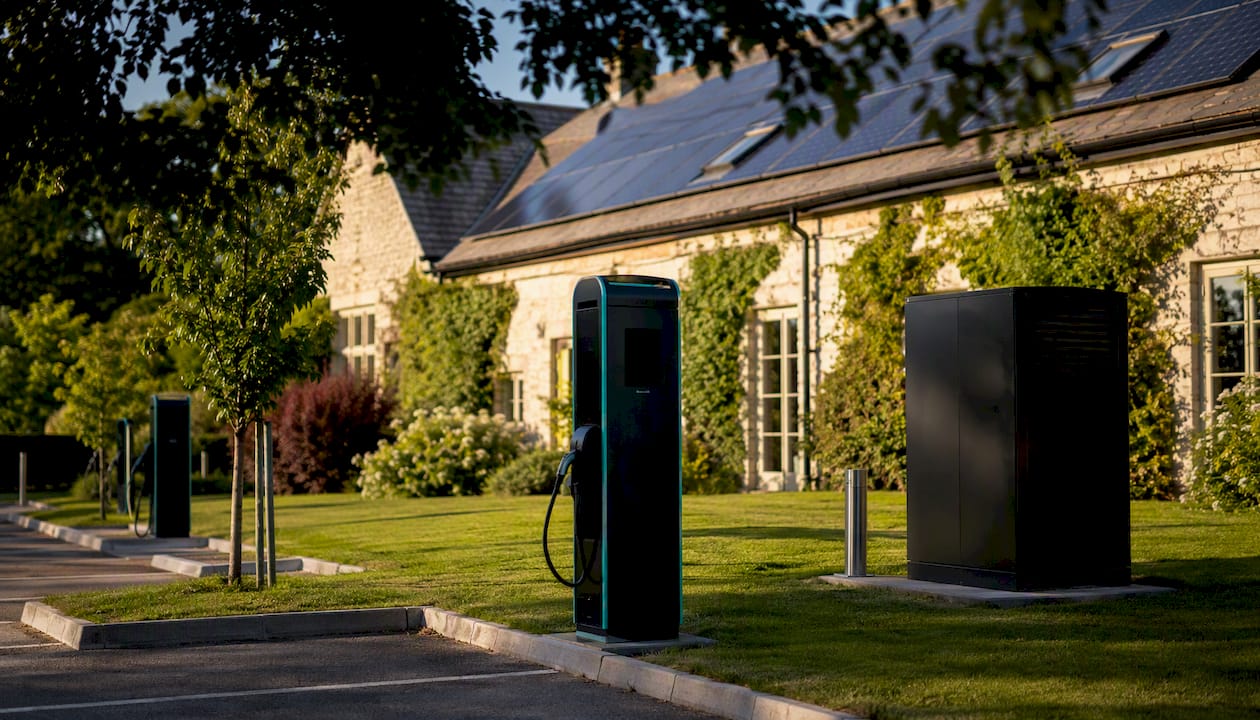
Mid-market hotel, 80 rooms: The property added ten 22 kW AC units and two 50 kW DC rapids in a surface car park. Chargers were made available to non-guests via QR-code pay-as-you-go, generating incremental revenue from a nearby business park. Access control via the management platform prevented non-paying use of the AC units by guests who had not pre-booked a charging bay.
Lessons from both projects:
Access control is non-negotiable. Without it, chargers are monopolised and guest satisfaction drops.
Match the charger mix to your actual guest profile before ordering hardware.
Measure ADR for EV-driving guests separately from the start; the data will justify future expansion.
Swift Charging’s perspective on working with hoteliers
Hotels are one of the most rewarding environments to work in for EV charging, because the business case is genuinely strong and the guest benefit is immediate. What we consistently find is that the feasibility survey is where the real value is created. It surfaces the constraints that change cost, and it identifies the grant opportunities that reduce it.
One point worth making clearly: if your hotel has a south-facing roof or a large car park with solar potential, assess solar plus battery storage at the same time as the charger specification. The operating economics of offering free guest charging shift considerably when the electricity is generated on site.
Pro Tip: Ask your supplier to model the EMS specification alongside the solar and battery options before finalising the design. Getting this right at the start avoids expensive retrofits later.
Swiftcharging runs full feasibility surveys, handles OZEV grant applications, and delivers turnkey installations with SLA-backed maintenance. After commissioning, we provide ongoing reporting so you can track utilisation, revenue and uptime from a single dashboard.
Swiftcharging can help you get started
Swiftcharging delivers end-to-end commercial EV charging for hotels across the UK, from the first site survey through to long-term managed operations.
What you get when you work with us:
A professional site feasibility survey, including power assessment and grant eligibility check
Full DNO liaison and application management
Hardware supply, civil works and electrical installation
OCPP-compliant charge-point management software with guest access and reporting
SLA-backed maintenance with remote monitoring and on-site support
Ongoing KPI reporting so you can measure ROI from day one
To get a site survey and quote, contact the Swiftcharging team via our Chichester installation page or reach us directly through the website. Most surveys are completed within two weeks of enquiry.
Sources
Recommended